Advertisements
Online Mock Tests
Chapters
2: Chemical Bonding
▶ 3: Acids, Bases and Salts
4: Analytical Chemistry
5: Mole concept and Stoichiometry
6: Electrolysis
7: Metallurgy
8: Study of Compounds A. Hydrogen Chloride
9: Study of Compounds B. Ammonia
10: Study of Compounds C. Nitric Acid
11: Study of Compounds D. Sulphuric Acid
12: Organic Chemistry
13: Practical Work

Advertisements
Solutions for Chapter 3: Acids, Bases and Salts
Below listed, you can find solutions for Chapter 3 of CISCE S.P. Singh for Concise Chemistry [English] Class 10 ICSE.
S.P. Singh solutions for Concise Chemistry [English] Class 10 ICSE 3 Acids, Bases and Salts lntext Questions [Pages 45 - 46]
- What do you understand by the term, acid?
- Name the positive ion formed when an acid is dissolved in water.
- Draw the structure of this ion.
Write the ionization of sulphuric acid showing the formation of hydronium ion.
Water is never added to acid in order to dilute it why?
Define the term ‘basicity’ of an acid.
Give the basicity of nitric acid.
Give the basicity of sulphuric acid.
Give the basicity of phosphoric acid.
Give two examples of the following:
oxy-acid
Give two examples of the following:
hydracids
Give two examples of the following:
tribasic acid
Give two examples of the following:
dibasic acid
Name the acidic anhydride of the following acid:
Sulphurous acid
Name the acidic anhydride of the following acid:
Nitric acid
Name the acidic anhydride of the following acid:
Phosphoric acid
Name the acidic anhydride of the following acid:
Carbonic acid
Name the acid present in vinegar.
Name the acid present in grapes.
Name the acid present in lemon.
What do you understand by the statement ‘acetic acid is a monobasic acid'?
Give a balanced equation for reaction of nitrogen dioxide with water.
Give a balanced equation for preparation of a non-volatile acid from a volatile acid.
What do you understand by the strength of an acid?
On which factor does the strength of an acid depend?
Explain the following:
Carbonic acid gives an acid salt but hydrochloric acid does not.
Explian the following:
Dil. HCl acid is stronger than highly concentrated acetic acid.
Explain the following:
H3PO3 is not a tribasic acid.
Explain the following:
Lead carbonate does not react with dilute HCl.
Explain the following:
Nitrogen dioxide is a double acid anhydride.
How is an acid prepared from a non-metal? Give an equation for it.
How is an acid prepared from a salt? Give an equation for it.
Give an equation to show how the following is made from their corresponding anhydride.
sulphurous acid
Give an equation to show how the following is made from their corresponding anhydride.
phosphoric acid
Give an equation to show how the following is made from their corresponding anhydride.
carbonic acid
Give an equation to show how the following is made from their corresponding anhydride.
sulphuric acid
Name an acid used to flavor and preserve food.
Name an acid used in a drink.
Name an acid used to remove ink spots.
Name an acid used as an eyewash.
Give the reaction of acid with chlorides. State the conditions under which they react.
Give the reaction of acid with nitrates. State the conditions under which they react.
S.P. Singh solutions for Concise Chemistry [English] Class 10 ICSE 3 Acids, Bases and Salts EXERCISE-3A [Pages 50 - 51]
What do you understand by an alkali?
Give two examples of strong alkalis.
Give two examples of weak alkalis.
What is the difference between an alkali and a base?
What is the difference between the chemical nature of an aqueous solution of HCl and an aqueous solution of NH3
Name the ions furnished by bases in solution.
Name the ions furnished by an acid.
Give one example in the following case:
A basic oxide which is soluble in water.
Give one example in the following case:
A hydroxide which is highly soluble in water.
Give one example in the following case:
A basic oxide which is insoluble in water.
Give one example in the following case:
A hydroxide which is insoluble in water.
Give one example in the following case:
A weak mineral acid.
Give one example in the following case:
A base which is not an alkali.
Give one example in the following case:
An oxide which is a base.
Give one example in the following case:
A hydrogen containing compound which is not an acid.
Give one example in the following case:
A base which does not contain a metal ion.
You have been provided with three test tubes. One of them contains distilled water and the other two have an acidic solution and a basic solution respectively. If you are given only red litmus paper, how will you identify the contents of each test tube?
HCl, HNO3, C2H5OH, C6H12O6 all contain H atoms but only HCI and HNO3 show acidic character. Why?
Dry HCI gas does not change the colour of dry litmus paper. Why?
Is PbO2 a base or not? Comment.
Do basic solutions also have H+(aq)? Why are they basic?
How would you obtain a base from another base.
How would you obtain an alkali from a base.
How would you obtain salt from another salt?
Write balanced equation to satisfy the following statement:
\[\ce{Acid + Active metal -> Salt + hydrogen}\]
Write balanced equation to satisfy the following statement:
\[\ce{Acid + Base -> Salt + water}\]
Write balanced equation to satisfy the following statement:
\[\ce{Acid + Carbonate or bicarbonate -> Salt + water + Carbon dioxide}\]
Write balanced equation to satisfy the following statement:
\[\ce{Acid + Sulphite or bisulphite -> Salt + water + sulphur dioxide}\]
Write balanced equation to satisfy the following statement:
\[\ce{Acid + sulphide -> Salt + Hydrogen sulphide}\]
The skin has and needs natural oils. Why is it advisable to wear gloves while working with strong allkalis?
Complete the table:
| Indicator | Neutral | Acidic | Alkaline |
| Litmus | Purple | ______ | ______ |
| Phenolphthalein | Colourless | ______ | ______ |
What do you understand by pH value?
Two solutions X and Y have Ph values of 4 and 10 respectively. Which one of these two will give a pink colour with phenolphthalein indicator?
Distinguish between a common acid base indicator and a universal indicator.
Distinguish between acidity of bases and basicity of acids.
Distinguish between acid and alkali (other than indicators).
What should be added to neutral solution in order to increase the concentration of hydronium ions?
What should be added to neutral solution in order to decrease the concentration of hydronium ions?
How does tooth enamel get damaged? What should be done to prevent it?
When you use universal indicator, you see that solutions of different acids produce different colours. Indeed, solution of the same acid with different concentrations will also give different colours. Why?
You are supplied with five solutions: A, B, C, D and E with pH values as follows: A = 1.8, B = 7, C = 8.5, D = 13, and E = 5
Classify these solutions as neutral, slightly or strongly acidic and slightly or strongly alkaline.
Which solution would be most likely to liberate hydrogen with:
- magnesium powder,
- powdered zinc metal?
Give a word equation for each reaction.
Solution P has a pH of 13, solution Q has a pH of 6 and solution R has a pH of 2. Which solution:
- will liberate ammonia from ammonium sulphate on heating?
- is a strong acid?
- contains molecules as well as ions?
S.P. Singh solutions for Concise Chemistry [English] Class 10 ICSE 3 Acids, Bases and Salts EXERCISE-3B [Pages 58 - 60]
Define the following and give two examples in case a normal salt .
Define the following and give two examples in case an acid salt .
Define the following and give two examples in case a basic salt.
What is a ‘salt’?
Answer the following question related to salts and their preparations:
What kind of salt is prepared by precipitation?
Name a salt prepared by direct combination. Write an equation for the reaction that takes place in preparing the salt you have named.
Name the procedure used to prepare a sodium salt such as sodium sulphate.
Explain the following method with example.
Direct combination
Explain the following method with example.
Displacement
Explain the following method with example.
Double decomposition (precipitation)
Explain the following method with example.
Neutralisation of insoluble base
Explain the following method with example.
Neutralisation of an alkali (titration)
How would you prepare :
Copper sulphate crystals from a mixture of charcoal and black copper oxide.
How would you prepare:
zinc sulphate crystals from zinc dust (powdered zinc and zinc oxide).
How would you prepare:
sodium hydrogen carbonate crystals.
How would you prepare:
Calcium sulphate from calcium carbonate
The following is a list of methods for the preparation of salts.
A - direct combination of two elements
B - reaction of a dilute acid with a metal.
C - reaction of a dilute acid with an insoluble base.
D - titration of a dilute acid with a solution of soluble base.
E - reaction of two solutions of salts to form a precipitate.
Choose from the above list A to E, the best method for preparing the following salts by giving a suitable equation in each case:
- Anhydrous ferric chloride,
- Lead chloride,
- Sodium sulphate,
- Copper sulphate.
Name a chloride which is insoluble in cold water but dissolves in hot water.
Name a chloride which is insoluble.
Name two sulphates which are insoluble.
Name a basic salt.
Name an acidic salt.
Name a mixed salt.
Name a complex salt.
Name a double salt.
Fill in the blanks with suitable words:
An acid is a compound which when dissolved in water forms hydronium ions as the only ______ ions. A base is a compound which is soluble in water and contains ______ ions. A base reacts with an acid to form a ______ and water only. This type of reaction is known as ______.
What would you observe when blue litmus is introduced into a solution of hydrogen chloride gas?
What would you observe when red litmus paper is introduced into a solution of ammonia in water?
What would you observe when red litmus paper is introduced in Caustic soda solution?
Explain why It is necessary to find out the ration of reactants required in the preparation of sodium sulphate.
Explain why fused calcium chloride is used in the preparation of FeCI3?
Explain why Anhydrous FeCl3 cannot be prepared by heating hydrated iron (III) chloride.
From the list given below, which one is:
[SO2, SiO2, Al2O3, CO, MgO, Na2O]
- A covalent oxide of a metalloid.
- An oxide which when dissolved in water form acid.
- A basic oxide.
- An amphoteric oxide.
Give the pH value of pure water.
Does pH value of pure water change if common salt is added to it?
Classify the following solutions as acids, bases or salts.
Ammonium hydroxide, barium chloride, sodium chloride, sodium hydroxide, H2SO4 and HNO3
Complete the following table and write one equation for each to justify the statement:
|
Reactants |
Products |
Method |
|
Soluble base + Acid (dil) |
Salt + water |
Neutralisation Titration |
|
Metal + Non-metal |
Salt (soluble/insoluble) |
______ |
|
Insoluble base + ______ |
Salt (soluble) + water |
______ |
|
Active metal + Acid (dil) |
______ + ______ |
______ |
|
Soluble salt solution (A) + Soluble salt solution (B) |
Precipitated salt + Soluble salt |
______ |
|
Carbonate/bicarbonate + Acid (dil) |
Salt + ______ + ______ |
Decomposition of carbonate |
|
Chlorides/nitrates + Acid (conc.) |
______ + ______ |
Decomposition of chlorides and nitrates |
Write the balanced equation for the preparation of the following salt in the laboratory:
A soluble sulphate by the action of an acid on an insoluble base.
Write the balanced equation for the preparation of the following salt in the laboratory:
An insoluble salt by the action of an acid on another salt.
Write the balanced equation for the preparation of the following salt in the laboratory:
An insoluble base by the action of a soluble base on a soluble salt.
Write the balanced equation for the preparation of the following salt in the laboratory:
A soluble sulphate by the action of an acid on a metal.
You are provided with the following chemicals:
NaOH, Na2CO3, H2O, Zn(OH)2, CO2, HCI, Fe, H2SO4, CI2, Zn.
Using the suitable chemicals from the given list only, state briefly how you would prepare iron (III) chloride.
You are provided with the following chemicals:
NaOH, Na2CO3, H2O, Zn(OH)2, CO2, HCI, Fe, H2SO4, CI2, Zn.
Using the suitable chemicals from the given list only, state briefly how you would prepare sodium sulphate.
You are provided with the following chemicals:
NaOH, Na2CO3, H2O, Zn(OH)2, CO2, HCI, Fe, H2SO4, CI2, Zn.
Using the suitable chemicals from the given list only, state briefly how you would prepare sodium zincate.
You are provided with the following chemicals:
NaOH, Na2CO3, H2O, Zn(OH)2, CO2, HCI, Fe, H2SO4, CI2, Zn.
Using the suitable chemicals from the given list only, state briefly how you would prepare iron (II) sulphate.
You are provided with the following chemicals:
NaOH, Na2CO3, H2O, Zn(OH)2, CO2, HCI, Fe, H2SO4, CI2, Zn.
Using the suitable chemicals from the given list only, state briefly how you would prepare sodium chloride.
For each of the salt: A, B, C and D, suggest a suitable method of its preparation.
- A is a sodium salt.
- B is an insoluble salt.
- C is a soluble salt of copper.
- D is a soluble salt of zinc.
For each of the salt: A, B, C and D, suggest a suitable method of its preparation.
D is a soluble salt of zinc.
Choosing only substances from the list given in the box below, write equations for the reactions which you would use in the laboratory to obtain: Sodium sulphate
| Dilute sulphuric acid | Copper | Copper carbonate |
| Iron | Sodium carbonate | |
| Sodium | ||
| Zinc |
Choosing only substances from the list given in the box below, write equations for the reactions which you would use in the laboratory to obtain: Copper sulphate.
| Dilute sulphuric acid | Copper | Copper carbonate |
| Iron | Sodium carbonate | |
| Sodium | ||
| Zinc |
Choosing only substances from the list given in the box below, write equations for the reactions which you would use in the laboratory to obtain: lron(II) sulphate
| Dilute sulphuric acid | Copper | Copper carbonate |
| Iron | Sodium carbonate | |
| Sodium | ||
| Zinc |
Choosing only substances from the list given in the box below, write equations for the reactions which you would use in the laboratory to obtain: Zinc carbonate.
| Dilute sulphuric acid | Copper | Copper carbonate |
| Iron | Sodium carbonate | |
| Sodium | ||
| Zinc |
From the formula listed below, choose one, in the following case, corresponding to the salt having the given description:
AgCl, CuCO3, CuSO4.5H2O, KNO3, NaCl, NaHSO4, Pb(NO3)2, ZnCO3, ZnSO4.7H2O.
An acid salt.
From the formula listed below, choose one, in the following case, corresponding to the salt having the given description:
AgCl, CuCO3, CuSO4.5H2O, KNO3, NaCl, NaHSO4, Pb(NO3)2, ZnCO3, ZnSO4.7H2O.
An insoluble chloride.
From the formula listed below, choose one, in the following case, corresponding to the salt having the given description:
AgCl, CuCO3, CuSO4.5H2O, KNO3, NaCl, NaHSO4, Pb(NO3)2, ZnCO3, ZnSO4.7H2O.
On treating with concentrated sulphuric acid, this salt changes from blue to white.
From the formula listed below, choose one, in the following case, corresponding to the salt having the given description:
AgCl, CuCO3, CuSO4.5H2O, KNO3, NaCl, NaHSO4, Pb(NO3)2, ZnCO3, ZnSO4.7H2O.
On heating, this salt changes from green to black.
From the formula listed below, choose one, in the following case, corresponding to the salt having the given description:
AgCl, CuCO3, CuSO4.5H2O, KNO3, NaCl, NaHSO4, Pb(NO3)2, ZnCO3, ZnSO4.7H2O.
This salt gives nitrogen dioxide on heating.
Ca(H2PO4)2 is an example of a compound called _______ .
acid salt
basic salt
normal salt
Write the balanced equation for the reaction of:
A named acid and a named alkali.
State the term defined by the following sentence:
A soluble base.
State the term defined by the following sentence:
The insoluble solid formed when two solutions are mixed together.
State the term defined by the following sentence:
An acidic solution in which there is only partial ionisation of the solute molecules.
Which of the following methods, (a), (b), (c), (d) or (e) is generally used for preparing the chlorides listed below from (i) to (v). Answer by writing down the chloride and the letter pertaining to the corresponding method. Each letter is to be used only once.
(a) Action of an acid on a metal.
(b) Action of an acid on an oxide or carbonate.
(c) Direct combination.
(d) Neutralization of an alkali by an acid.
(e) Precipitation (double decomposition).
(i) copper(II) chloride.
(ii) iron(II) chloride.
(iii) iron(IIl) chloride.
(iv) lead (II) chloride.
(v) sodium chloride.
S.P. Singh solutions for Concise Chemistry [English] Class 10 ICSE 3 Acids, Bases and Salts EXERCISE-3C [Page 63]
What do you understand by water of crystallization?
Give four substances which contain water of crystallization and write their common names.
Define efflorescence.
Give examples of efflorescence.
Define deliquescence.
Give examples of deliquescence.
Answer the question below:
What name is given to the water in the compound copper sulphate-5-water?
Answer the question below:
If copper sulphate-5-water is heated, anhydrous copper sulphate is formed. What is its colour?
Answer the question below:
By what means, other than heating, could you dehydrate copper sulphate-5-water and obtain anhydrous copper sulphate?
Answer the question below:
Name a deliquescent salt.
Answer the question below:
Why hydrated copper sulphate turns white on heating.
State your observation when the following is exposed to the atmosphere.
Washing soda crystals
State your observation when the following is exposed to the atmosphere.
Iron (III) chloride salts
Give reason for the following:
Sodium hydrogen sulphate is not an acid but it dissolves in water to give hydrogen ions, according to the equation
\[\ce{NaHSO4 <=> H+ + Na+ + SO^2-_4}\]
Give reason for the following:
Anhydrous calcium chloride is used in a desiccator.
Explain clearly how conc, H2SO4 is used as dehydrating as well as drying agent.
Distinguish between drying and dehydrating agent.
State whether a sample of the following would increase or decrease in a mass if exposed to air.
Solid NaOH.
State whether a sample of the following would increase or decrease in a mass if exposed to air.
Solid CaCI2
State whether a sample of the following would increase or decrease in a mass if exposed to air.
Solid Na2CO3 .10H2O
State whether a sample of the following would increase or decrease in a mass if exposed to air.
Conc. Sulphuric acid
State whether a sample of the following would increase or decrease in a mass if exposed to air.
Iron (III) Chloride
Why does common salt get wet during the rainy season?
How can this impurity be removed?
Name a substance which changes the blue colour of copper sulphate crystals to white.
Name two crystalline substances which do not contain water of crystallization.
Name the salt which on hydrolysis forms acidic. Give a balanced equation for the following reaction.
Name the salt which on hydrolysis forms basic. Give a balanced equation for the following reaction.
Name the salt which on hydrolysis forms neutral solution. Give a balanced equation for each reaction.
State the change noticed when blue litmus and red litmus is introduced in the following solution:
Na2CO3 solution
State the change noticed when blue litmus and red litmus is introduced in the following solution:
NaCl solution
State the change noticed when blue litmus and red litmus is introduced in the following solution:
NH4NO3
State the change noticed when blue litmus and red litmus is introduced in the following solution:
MgCl2 Solution
S.P. Singh solutions for Concise Chemistry [English] Class 10 ICSE 3 Acids, Bases and Salts MISCELLANEOUS QUESTIONS [Pages 63 - 66]
MULTIPLE CHOICE TYPE: (Choose the correct answer from the options given below).
The acid which contains four hydrogen atoms is ______.
Formic acid
Sulphuric acid
Nitric acid
Acetic acid
A black coloured solid which on reaction with dilute sulphuric acid forms a blue coloured solution is ______.
Carbon
Manganese [IV] oxide
Lead [II] oxide
Copper [II] oxide
A weak acid is ______.
Formic acid
Sulphuric acid
Nitric acid
Hydrochloric acid
A complex salt is ______.
Zinc sulphate
Sodium hydrogen sulphate
Iron ammonium sulphate
Tetrammine copper (II) sulphate
Which one of the following will not produce acid with water?
CO
\[\mathrm{CO}_{2}\]
\[\mathrm{NO}_{2}\]
\[\mathrm{SO}_{3}\]
The basicity of acetic acid \[\left(\mathrm{CH}_{3}\mathrm{COOH}\right)\] is ______.
3
1
4
2
Lead sulphate can be prepared by the following methods.
P Reacting lead with sulphuric acid.
Q Reacting lead nitrate with sodium sulphate solution.
R Reacting lead oxide with sodium sulphate solution.
Only P
Only Q
Only R
Both Q and R
The following questions are Assertion-Reason based questions. Choose the answer based on the options given below.
Assertion (A): All acids form hydronium ions when dissolved in water.
Reason (R): Every acid has hydrogen as the necessary element.
Both A and R are true and R is the correct explanation of A.
Both A and R are true but R is not the correct explanation of A.
A is true but R is false.
A is false but R is true.
Assertion (A): All bases react with acids to form salt and water only.
Reason (R): All alkalies are bases but all bases are not alkalies.
Both A and R are true and R is the correct explanation of A.
Both A and R are true but R is not the correct explanation of A.
A is true but R is false.
A is false but R is true.
Assertion (A): Acids which contain carbon are necessarily organic acids.
Reason (R): All organic acids are derived from plants and animals.
Both A and R are true and R is the correct explanation of A.
Both A and R are true but R is not the correct explanation of A.
A is true but R is false.
A is false but R is true.
Assertion (A): Acids have a pH of more than 7.
Reason (R): Acids produce hydronium ions as the only positively charged ion in solution.
Both A and R are true and R is the correct explanation of A.
Both A and R are true but R is not the correct explanation of A.
A is true but R is false.
A is false but R is true.
Assertion (A): Iron (III) chloride is stored in a moisture proof container.
Reason (R): Iron (III) chloride is hygroscopic in nature.
Both A and R are true and R is the correct explanation of A.
Both A and R are true but R is not the correct explanation of A.
A is true but R is false.
A is false but R is true.
Assertion (A): Water is added to acids to dilute it.
Reason (R): The addition of water to acids is a highly exothermic reaction. Splashes of acid solution may come in contact with skin and container may also break.
Both A and R are true and R is the correct explanation of A.
Both A and R are true but R is not the correct explanation of A.
A is true but R is false.
A is false but R is true.
VERY SHORT ANSWER TYPE:
M is an element in the form of a powder. M burns in oxygen and the product obtained is soluble in water. The solution is tested with litmus. Write down only the word which will correctly complete the following sentence.
- If M is a metal, then the litmus will turn ______.
- If M is a non-metal, then the litmus will turn ______.
- If M is a reactive metal, then ______ will be evolved when M reacts with dilute sulphuric acid.
- If M is a metal, it will form ______ oxide, which will form ______ solution with water.
- If M is a non-metal, it will not conduct electricity in the form of ______.
From the list given below, select the word(s) required to correctly complete blanks (i) to (v) in the following passage. The words from the list are to be used only once. Write the answers as (a) (i), (ii), (ii) and so on.
Do not copy the passage.
Ammonia, ammonium, carbonate, carbon dioxide, hydrogen, hydronium, hydroxide, precipitate, salt, water
- A solution M turns blue litmus red, so it must contain (i) ______ ions; another solution O turns red litmus blue and hence, must contain (ii) ______ ions.
- When solutions M and O are mixed together, the products will be (iii) ______ and (iv) ______.
- If a piece of magnesium was put into a solution M. (v) ______ gas would be evolved.
Match the following:
| Column A | Column B | ||
| (i) | Acid salt | (A) | Ferrous ammonium sulphate |
| (ii) | Double salt | (B) | Contains only ions |
| (iii) | Ammonium hydroxide solution | (C) | Sodium hydrogen sulphate |
| (iv) | Dilute hydrochloric acid | (D) | Contains only molecules |
| (v) | Carbon tetrachloride | (E) | Contains ions and molecules |
Match the salts given in Column I with their method of preparation given in Column II:
| Column I | Column II | ||
| (i) | Pb(NO3)2 from PbO | (a) | Simple displacement |
| (ii) | MgCl2 from Mg | (b) | Titration |
| (iii) | FeCl3 from Fe | (c) | Neutralization |
| (iv) | NaNO3 from NaOH | (d) | Precipitation |
| (v) | ZnCO3 from ZnSO4 | (e) | Combination |
Give the preparation of the salt shown in the left column by matching with the methods given in the right column. Write a balanced equation for each preparation.
| Salt | Method of preparation |
| Zinc Sulphate | Precipitation |
| Ferrous sulphide | Oxidation |
| Barium Sulphate | Displacement |
| Ferric sulphate | Neutralisation |
| Sodium sulphate | Synthesis |
From the following list,
Na2O, SO2, SiO2, Al2O3, MgO, CO, select an oxide which dissolves in water forming an acid.
From the list given below, which one is:
- a deliquescent compound
- a compound soluble in hot water but insoluble in cold water
- a compound which in the aqueous solution state, is neutral in nature.
A. Nitroso iron [II] sulphate
B. Iron [III] chloride
C. Chromium sulphate
D. Lead chloride
E. Sodium chloride
From the list of the following salts choose the salt that most appropriately fits the description given in the following:
[AgCl, MgCl2, NaHSO4, PbCO3, ZnCO3, KNO3, Ca(NO3)2]
- A deliquescent salt
- An insoluble chloride.
- On heating, this salt gives a yellow residue when hot and white when cold.
- On heating this salt, a brown colored gas is evolved.
Give a suitable word or phrase for:
A salt formed by incomplete neutralisation of an acid by a base.
Give a suitable word or phrase for:
The definite number of water molecules bound to some salts.
Give a suitable word or phrase for:
The process in which a substance absorbs moisture from the atmospheric air to become moist, and ultimately dissolves in the absorbed water.
Give a suitable word or phrase for:
A salt containing a metal ion surrounded by other ions or molecules.
What is the term defined by the following?
A base which is soluble in water.
Name the method used for preparation of the following salts from the list given below:
(i) Sodium nitrate
(ii) Iron (III) chloride
(iii) Lead chloride
(iv) Zinc sulphate
(v) Sodium hydrogen sulphate
List :
(a) Simple displacement
(b) Neutralization
(c) Decomposition by acid
(d) Double decomposition
(e) Direct synthesis
SHORT ANWER TYPE:
Define neutralization.
State your observation:
Zinc granule is added to copper sulphate solution.
State the inference drawn from the following observation:
Salt S is prepared by reacting dilute sulphuric acid with copper oxide Identify S.
Making use only of substances chosen from those given below:
Dilute sulphuric acid
Sodium carbonate
Zinc
Sodium sulphite
Lead
Salcium carbonate
Give the equation for the reaction by which you could obtain:
- Hydrogen
- Sulphur dioxide
- Carbon dioxide
- Zinc Carbonate (two steps required).
Choosing the substances from the given list:
| dil. sulphuric acid, copper, iron, sodium, copper [IП] carbonate, sodium carbonate, sodium chloride, zinc nitrate. |
write balanced equations for the reactions which would be used in the laboratory to obtain the salts given ahead:
- sodium sulphate
- zinc carbonate
- copper [II] sulphate
- iron [II] sulphate
Solution A is a strong acid.
Solution B is a weak acid.
Solution C is a strong alkali.
- Which solution contains solute molecules in addition to water molecules?
- Which solution will give a gelatinous white precipitate with zinc sulphate solution? The precipitate disappears when an excess of the solution is added.
- Which solution could be a solution of glacial acetic acid?
- Give an example of a solution which is a weak alkali.
What do you observe when silver nitrate is added to a solution of sodium chloride?
Write the balanced chemical equation.
Lead nitrate solution is added to sodium chloride solution.
What happen to the crystals of washing soda when exposed to air? Name the phenomenon exhibited.
Give the equation for the preparation of the following salt from the starting material given.
Copper sulphate from copper (II) oxide
Give the equation for the preparation of the following salt from the starting material given.
Iron (III) Chloride from Iron
Give balanced chemical equation to prepare the following salt:
Lead sulphate from lead carbonate
Give the equation for the preparation of the following salt from the starting material given.
Potassium sulphate from potassium hydroxide solution
For the preparation of the following salts - give a balanced equation in the following case.
Lead [II] chloride from lead carbonate [give two equations]
Give balanced chemical equation to prepare the following salt:
Sodium sulphate using dilute sulphuric acid
Give balanced chemical equation to prepare the following salt:
Copper chloride using copper carbonate
Write the balanced equation for the preparation of the following compound (as major product) starting from iron and using only one other substance:
Iron (II) chloride
Write the balanced equation for the preparation of the following compound (as major product) starting from iron and using only one other substance:
Iron (III) chloride
Write the balanced equation for the preparation of the following compound (as major product) starting from iron and using only one other substance:
Iron (II) sulphate
Write the balanced equation for the preparation of the following compound (as major product) starting from iron and using only one other substance:
Iron (II) sulphide
LONG ANSWER TYPE:
A solution has a pH of 7. Explain how you would increase its pH .
A solution has a pH of 7. Explain how you would decrease its pH.
If a solution changes the colour of litmus from red to blue, what can you say about its pH?
What can you say about the pH of a solution that liberates carbon dioxide from sodium carbonate?
An acid is dissolved in water, write an equation for the formation of its ions. (You can take any acid like HCl, H2SO4, etc.)
Draw the structure of the stable positive ion formed when an acid dissolves in water.
Write a balanced reaction for the following conversions (A, B, C, D)
\[\ce{Fe→[A]FeCl2 →[B]FeCO3→[C]Fe(NO3)2→[D]Fe(OH)2}\]
Give equations for the following conversions A to E.
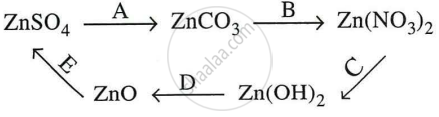
The preparation of lead sulphate from lead carbonate is a two-step process (lead sulphate cannot be prepared by adding dilute sulphuric acid to lead carbonate.)
- What is the first step that is required to prepare lead sulphate from lead carbonate?
- Write the equation for the reaction that will take place when this first step is carried out.
- Why is the direct addition of dilute sulphuric acid to lead carbonate an impractical method of preparing lead sulphate?
The diagram given below is to prepare iron (III) chloride in the laboratory.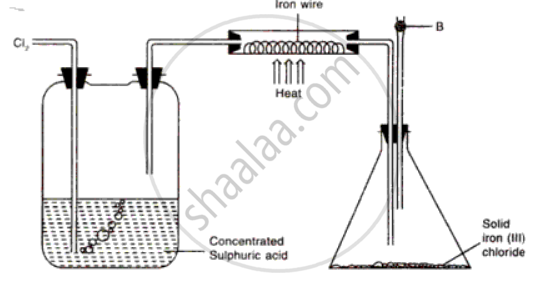
(i) What is substance B?
(ii) What is the purpose of B?
(iii)Why is iron (III) chloride to be stored in a closed container?
(iv) Write the equation for the reaction between iron and chloride ?
Robert bought a bottle of cleaning agent to clean his kitchen sink. He noticed a warning label on the bottle - ”Use with Caution”. Curious about its nature, he tested the solution using litmus. The red litmus turned blue, while the blue one remained unchanged. Later he learned that bases like sodium hydroxide, ammonium hydroxide are commonly used for cleaning as they can dissolve grease and organic waste. Such substances can be harmful to the skin and eyes if not handled properly.
- Why is a basic solution used in drain cleaners?
- What does a change in the colour of litmus indicate?
- Why was the warning label given on the cleaning agent?
- How does this example show the practical application of bases in everyday life?
Solutions for 3: Acids, Bases and Salts
S.P. Singh solutions for Concise Chemistry [English] Class 10 ICSE chapter 3 - Acids, Bases and Salts
Shaalaa.com has the CISCE Mathematics Concise Chemistry [English] Class 10 ICSE CISCE solutions in a manner that help students grasp basic concepts better and faster. The detailed, step-by-step solutions will help you understand the concepts better and clarify any confusion. S.P. Singh solutions for Mathematics Concise Chemistry [English] Class 10 ICSE CISCE 3 (Acids, Bases and Salts) include all questions with answers and detailed explanations. This will clear students' doubts about questions and improve their application skills while preparing for board exams.
Further, we at Shaalaa.com provide such solutions so students can prepare for written exams. S.P. Singh textbook solutions can be a core help for self-study and provide excellent self-help guidance for students.
Concepts covered in Concise Chemistry [English] Class 10 ICSE chapter 3 Acids, Bases and Salts are Basics of Acids, Bases, and Salts, Acids, Classification of Acids, Preparation of Acids, Properties of Acids > Physical Properties, Uses of Acids, Properties of Acids > Chemical Properties, Properties of Bases > Chemical Properties, Bases, Classification of Bases (Alkalis), Preparation of Bases, Properties of Bases > Physical Properties, Uses of Bases, Test for Acidity and Alkalinity, Importance of pH in Everyday Life, Salts, Classification of Salts, Methods of Preparation of Soluble Salts, Preparation of Insoluble Salts, Laboratory Preparation of Some Salts, General Properties of Salts, Differences Between Drying Agent and Dehydrating Agent, Basics of Acids, Bases, and Salts, Acids, Classification of Acids, Preparation of Acids, Properties of Acids > Physical Properties, Uses of Acids, Properties of Acids > Chemical Properties, Properties of Bases > Chemical Properties, Bases, Classification of Bases (Alkalis), Preparation of Bases, Properties of Bases > Physical Properties, Uses of Bases, Test for Acidity and Alkalinity, Importance of pH in Everyday Life, Salts, Classification of Salts, Methods of Preparation of Soluble Salts, Preparation of Insoluble Salts, Laboratory Preparation of Some Salts, General Properties of Salts, Differences Between Drying Agent and Dehydrating Agent, Basics of Acids, Bases, and Salts, Acids, Classification of Acids, Preparation of Acids, Properties of Acids > Physical Properties, Uses of Acids, Properties of Acids > Chemical Properties, Properties of Bases > Chemical Properties, Bases, Classification of Bases (Alkalis), Preparation of Bases, Properties of Bases > Physical Properties, Uses of Bases, Test for Acidity and Alkalinity, Importance of pH in Everyday Life, Salts, Classification of Salts, Methods of Preparation of Soluble Salts, Preparation of Insoluble Salts, Laboratory Preparation of Some Salts, General Properties of Salts, Differences Between Drying Agent and Dehydrating Agent.
Using S.P. Singh Concise Chemistry [English] Class 10 ICSE solutions Acids, Bases and Salts exercise by students is an easy way to prepare for the exams, as they involve solutions arranged chapter-wise and also page-wise. The questions involved in S.P. Singh Solutions are essential questions that can be asked in the final exam. Maximum CISCE Concise Chemistry [English] Class 10 ICSE students prefer S.P. Singh Textbook Solutions to score more in exams.
Get the free view of Chapter 3, Acids, Bases and Salts Concise Chemistry [English] Class 10 ICSE additional questions for Mathematics Concise Chemistry [English] Class 10 ICSE CISCE, and you can use Shaalaa.com to keep it handy for your exam preparation.
