Advertisements
Advertisements
Question
What is the difference between an alkali and a base?
Distinguish Between
Advertisements
Solution
| Alkali | Base | |
| 1. | An alkali is a basic hydroxide that, when dissolved in water, produces hydroxyl (OH−) ions, the only negatively charged ions. | A base is a chemical compound that, when reacting with a hydronium ion or H+ ions furnished by an acid, forms salt and water only. |
| 2. | All alkalis are water soluble. | Bases may or may not be water soluble. |
| 3. | All alkalis are bases | All bases are not alkalis. |
| 4. | Examples are NaOH, KOH, Ca(OH)2. | Examples are CuO, Mg(OH)2. |
shaalaa.com
Is there an error in this question or solution?
APPEARS IN
RELATED QUESTIONS
Give one example in the following case:
A hydroxide which is highly soluble in water.
Sodium hydroxide is a ______.
Wasp sting contains _______.
All bases are alkalis.
Give the significance of pH of soil in agriculture.
Which among the following is not a base?
Look at figure which shows solutions taken in test tubes A, B, C and D. What colour is expected when a piece of red litmus paper is dropped in each test tube? Nature of the solutions is given in the table for your help.
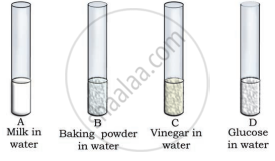
| Test tube | Nature of Solution | Change in colour of red litmus |
| A | Neutral | |
| B | Basic | |
| C | Acidic | |
| D | Neutral |
Water-soluble bases are called ______.
Match the following:
| 1. | Wasp sting | a. | Milk of magnesia |
| 2. | Common salt | b. | Acetic acid |
| 3. | Organic acid | c. | Sodium chloride |
| 4. | Antacid | d. | Vinegar |
What are bases?
