Advertisements
Online Mock Tests
Chapters
2: Chemical Bonding
▶ 3: Study of Acids, Bases and Salts
4: Analytical Chemistry
5: Mole Concept and Stoichiometry
6: Electrolysis
7: Metallurgy
8A: Study of Compounds: Hydrogen Chloride
8B: Study of Compounds: Ammonia
8C: Study of Compounds: Nitric Acid
8D: Study of Compounds: Sulphuric Acid
9A: Organic Chemistry: Organic Compounds
9B: Saturated Hydrocarbons: Alkanes
9C: Unsaturated Hydrocarbons: Alkenes
9D: Unsaturated Hydrocarbons: Alkynes
9E: Alcohols
9F: Carboxylic Acids
10: Practical Work
![Frank solutions for Chemistry Part 2 [English] Class 10 ICSE chapter 3 - Study of Acids, Bases and Salts - Shaalaa.com](/images/chemistry-part-2-english-class-10-icse_6:c50a513f247a47188e49d8899d6aee9a.jpg "Frank solutions for Chemistry Part 2 [English] Class 10 ICSE chapter 3 - Study of Acids, Bases and Salts")
Advertisements
Solutions for Chapter 3: Study of Acids, Bases and Salts
Below listed, you can find solutions for Chapter 3 of CISCE Frank for Chemistry Part 2 [English] Class 10 ICSE.
Frank solutions for Chemistry Part 2 [English] Class 10 ICSE 3 Study of Acids, Bases and Salts Exercises [Pages 67 - 70]
Choose the correct answer from the options given below
Which of them occurs in solid state?
Citric acid
Formic acid
Acetic acid
Hydrochloric acid
Choose the correct answer from the options given below:
Benzoic acid is used for/in/as
Baking powder
Food preservative
Fertilizers
Explosives
Choose the correct answer from the options given below:
Which colour with the universal indicator indicates highly alkaline solution?
Dark red
Yellow
Green
Violet
Choose the correct answer from the options given below:
Which one is the acidic salt?
KNO3
Sodium acetate
Calcium chloride
Ammonium acetate
An acidic solution has a pH of ______.
7
Less than 7
More than 7
None of the above
Which of the following is tribasic acid:
H3PO3
H3PO2
H3PO4
H2SO4
Assertion (A): Acetic acid and hydrochloric acid are mineral acids.
Reason (R): Both the acids contain carbon.
If both A and R are true, and R is the correct explanation of A.
If both A and R are true, but R is not the correct explanation of A.
If A is true, but R is false.
If both A and R are false.
Assertion (A): Sodium sulphate is the normal salt.
Reason (R): Sodium sulphate is formed by the partial replacement of hydrogen of acid.
If both A and R are true, and R is the correct explanation of A.
If both A and R are true, but R is not the correct explanation of A.
If A is true, but R is false.
If both A and R are false.
Assertion (A): Hydrated copper sulphate is an efflorescent salt.
Reason (R): Hydrated copper sulphate absorbs moisture from the atmosphere and dissolves in moisture.
If both A and R are true, and R is the correct explanation of A.
If both A and R are true, but R is not the correct explanation of A.
If A is true, but R is false.
If both A and R are false.
Assertion (A): pH of normal water is seven.
Reason (R): Normal water gives no colour with universal indicator.
If both A and R are true, and R is the correct explanation of A.
If both A and R are true, but R is not the correct explanation of A.
If A is true, but R is false.
If both A and R are false.
Assertion (A): When the pH of rainwater drops below 5.6, it is called acid rain.
Reason (R): Acid rain is formed when oxides of carbon dissolve in rainwater.
If both A and R are true, and R is the correct explanation of A.
If both A and R are true, and R is the correct explanation of A.
If A is true, but R is false.
If both A and R are false.
Fill in the blank
The word acid comes from latin word acidus meaning _________
Fill in the blank
Vinegar is the source of ________ acid.
Fill in the blank
Magnesia is used in making __________.
Fill in the blank
pH scale was introduced by _________ in 1909.
Fill in the blank
___________ is the phenomenon by which hydrated salts on exposure to dry air, lose their water of crystallization and crumble to powder.
Give one example : Basic oxide which is soluble in water.
Give one example : A hydroxide which is highly soluble in water.
Give one example : A basic oxide which is insoluble in water.
Give one example : A hydroxide which is insoluble in water.
Give one example : A weak mineral acid.
Give one example : A base which is not an alkali.
Give one example : An oxide which is a base.
Give one example : A hydrogen containing compound which is not an acid.
An acid is a proton ______.
acceptor
producer
pH of human blood is ______.
7.8
7.35
Chemical formula of Gypsum is ______.
\[\ce{CaSO4. 1/2 H2O}\]
CaSO4.2H2O
Name one efflorescent salt.
Name one deliquescent substance.
Name an acidic salt.
Name one oxyacid.
Define the following term:
Efflorescence
Define the following term:
Hygroscopy
Define the term ‘water of crystallization’.
Give the preparation of the salt given in the left column by matching with the methods given in the right column. Write balanced equations for each preparation.
| Salt | Method of Preparation |
| Zinc sulphate | Precipitation |
| Ferrous sulphide | Displacement |
| Barium sulphate | Neutralization |
| Sodium sulphate | Synthesis |
Define an acid.
Give the name and formula of two : Strong monobasic acids
Give the name and formula of two : Weak dibasic acids
Give the name and formula of two : Non-volatile acids
Give the name and formula of two : Volatile acids
Define a base.
Explain, all alkalis are bases but all bases are not alkalis.
Define pH.
State three applications of pH scale.
Define an indicator.
Explain, why a universal indicator is preferred to acid-base indicators.
What is the difference between an alkali and a base?
What is the difference between : An alkali and a metal hydroxide?
Name the ions furnished by bases in solution.
Name the ions furnished by : a weak alkali
Name the ions furnished by : an acid
Explain hydronium ion. Write the ionization of sulphuric acid showing the formation of hydronium ion.
An hydrous hydrogen chloride is not an acid but its aqueous solution is a strong acid. Explain.
Carbonic acid gives an acid salt but hydrochloric acid does not. Explain.
What do you understand by the strength of an acid? On what factors does the strength of an acid depend?
How is an acid prepared from a non metal and a base from a metal? Give equation.
Two solutions A and B have pH values of 2 and 9 respectively which one of these two will give a pink colour with phenolphthalein indicator?
Name two indicators which can identify the presence of an acid?
State how would you prepare copper (II) oxide from
Copper nitrate
State how would you prepare copper (II) oxide from
Copper Carbonate
State how would you prepare copper (II) oxide from
copper sulphate
Give four examples of preparation of acids by synthesis.
Define an acid salt.
Define normal salt.
How many salts can be obtained from ortho phosphoric acid? Is there any difference in the salts formed by the acid?
Give equation to prepare the following as directed
MgCO3 from MgCl2
Give equation to prepare the following as directed
PbCO3 from Pb(NO3)
Give equation to prepare the following as directed
NaHCO3 from Na2CO3
What is deliquescence? What name is given to the compounds exhibiting such property?
Explain salt hydrolysis.
Name two salts which are acidic when dissolved in water.
Name two salts which are basic when dissolved in water.
Name two salts which are neutral when dissolved in water.
Why common salt gets wet during rainy season?
Give four substances which contain water of crystallization and write their common name.
Write the reactions of SO2 and oxides of nitrogen which leads to acid rain formation.
Give four substances which contain water of crystallization and write their common names.
Write the reactions of SO2 and oxides of nitrogen which leads to acid rain formation.
Frank solutions for Chemistry Part 2 [English] Class 10 ICSE 3 Study of Acids, Bases and Salts Questions from ICSE Examinations [Pages 70 - 77]
A solution has a pH of 7. Explain, how you would:
Increase its pH, If a solution changes the color of litmus from red to blue, what can you say about its pH?
A solution has a pH of 7. Explain, how you would:
Decrease its pH, If a solution changes the color of litmus from red to blue, what can you say about its pH?
What can you say about the pH of a solution that liberates carbon dioxide from sodium carbonate?
From the list of the substances given, name the substances which you would use to prepare each of the following salts:
List of substances: Copper, lead, sodium, zinc, copper oxide, lead carbonate, sodium carbonate solution, dilute hydrochloric acid, dilute nitric acid and dilute sulphuric acid.
Salts: (a) zinc sulphate (b) copper sulphate (c) sodium sulphate (d) lead sulphate.
Define the meaning of the term 'acid salt'.
What is the purpose of the pH scale?
What is the pH of pure water?
A is a soluble acidic oxide; B is a soluble base. Compared to the pH of pure water, what is the pH of (a) a solution of A (b) a solution of B.
Taking sodium carbonate as an example, give the meaning of the following terms:
Water of crystallization
Outline the steps required to convert hydrogen chloride to anhydrous iron (III) chloride. Write the equations for the reactions.
Taking sodium carbonate as an example, give the meaning of the following terms:
Anhydrous
Answer the following questions below, relating your answers only to salts in the following list:
Sodium chloride, anhydrous calcium chloride, copper sulphate-5-water.
(i) What is the name given to the water in the compound copper sulphate-5-water?
(ii) If copper sulphate-5-water is heated, the water is driven off leaving anhydrous copper sulphate. What is the colour of anhydrous copper sulphate?
(iii) By what means, other than heating, you can dehydrate copper sulphate-5-water and obtain anhydrous copper sulphate?
(iv) Which one of the salts in the given list is deliquescent?
What is meant by the term weak acid?
Solution P has a pH of 13, solution Q has a pH of 6, and solution R has a pH of 2. Which solution:
- will liberate ammonia from ammonium sulphate on heating?
- is a strong acid?
- contains molecules as well as ions?
Give the name and formula of the acid salt which gives sodium ions and sulphate ions in solution.
Define Acid.
Define the following term : pH scale
Define the following term:
Neutralisation
Outline the steps that would be necessary to convert insoluble lead (II) oxide into insoluble chloride.
Write the balanced equations for the reaction required to convert insoluble lead (II) oxide into insoluble lead chloride.
If iron reacts with dilute sulphuric acid, what will be the products?
A solution of iron (III) chloride has a pH less than 7. Is the solution acidic or alkaline?
Some methods used for the laboratory preparation of salts are:
(a) Metal + acid
(b) Carbonate + acid
(c) Precipitation
(d) Direct combination
(e) Titration
Copy and complete the following table :
| Salt | Method of Preparation |
| Ammonium Sulphate | |
| Calcium carbonate | |
| Iron (III) chloride | |
| Lead nitrate | |
| Zinc sulphate |
Choosing only substances from the list given in the box below, write equations for the reactions which you would use in the laboratory to obtain:
(i) Sodium sulphate
(ii) Copper sulphate
(iii) Iron (II) sulphate
(iv) Zinc carbonate
| Dilute sulphuric acid |
Copper, Iron, |
Copper carbonate, Sodium carbonate |
From the formulae listed below, choose one in each case corresponding to the salt having the given description :
AgCI, CuCO3, CuSO4.5H2O, KNO3, NaCI, NaHSO4, Pb(NO3), ZnCO3, ZnSO4.7H2O
(a) An acid salt
(b) An insoluble chloride
(c) On treating with concentrated sulphuric acid, this salt changes from blue to white.
(d) On heating this salt changes from green to black.
(e) This salt gives nitrogen dioxide on heating
Write the balanced equation for the preparation of the following compounds, starting from iron and using other substance: Iron (II) chloride
Write the balanced equation for the preparation of the following compound (as the major product) starting from iron and other substance:
Iron (III) chloride
Write the balanced equation for the preparation of the following compounds, starting from iron and other substance:
Iron (II) sulphate
Write the balanced equation for the preparation of the following compounds, starting from iron and other substance:
Iron (II) sulphide
Write the equation for the laboratory preparation of sodium sulphate using dilute sulphuric acid.
Write the balanced equation for the preparation of the following compounds, starting from iron and other substance:
lead sulphate using dilute sulphuric acid.
Choosing the correct words given in brackets, complete the sentence given below:
An acid is a compound which, when dissolved in water gives ______ ( hydronium / hydroxide) ions as the only ______ (positive/negative) ions.
Choosing the correct words given in brackets, complete the sentence given below:
A(n) ______ (acid/basic) salt is one in which the hydrogen of an acid has been partially replaced by a ______ (metal/non-metal).
Write equation for the laboratory preparation of the following salt, using sulphuric acid: Iron (II) sulphate from the iron.
Choosing the correct words given in brackets, complete the sentence given below: Copper sulphate from copper.
Choosing the correct words given in brackets, complete the sentence given below: Lead sulphate from lead nitrate.
Choosing the correct words given in brackets, complete the sentence given below: Sodium sulphate from sodium carbonate.
Which of the following methods, (a), (b), (c), (d) or (e) is generally used for preparing the chlorides listed below from (i) to (v). Answer by writing down the chloride and the letter pertaining to the corresponding method. Each letter is to be used only once.
(a) Action of an acid on a metal.
(b) Action of an acid on an oxide or carbonate.
(c) Direct combination.
(d) Neutralization of an alkali by an acid.
(e) Precipitation (double decomposition).
(i) copper(II) chloride.
(ii) iron(II) chloride.
(iii) iron(IIl) chloride.
(iv) lead (II) chloride.
(v) sodium chloride.
The preparation of lead sulphate from lead carbonate is a two-step process (lead sulphate cannot be prepared by adding dilute sulphuric acid to lead carbonate.)
- What is the first step that is required to prepare lead sulphate from lead carbonate?
- Write the equation for the reaction that will take place when this first step is carried out.
- Why is the direct addition of dilute sulphuric acid to lead carbonate an impractical method of preparing lead sulphate?
Fill in the blanks with suitable words:
An acid is a compound which when dissolved in water forms hydronium ions as the only ______ ions. A base is a compound which is soluble in water and contains ______ ions. A base reacts with an acid to form a ______ and water only. This type of reaction is known as ______.
What is observed when neutral litmus solution is added to sodium hydrogen carbonate solution?
Mention the colour changes observed when the following indicator is added to acid: Alkaline phenolphthalein solution.
Mention the colour changes observed when the following indicator is added to acid: Methyl orange solution.
Mention the colour changes observed when the following indicator is added to acid: Neutral litmus solution.
From the list given below, select the word(s) required to correctly complete the blanks (i) to (v) in the following passage:
Ammonia, Ammonium, Carbonate, Carbon dioxide, Hydrogen, Hydronium, Hydroxide, Precipitate, Salt, Water.
A solution ‘X’ turns blue litmus red so it must contain (i) ______ ions; another solution ‘Y’ turns red litmus blue and therefore must contain (ii) ______ ions. When solutions X and Y are mixed together, the products will be a (iii) ______ and (iv) ______. If a piece of magnesium was put into solution X, (v) ______ gas would be evolved.
Macth the following.
| Column A | Column B |
| 1. Acid salt | a. Sodium potassium carbonate |
| 2. Mixed salt | b. Alum |
| 3. Complex salt | c. Sodium Carbonate |
| 4. Double salt | d. Sodium zincate |
|
5. Normal salt |
e. Sodium hydrogen carbonate |
What is the term defined by the following?
A salt containing a metal ion surrounded by other ions or molecules.
What is the term defined below?
A base which is soluble in water.
Carbon dioxide and sulphur dioxide gas can be distinguished by using ______.
moist blue litmus paper
lime water
acidified potassium dichromate paper
none of the above
Solution A is a strong acid.
Solution B is a weak acid.
Solution C is a strong alkali.
- Which solution contains solute molecules in addition to water molecules?
- Which solution will give a gelatinous white precipitate with zinc sulphate solution? The precipitate disappears when an excess of the solution is added.
- Which solution could be a solution of glacial acetic acid?
- Give an example of a solution which is a weak alkali.
The diagram given below is to prepare iron (III) chloride in the laboratory.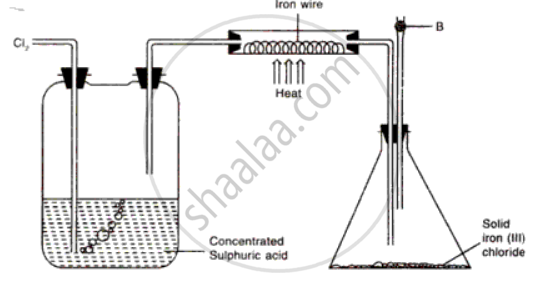
(i) What is substance B?
(ii) What is the purpose of B?
(iii)Why is iron (III) chloride to be stored in a closed container?
(iv) Write the equation for the reaction between iron and chloride ?
Select the correct answer from the choices a,b,c and d which are given.Write only the letter corresponding to the correct answer.
A particular solution contains molecules and ions of the solute so it is a
Weak acid
Strong acid
Strong base
Salt solution
An organic weak acid is ______.
Formic acid
Sulphuric acid
Sulphuric base
Hydrochloric acid
Nitric acid
Select the correct answer from the choices a,b,c and d which are given.Write only the letter corresponding to the correct answer.
An example of a complex salt is
Zinc sulphate
Solution hydrogen sulphate
Iron(II) ammonium sulphate
Tetramine copper (II) sulphate
Write the equation for the following reaction:
Magnesium sulphate solution is mixed with barium chloride solution.
Give the equation for the preparation of the following salt from the starting material given.
Copper sulphate from copper (II) oxide
Give the equation for the preparation of the following salt from the starting material given.
Iron (III) Chloride from Iron
Give the equation for the preparation of the following salt from the starting material given.
Potassium sulphate from potassium hydroxide solution
Give the equation for the preparation of the following salt from the starting material given.
Lead chloride from lead carbonate (two equations)
Solution A is a sodium hydroxide solution. Solution B is a weak acid. Solution C is dilute sulphuric acid. Which solution will.
(i) Liberate sulphur dioxide from sodium sulphite
(ii) Give a white precipitate with zinc sulphate solution,(iii) Contain solute molecules and ions?
What happen to the crystals of washing soda when exposed to air? Name the phenomenon exhibited.
Name the method used for preparation of the following salts from the list given below:
(i) Sodium nitrate
(ii) Iron (III) chloride
(iii) Lead chloride
(iv) Zinc sulphate
(v) Sodium hydrogen sulphate
List :
(a) Simple displacement
(b) Neutralization
(c) Decomposition by acid
(d) Double decomposition
(e) Direct synthesis
From the list given below, select the word(s) required to correctly complete blanks (i) to (v) in the following passage. The words from the list are to be used only once. Write the answers as (a) (i), (ii), (ii) and so on.
Do not copy the passage.
Ammonia, ammonium, carbonate, carbon dioxide, hydrogen, hydronium, hydroxide, precipitate, salt, water
- A solution M turns blue litmus red, so it must contain (i) ______ ions; another solution O turns red litmus blue and hence, must contain (ii) ______ ions.
- When solutions M and O are mixed together, the products will be (iii) ______ and (iv) ______.
- If a piece of magnesium was put into a solution M. (v) ______ gas would be evolved.
State what would you observe when :
Washing soda crystals are exposed to the atmosphere.
State what would you observe when :
The salt ferric chloride is exposed to the atmosphere.
Match the salts given in Column I with their method of preparation given in Column II:
| Column I | Column II | ||
| (i) | Pb(NO3)2 from PbO | (a) | Simple displacement |
| (ii) | MgCl2 from Mg | (b) | Titration |
| (iii) | FeCl3 from Fe | (c) | Neutralization |
| (iv) | NaNO3 from NaOH | (d) | Precipitation |
| (v) | ZnCO3 from ZnSO4 | (e) | Combination |
Fill in the blank from the choices given in bracket.
When a metallic oxide is dissolved in water, the solution formed has a high concentration of ___________ ions. (H+,H3O+,OH-)
To increase the pH value of neutral solution, we should add
An acid
An acid salt
An alkali
A salt
Give one word or a phrase:
The property by which certain hydrated salts, when left exposed to atmosphere, lose their water of crystallization and crumble into powder.
State one relevant observation for the following:
Anhydrous calcium chloride is exposed to air for some time.
The salt prepared by the method of direct combination is _______.
Iron (II) chloride \[\ce{(FeCl2)}\]
Iron (III) chloride \[\ce{(FeCl3)}\]
Three solutions P, Q and R have pH value of 3.5, 5.2 and 12.2 respectively. Which one of these is a:
- Weak acid?
- Strong alkali?
Give the appropriate term defined by the statements given below :
The substance that releases hydronium ion as the only positive ion when dissolved in water.
The pH values of three solutions A, B and C are given in the table. Answer the following questions:
| Solution | pH value |
| A | 12 |
| B | 2 |
| C | 7 |
- Which solution will have no effect on litmus solution?
- Which solution will liberate CO2 when reacted with sodium carbonate?
- Which solution will turn red litmus solution blue?
Choose the method of preparation of the following salts, from the methods given in the list:
[List : A. Neutralization B. Precipitation C. Direct combination D. Substitution ]
(i) Lead chloride
(ii) Iron (II) sulphate
(iii) Sodium nitrate
(iv) Iron (III) chloride
Fill in the blank from the choices given in the options.
An alkali which completely dissociates into ions is ______.
ammonium hydroxide
calcium hydroxide
lithium hydroxide
pH of acetic acid is greater than dilute sulphuric acid. So, acetic acid contains ______ concentration of H+ ions.
greater
same
low
The indicator which does not change colour on passage of HCl gas is ______.
methyl orange
moist blue litmus
phenolphthalein
The acid which cannot act as an oxidising agent is ______.
Conc. H2SO4
Conc. HNO3
Conc. HCl
Differentiate between the following pair based on the information given in the bracket.
Acid and Alkali (formation of type of ions)
Write balanced chemical equation for the preparation of the given salts (a) to (c) by using the method A to C respectively:
A: Neutralisation
B: Precipitation
C: Titration
- Copper sulphate
- Zinc carbonate
- Ammonium sulphate
Choose the correct answer to the questions from the given options.
The acid which does not form acid salt by a basic radical.
H2CO3
H3PO4
H2SO4
CH3COOH
The indicator that changes to pink colour in an alkaline solution is ______.
Blue Litmus
Methyl Orange
Red Litmus
Phenolphthalein
Fill in the blank.
Higher the pH value of a solution, the more ______ it is.
Acidic
Alkaline
Complete and balance the following equation:
\[\ce{NH4Cl + Ca(OH)2 ->}\]
Complete and balance the following equation.
\[\ce{CuSO4 + NH4OH ->}\]
Complete and balance the following equation:
\[\ce{Cu + Conc{.} HNO3 ->}\]
The salt prepared by the method of direct combination is _______.
Iron (II) chloride \[\ce{(FeCl2)}\]
Iron (III) chloride \[\ce{(FeCl3)}\]
The metallic oxide which can be reduced by using common reducing agents is ______.
\[\ce{Fe2O3}\]
\[\ce{Al2O3}\]
Mohan has three solutions P, Q and R having a pH of 13, 5 and 2 respectively. Which of the above solutions P, Q or
- will react with magnesium to liberate hydrogen gas?
- will liberate ammonia gas when it reacts with ammonium chloride?
- will contain molecules as well as ions?
The following table is related to an industrial process of an acid.
| Name of the process | Reactant | Catalyst | Final product |
| (a) | SO2 + O2 | (b) | (c) |
Identify (a), (b) and (c).
Define normal salt.
Match the salts underlined in Column A with the most suitable method of preparation given in Column B.
| Column A | Column B | ||
| (a) | \[\ce{ZnCl2 \text{from} Zn}\] | 1. | Precipitation |
| (b) | \[\ce{KNO3 \text{from} KOH}\]. | 2. | Direct combination |
| (c) | \[\ce{CaCO3 \text{from} CaCl2}\]. | 3. | Displacement reaction |
| 4. | Neutralization |
Solutions for 3: Study of Acids, Bases and Salts
Frank solutions for Chemistry Part 2 [English] Class 10 ICSE chapter 3 - Study of Acids, Bases and Salts
Shaalaa.com has the CISCE Mathematics Chemistry Part 2 [English] Class 10 ICSE CISCE solutions in a manner that help students grasp basic concepts better and faster. The detailed, step-by-step solutions will help you understand the concepts better and clarify any confusion. Frank solutions for Mathematics Chemistry Part 2 [English] Class 10 ICSE CISCE 3 (Study of Acids, Bases and Salts) include all questions with answers and detailed explanations. This will clear students' doubts about questions and improve their application skills while preparing for board exams.
Further, we at Shaalaa.com provide such solutions so students can prepare for written exams. Frank textbook solutions can be a core help for self-study and provide excellent self-help guidance for students.
Concepts covered in Chemistry Part 2 [English] Class 10 ICSE chapter 3 Study of Acids, Bases and Salts are Basics of Acids, Bases, and Salts, Acids, Classification of Acids, Preparation of Acids, Properties of Acids > Physical Properties, Uses of Acids, Properties of Acids > Chemical Properties, Properties of Bases > Chemical Properties, Bases, Classification of Bases (Alkalis), Preparation of Bases, Properties of Bases > Physical Properties, Uses of Bases, Test for Acidity and Alkalinity, Importance of pH in Everyday Life, Salts, Classification of Salts, Methods of Preparation of Soluble Salts, Preparation of Insoluble Salts, Laboratory Preparation of Some Salts, General Properties of Salts, Differences Between Drying Agent and Dehydrating Agent.
Using Frank Chemistry Part 2 [English] Class 10 ICSE solutions Study of Acids, Bases and Salts exercise by students is an easy way to prepare for the exams, as they involve solutions arranged chapter-wise and also page-wise. The questions involved in Frank Solutions are essential questions that can be asked in the final exam. Maximum CISCE Chemistry Part 2 [English] Class 10 ICSE students prefer Frank Textbook Solutions to score more in exams.
Get the free view of Chapter 3, Study of Acids, Bases and Salts Chemistry Part 2 [English] Class 10 ICSE additional questions for Mathematics Chemistry Part 2 [English] Class 10 ICSE CISCE, and you can use Shaalaa.com to keep it handy for your exam preparation.
