Advertisements
Online Mock Tests
Chapters
2: Chemical Bonding
3: Study of Acids, Bases and Salts
4: Analytical Chemistry
5: Mole Concept and Stoichiometry
6: Electrolysis
7: Metallurgy
8A: Study of Compounds: Hydrogen Chloride
8B: Study of Compounds: Ammonia
▶ 8C: Study of Compounds: Nitric Acid
8D: Study of Compounds: Sulphuric Acid
9A: Organic Chemistry: Organic Compounds
9B: Saturated Hydrocarbons: Alkanes
9C: Unsaturated Hydrocarbons: Alkenes
9D: Unsaturated Hydrocarbons: Alkynes
9E: Alcohols
9F: Carboxylic Acids
10: Practical Work
![Frank solutions for Chemistry Part 2 [English] Class 10 ICSE chapter 8C - Study of Compounds: Nitric Acid - Shaalaa.com](/images/chemistry-part-2-english-class-10-icse_6:c50a513f247a47188e49d8899d6aee9a.jpg "Frank solutions for Chemistry Part 2 [English] Class 10 ICSE chapter 8C - Study of Compounds: Nitric Acid")
Advertisements
Solutions for Chapter 8C: Study of Compounds: Nitric Acid
Below listed, you can find solutions for Chapter 8C of CISCE Frank for Chemistry Part 2 [English] Class 10 ICSE.
Frank solutions for Chemistry Part 2 [English] Class 10 ICSE 8C Study of Compounds: Nitric Acid Exercises [Pages 227 - 229]
Choose the correct answer from the option given below :
Nitric acid on standing develops brownish colour which may be attributed to the presence of :
\[\ce{No^{+}_{2}}\]
\[\ce{NO^{-}_{3}ions}\]
NO2
HNO2
Choose the correct answer from the option given below :
Concentrated nitric acid oxidises phosphorus to :
H3PO4
P2O3
H3PO2
H4P2O7
Choose the correct answer from the option given below :
When treated with nitric acid which of the following liberate hydrogen?
Zinc
Magnesium
Copper
Mercury
Choose the correct answer from the option given below:
The catalyst used in the manufacture of HNO3 by Ostwald process is
Platinum black
Finely dividend nickel
Vanadium pentoxide
Platinum gauze
Which one of the following will not produce an acid when made to react with water.
Carbon monoxide
Carbon dioxide
Zinc oxide
Copper (II) oxide
Fill in the blank with appropriate word/words.
Aqua regia is a mixture of _______ and________
Fill in the blank with appropriate word.
Furning nitric acid is obtained by dissolving an excess of _______ in conc. Nitric acid
Fill in the blank with appropriate word/words.
98% nitric acid is obtained by distilling 68% nitric acid with ________ under ______
Fill in the blank with appropriate word/words.
Ammonal is a mixture of ________ and __________
Fill in the blank with appropriate word/words.
3 Cu + 8 HNO3 (dilute) → _______ + 4H2O + _________
Aqueous solution of ammonia consists of ______ and ______ ions.
______ is manufactured by Haber’s process which is a ______ gas.
The catalyst used in industrial preparation of ammonia is ______, and ______ is used as a promoter.
Ammonia is collected by ______ in an inverted gas jar.
Liquid ammonia as is used as ______.
Name the following :
Gas produced in air during lighting.
Name the Following:
Gas obtained by treating manganese with 1% nirtric acid.
Name the Following:
Salt referred to as chile saltpeter.
Name the Following:
Salt used in the laboratory to prepare nitric acid
Name the Following:
Product obtained by the catalytic oxidation of ammonia.
Name the Following:
Product obtained by heating concentrated nitric acid.
Name the Following:
Two coloured nitrates.
Name the substance used for drying ammonia.
Name the following:
Hydroxide of one metal not precipitated by ammonium hydroxide.
Name the following:
The indicator which changes from colourless to pink with ammonia.
Name the following:
The compound which gives reddish brown precipitate with ammonium hydroxide.
Name the following:
The products formed by the reduction of copper oxide by ammonia.
Write balanced equation and name the product formed when :
Sodium hydrogen carbonate is added to nitric acid.
Write balanced equation and name the product formed when :
Cupric oxide reacts with nitric acid.
Write balanced equation and name the product formed when :
Zinc reacts with dilute nitric acid.
Write balanced equation and name the product formed when :
Concentrated nitric acid is heated.
What happens when (Given balanced equation) :
Sulphar is added to hot and conc. HNO3?
What happens when (Given balanced equation):
Nitric acid is added to Kl (aq)?
What happen when (Given balanced equation) :
Nitric acid is dissolved in large amount of water?
What happen when (Given balanced equation):
Nitric acid is added to washing soda and the resulting gas is passed through a freshly prepared lime water?
What happen when (Given balanced equation):
Limestone reacts with nitric acid?
Complete and balance the following equation :
C + HNO3 → ___________
Complete and balance the following equation :
SO2 + HNO3 → ______________
Complete and balance the following equation :
Fe + HNO3(conc.) → _____________
Complete and balance the following equation :
FeSO4 + NO + H2O → ______________
Complete and balance the following equation :
Pt + HNO3 + HCl → ___________
Complete and balance the following equation :
HNO3 + FeSO4 + H2SO4 → ______________
What is meant by the following term?
Aqua Fortis
What is meant by the following term?
Aqua regia
What is meant by the following term?
Fuming nitric acid
What is meant by the following term?
Decrepitation
How is nitric acid prepared in a laboratory?
What is the purpose of Conc. H2SO4 in the above preparation?
Why is the temperature maintained at 200°C in the above reaction?
Can we use conc. HCl in place of Conc. H2SO4 ?
- Name the process used for the manufacture of nitric acid.
- What are the reactants required for it and what are their sources?
- In which ratio reactants are taken in this process?
- Name the catalyst used in the process.
- What is the oxidizing agent in this process?
- Write the equations involved.
Write the balanced equation for the following:
Action of concentrated nitric acid on copper.
Write the balanced equation for the following:
Action of heat on AgNO3
What do you observe when?
Concentrated nitric acid is dropped on a hot surface?
What do you observe when?
Hydrogen sulphide is bubbled through conc. HNO3?
What do you observe when?
Conc. HNO3 drops on the skin of a person?
What do you observe when?
Scrap zinc is heated with conc. HNO3?
Give reason for the following:
In laboratory preparation of nitric acid all the apparatus including cork should be made up of glass.
Give reason for the following:
Commercial concentrated nitric acid is yellow in colour, but when it is dilute with water, it turns colourless.
Give one chemical test for nitric acid.
Give reason for the following:
Aluminum does not react with nitric acid of any concentration.
Give reason for the following:
Conc. Nitric acid renders iron passive.
Give reason for the following:
Nitric acid is used in purification of gold.
Give reason for the following:
Aqua regia dissolves gold and platinum.
Give reason for the following :
Nitric acid usually does not yield hydrogen from acids.
Give reason for the following:
Lighting is a blessing in disguise.
Give reason for the following:
Concentrated nitric acid is brown in colour.
Give reason for the following:
Concentrated nitric acid is a stronger oxidizing agent.
How does nitric acid formed in the atmosphere?
Describe the Ostwald's process for the manufacture of nitric acid with labeled diagram.
Nitric acid cannot be concentrated beyond 68% by the distillation of a dilute solution of HNO3, State the reason.
How can 68% nitric acid be concentrated to 98% nitric acid?
Give three equations of the reaction to prove that nitric acid is an acid.
Mention three important uses of nitric acid. Give the properties of the nitric acid involved in its use.
Explain with the help of a balanced equation, the brown ring test for nitric acid.
Why is freshly prepared ferrous sulphate solution used in the ring test?
Brown ring disappear if the test tube is disturbed.
Give two chemical tests for nitric acid.
How will you prepare Aqua regia from nitric acid?
Give two chemical tests to distinguish between dilute nitric acid and hydrochloric acid.
Frank solutions for Chemistry Part 2 [English] Class 10 ICSE 8C Study of Compounds: Nitric Acid Questions from ICSE Examination [Pages 229 - 232]
How would you separate gold from a mixture of gold and copper filling?
Write balanced equation for the preparation of nitric acid from potassium nitrate.
Write down the word equation or balanced equation for the action of concentrated nitric acid on copper.
Give reason for the following:
In the laboratory preparation of nitric acid, the mixture of concentrated sulphuric acid and sodium nitatre should not be heated very strongly, above 200°C
Complete and balance the following equation:
Cu + HNO3 → NO2 + ________+ _________
Give reason for the following:
Commercial concentrated nitric acid is yellow in colour, but when it is dilute with water, it turns colourless.
Give one chemical test for nitric acid.
State the conditions for the oxidation of ammonia to nitrogen monoxide [nitric oxide], in the manufacture of nitric acid by Ostwald's process. Write the balanced equcation for the reaction.
The following statement is correct only under certain conditions. Rewrite the statement including the appropriate condition(s) and underline it in your answer.
Copper and nitric acid react together to produce nitrogen dioxide.
Write a balanced equation for the production of nitrogen dioxide using copper.
Name the product, catalyst and approximate temperature maintained in Ostwald's process. How is the temperature maintained in the Ostwald's process?
Name the product, catalyst and approximate temperature maintained in Ostwald's process. How is the temperature maintained in the Ostwald's process?
During a thunderstorm, the rainwater contains nitric acid. The nitric acid is formed as a result of three chemical reactions. Describe or write balanced chemical equation for these three reactions.
Give the name of a soluble lead salt and write the equation for the action of heat on this salt.
Write the balanced equation for the equation preparation of nitric acid from potassium nitrate.
Write balanced equation for the reaction between nitrogen and oxygen, when lightning strikes.
Describe what you see when concentrated nitric acid is added to copper.
What do you see when concentrated nitric acid is added to copper?
Name (formula is not acceptable) the gas produced in the following reaction:
By the action of concentrated nitric acid on copper.
Name (formula is not acceptable) the gas produced in the following reaction:
On warming ammonium sulphate with sodium hydroxide solution.
Choose the correct word from the given options to complete the sentence :
Sulphur can be converted to sulphuric acid using __________ nitric acid.
Concentrated
dilute
Write the equation of the following reaction.
Sulphur can be converted to sulphuric acid using concentrated nitric acid.
Write the equation to show the reaction between the following:
Dilute nitric acid to produce carbon dioxide.
Write the equation to show the reaction between the following:
Between copper and concentrated nitric acid.
Name the compounds required for the laboratory preparation of nitric acid.
Why does pure nitric acid take on a yellowish brown colour when exposed to light?
Write equation to show the reaction between the following:
Copper and concentrated nitric acid.
Write equation to show the reaction between the following:
Copper oxide and dilute nitric acid.
The first step in the manufacture of nitric acid is the catalytic oxidation of ammonia. What is the name of the catalyst?
When nitric acid is prepared by the action of concentrated sulphuric acid on potassium nitrate. what is the special feature of the apparatus used?
Write the equation for the laboratory preparation of nitric acid from potassium nitrate and concentrated sulphuric acid.
Write balanced equation to show the reaction between the sulphur and hot concentrated nitric acid.
Dilute nitric acid is generally considered a typical acid except for its reaction with metals. In what way is dilute nitric acid different from other acids when it reacts with metals?
Write the equation for the reaction of dilute nitric acid with copper.
Account for the yellow colour that appears in concentrated nitric acid when it is left standing in an ordinary glass bottle.
Explain, why only all glass apparatus should be used for the preparation of nitric acid by heating concentrated sulphuric acid and potassium nitrate.
Write a chemical equation to illustrate the acidic nature of nitric acid.
The figure given below illustrates the apparatus used in the laboratory preparation of nitric acid: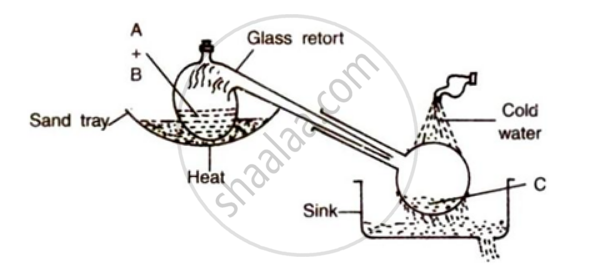
(i) Name A (a liquid), B( a Solid) and C(a liquid).
(ii) write the balanced chemical equation to show how nitric acid undergoes decomposition.
(iii) Write the balanced chemical equation for the reaction in which copper is oxidized by concentrated nitric acid.
State, what is observe when nitric acid is kept in a reagent bottle for a long time.
Write the equation for the reaction:
Aluminium nitride and Water.
Copy and complete the following table relating to important industrial processes output refers to the product of the process not the intermediate steps.
| Name of process | Inputs | Catalyst | Equation for catalysed reaction | Output |
| Haber process | Hydrogen + | |||
|
Ammonia + |
Nitric acid |
Name the gas evolved:
The gas produced on heating sodium nitrate.
What is the special feature of the apparatus that is used in the laboratory preparation of nitric acid?
Why should the temperature of the reaction mixture of nitric acid not be allowed to rise above 200oC?
What would you observe in the following case:
Copper is heated with concentrated nitric acid in a hard glass test tube.
Identify the gas evolved when sulphur is treated with concentrated nitric acid.
Balanced equation of oxidation of carbon with concentrated HNO3
Explain the following:
Dilute nitric acid is generally considered a typical acid but not so in its reaction with metals.
Explain the following:
Concentrated nitric acid appears yellow when it is left standing in a glass bottle.
Explain the following :
An all glass apparatus is used in the laboratory preparation of nitric acid.
Fill in the blank using the appropriate words given below:
Cold, dilute nitric acid reacts with copper to give ______.
Sulphur dioxide
Nitrogen dioxide
Nitric oxide
Sulphuric acid
Fill in the blank using the appropriate words given below:
Hot, concentrated nitric add reacts with sulphur to form ______.
Sulphur dioxide
Nitrogen dioxide
Nitric oxide
Sulphuric acid
Write a balanced equation for following :
Action of cold and dilute nitric acid on copper
Write a balanced equation for following :
Action of conc. Nitric acid on sulphur
Write a balanced equation for following :
Reaction of ammonia with nitric acid
Write a balanced equation for following :
Laboratory preparation nitric acid.
Name the gas that is produced in the given cases :
Sulphur is oxidized by concentrated nitric acid.
Name the gas that is produced in the given case:
The action of cold and dilute nitric acid on copper
What is the type of salt formed when the reactants are heated at a suitable temperature for the preparation of nitric acid?
State why for the preparation of Nitric acid, the complete apparatus is made up of glass.
State one observation for the following:
Concentrated nitric acid is reacted with sulphur.
Complete the following equations :
S + conc.HNO3 →
Complete the following equations:
\[\ce{C + conc{.} H2SO4 ->}\]
Complete the following equation:
\[\ce{Cu + dil{.} HNO3 ->}\]
The acid which can produce carbon from cane sugar is ______.
concentrated hydrochloric acid
concentrated nitric acid
concentrated acetic acid
concentrated acetic acid
Write the balanced equation for the following:
Action of concentrated nitric acid on copper.
Write a balanced chemical equation for the following:
Reaction of carbon powder and concentrated nitric acid.
State one relevant observation for the following:
Concentrated nitric acid appears yellow, when it is left for a while in a glass bottle.
Solutions for 8C: Study of Compounds: Nitric Acid
Frank solutions for Chemistry Part 2 [English] Class 10 ICSE chapter 8C - Study of Compounds: Nitric Acid
Shaalaa.com has the CISCE Mathematics Chemistry Part 2 [English] Class 10 ICSE CISCE solutions in a manner that help students grasp basic concepts better and faster. The detailed, step-by-step solutions will help you understand the concepts better and clarify any confusion. Frank solutions for Mathematics Chemistry Part 2 [English] Class 10 ICSE CISCE 8C (Study of Compounds: Nitric Acid) include all questions with answers and detailed explanations. This will clear students' doubts about questions and improve their application skills while preparing for board exams.
Further, we at Shaalaa.com provide such solutions so students can prepare for written exams. Frank textbook solutions can be a core help for self-study and provide excellent self-help guidance for students.
Concepts covered in Chemistry Part 2 [English] Class 10 ICSE chapter 8C Study of Compounds: Nitric Acid are Concept of Nitric Acid, Laboratory Preparation of Nitric Acid, Manufacture of Nitric Acid, Physical Properties of Nitric Acid, Chemical Properties of Nitric Acid, Uses of Nitric Acid, Tests for Nitric Acid and Nitrates, Effects of Heat on Nitrates.
Using Frank Chemistry Part 2 [English] Class 10 ICSE solutions Study of Compounds: Nitric Acid exercise by students is an easy way to prepare for the exams, as they involve solutions arranged chapter-wise and also page-wise. The questions involved in Frank Solutions are essential questions that can be asked in the final exam. Maximum CISCE Chemistry Part 2 [English] Class 10 ICSE students prefer Frank Textbook Solutions to score more in exams.
Get the free view of Chapter 8C, Study of Compounds: Nitric Acid Chemistry Part 2 [English] Class 10 ICSE additional questions for Mathematics Chemistry Part 2 [English] Class 10 ICSE CISCE, and you can use Shaalaa.com to keep it handy for your exam preparation.
