Advertisements
Advertisements
Question
Complete and balance the following equation:
Cu + HNO3 → NO2 + ________+ _________
Advertisements
Solution
Cu + 4HNO3 → Cu(NO3)2 + 2NO2 + 2H2O
APPEARS IN
RELATED QUESTIONS
Explain the following:
An all-glass apparatus is used in the laboratory preparation of nitric acid.
Name a solution which absorbs nitric oxide.
Name the Following:
Gas obtained by treating manganese with 1% nirtric acid.
- Name the process used for the manufacture of nitric acid.
- What are the reactants required for it and what are their sources?
- In which ratio reactants are taken in this process?
- Name the catalyst used in the process.
- What is the oxidizing agent in this process?
- Write the equations involved.
Give reason for the following :
Nitric acid usually does not yield hydrogen from acids.
Give two chemical tests for nitric acid.
What do you observe when?
Scrap zinc is heated with conc. HNO3?
The figure given below illustrates the apparatus used in the laboratory preparation of nitric acid: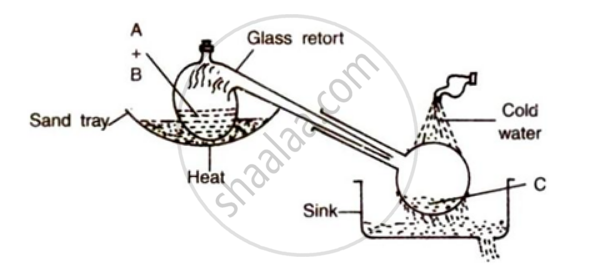
(i) Name A (a liquid), B( a Solid) and C(a liquid).
(ii) write the balanced chemical equation to show how nitric acid undergoes decomposition.
(iii) Write the balanced chemical equation for the reaction in which copper is oxidized by concentrated nitric acid.
Write the equation for the reaction:
Aluminium nitride and Water.
What happens when
NH3 solution is added to CuSO4 solution drop by drop and then in excess.
