Advertisements
Advertisements
Question
Give reason for the following:
Concentrated nitric acid is brown in colour.
Advertisements
Solution
Concentrated nitric acid is brown in colour due to the presence of nitrogen dioxide formed by heating the acid.
APPEARS IN
RELATED QUESTIONS
Write balanced chemical equations for Action of hot and concentrated Nitric acid on copper
Give the chemical name and formula of the substance formed as a brown ring in the test for nitrate radical.
How is nitric acid prepared in a laboratory?
Write the equations involved in Ostwald process.
Brown ring disappear if the test tube is disturbed.
Give two chemical tests to distinguish between dilute nitric acid and hydrochloric acid.
The figure given below illustrates the apparatus used in the laboratory preparation of nitric acid: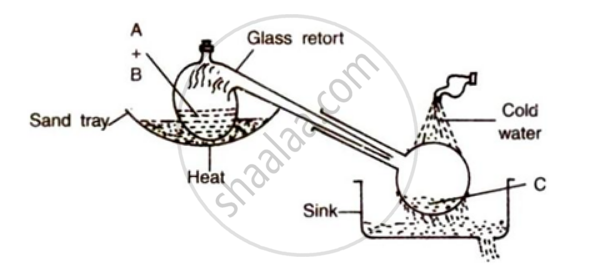
(i) Name A (a liquid), B( a Solid) and C(a liquid).
(ii) write the balanced chemical equation to show how nitric acid undergoes decomposition.
(iii) Write the balanced chemical equation for the reaction in which copper is oxidized by concentrated nitric acid.
What is the special feature of the apparatus that is used in the laboratory preparation of nitric acid?
Lead nitrate decomposes on heating to give ______.
From the following list of substances, choose one substance in the case which matches the description given below:
Ammonium nitrate, calcium hydrogen carbonate, copper carbonate, lead nitrate, potassium nitrate, sodium carbonate, sodium hydrogen carbonate, zinc carbonate.
A Substance that gives off only oxygen when heated.
