Advertisements
Online Mock Tests
Chapters
2: Chemical Bonding
3: Study of Acids, Bases and Salts
4: Analytical Chemistry
5: Mole Concept and Stoichiometry
6: Electrolysis
7: Metallurgy
8A: Study of Compounds: Hydrogen Chloride
8B: Study of Compounds: Ammonia
8C: Study of Compounds: Nitric Acid
8D: Study of Compounds: Sulphuric Acid
9A: Organic Chemistry: Organic Compounds
9B: Saturated Hydrocarbons: Alkanes
9C: Unsaturated Hydrocarbons: Alkenes
9D: Unsaturated Hydrocarbons: Alkynes
9E: Alcohols
9F: Carboxylic Acids
10: Practical Work
![Frank solutions for Chemistry Part 2 [English] Class 10 ICSE chapter 1 - Periodic Properties and Variations of Properties: Physical and Chemical - Shaalaa.com](/images/chemistry-part-2-english-class-10-icse_6:c50a513f247a47188e49d8899d6aee9a.jpg "Frank solutions for Chemistry Part 2 [English] Class 10 ICSE chapter 1 - Periodic Properties and Variations of Properties: Physical and Chemical")
Advertisements
Solutions for Chapter 1: Periodic Properties and Variations of Properties: Physical and Chemical
Below listed, you can find solutions for Chapter 1 of CISCE Frank for Chemistry Part 2 [English] Class 10 ICSE.
Frank solutions for Chemistry Part 2 [English] Class 10 ICSE 1 Periodic Properties and Variations of Properties: Physical and Chemical Exercises [Pages 16 - 19]
Select the correct answer
Which of the following electronic structure is of a metal?
2, 8, 8
2, 7
2, 8, 2
2, 8, 4
Select the correct answer
Atomic radii of fluorine and neon in angstrom unit are
0.72, 13.6
1.60, 1.60
0.72, 0.72
none of these
The electronic configuration of an element is 2, 8, 1. Which of the following statement is true?
Valency of element is 7
Element is diatomic
Element is non-metal
Element forms basic oxide
Select the correct answer
Which of the following element has highest electronegativity?
F
H
Ne
Na
Select the correct answer
Number of shells in potassium are
3
2
4
5
Select the correct answer
Most reactive character among the elements given below is found in
I
Br
Cl
F
Select the correct answer
Identify the metalloid
N
P
Bi
Sb
Which of the alkali metals given below has the smallest size?
Rubidium
Potassium
Sodium
Lithium
The element having maximum electron affinity is ______.
F
Cl
Br
I
Which of the following element has maximum electron affinity?
Mg
Al
Na
Cl
Assertion (A): F atom has less electron affinity than Cl atom.
Reason (R): Addition electrons are repelled more effectively in Cl atom.
If both A and R are true, and R is the correct explanation of A.
If both A and R are true, but R is not the correct explanation of A.
If A is true, but R is false.
If both A and R are false.
Assertion (A): Noble gases have higher ionisation energies in their respective periods.
Reason (R): Noble gases have stable closed shell electronic configuration.
If both A and R are true, and R is the correct explanation of A.
If both A and R are true, but R is not the correct explanation of A.
If A is true, but R is false.
If both A and R are false.
Assertion (A): The first ionisation energy of aluminium is lower than that of magnesium.
Reason (R): lonic radius of aluminium is smaller than that of magnesium.
If both A and R are true, and R is the correct explanation of A.
If both A and R are true, but R is not the correct explanation of A.
If A is true, but R is false.
If both A and R are false.
Assertion (A): Reactivity of alkali metals decreases down the group.
Reason (R): Electropositive character of alkali metals decreases down the group.
If both A and R are true, and R is the correct explanation of A.
If both A and R are true, but R is not the correct explanation of A.
If A is true, but R is false.
If both A and R are false.
Fill in the blank
There are ______ groups and ______ periods in the modern form of periodic table.
Fill in the blank
Most electropositive elements belong to ______ group.
Fill in the blank
Most electronegative elements belong to ______ group.
Fill in the blank
Energy released when electron is added to a neutral gaseous atom is called ______.
Fill in the blanks.
Size of the atoms ______ from left to right across a period and ______ on descending in a group of normal elements.
Fill in the blank
The maximum electro negativity is shown by ______.
Fill in the blank
Noble gases have ______ electron affinity.
Fill in the blank
Oxidising property ________from fluroine to iodine because the power to accpet electron decreases.
Fill in the blank
Reactivity ______ down the gruop for alkali metals with increase in electropositive character
Fill in the blank
The nature of oxide Al2O3 is ____
Name the following:
Metal which is a liquid at room temperature.
Name a non-metal which is a good conductor of electricity.
Name the following:
Neutral oxide
Name the following:
Non-metal which has lustre.
Name the following:
Metallic oxide which cannot be reduced by hydrogen.
Name the following:
The element which has highest electro-negativity.
Name the following:
The element which has lowest electro-negativity.
Name the following:
The element which has highest ionisation energy.
Name the following:
The element which has lowest ionisation energy.
Name two metalloids.
Name the following:
The element which has highest electron affinity.
Name the following:
The element with largest atomic size.
Name the following:
The element with smallest atomic size.
True
False
State whether the following statement is true or false
Similar electronic configuration is repeated after intervals of 2, 8, 8, 18 and 32.
True
False
State whether the following statement is true or false
Al2O3 is an amphoteric oxide.
True
False
State whether the following statement is true or false
On moving horizontally across a period, number of valence electrons increases from one to eight.
True
False
State whether the following statement is true or false
All members of zero group are non metals.
True
False
State whether the following statement is true or false
The elements with higher electron affinity have higher ionization potential.
True
False
Arrange the following in increasing order of property indicated
Li, Be, B (ionization energy)
Arrange the following in increasing order of property indicated
F, Cl, Br, I (electron affinity)
Arrange the following in increasing order of property indicated
SiO2, P2O5, SO3, Cl2O7 (acidic nature)
Arrange the following in increasing order of property indicated
I, I+, I- (atomic size)
Among the elements of the second period, Li to Ne, pick out the element with highest first ionization energy
Among the elements of the second period, Li to Ne, pick out the element with the highest electro negativity
Among the elements of the second period, Li to Ne, pick out the element with the largest atomic size
Among the elements of the second period, Li to Ne, pick out the element that is the most reactive non-metal
Among the elements of the second period, Li to Ne, pick out the element that is the most reactive metal
For the main group of the periodic table, the metallic properties of the elements vary approximately with their position as shown in the table.
| 1 | 2 | 13 | 14 | 15 | 16 | 17 | 18 |
| H | He | ||||||
| A | B | ||||||
| C | D |
- Will the most metallic element be found at A, B, C or D?
- Will the most non-metallic element be found at A, B, C or D?
A, B, C are three elements in which B is an inert gas other than helium. With this information complete the following table.
| Element | Atomic number | No. of electrons in the valence shell | Group to which the element belongs |
| A | Z − 1 | - | - |
| B | Z | - | - |
| C | Z + 1 | - | - |
Also, explain the following:
- Electron affinity of element A is more than that of element C.
- lonization energy of element C is less than that of element A.
- Electron affinity of B is zero.
Electron affinities of two elements A and B are given below:
A = 3.79 electron volts
B = 3.56 electron volts
Which of them will ionize more easily and why?
Explain
Larger the atomic size, more metallic is the element.
Explain
Halogens have high electron affinity.
Explain
Size of atom changes when it loses or gain electron
Explain
K is more reactive than Li.
Explain
Electronegativity of Cl is higher than S.
Explain
Group 17 elements are non-metals, while group 1 elements are metals.
What is modern periodic law?
How many groups and periods are there in the modern periodic table?
What is meant by periodicity of elements?
In terms of electronic configuration, what the elements of a given period and groups have in common?
Why is the electron affinity of fluorine less than chlorine?
Explain, the statement 'In each period, the atomic radii gradually decrease with increase in atomic number'. Give one example to justify your answer.
How could the atomic radius of a noble gas be compared with the other elements in a period?
'In a group, the atomic radii increase with increasing period number', explain this statement and justify it with reference to group 17.
In the third period, which is the most metallic and most non-metallic element?
What is meant by ionization potential?
In a group, a particular element has the lowest ionization potential; does it ionize most easily or least easily? Explain with example.
What is electron affinity?
Frank solutions for Chemistry Part 2 [English] Class 10 ICSE 1 Periodic Properties and Variations of Properties: Physical and Chemical Questions from ICSE Examinations [Pages 19 - 27]
State the number of elements in period 1, period 2 and period 3 of the periodic table.
Name the elements in period 1.
What happens to the atomic size of elements on moving from left to right in a period?
What is the common feature of electronic configurations of the elements at the end of period 2 and period 3?
If an element is in group 7 is it likely to be metallic or non metallic in character?
Supply the missing word from the words given in brackets.
If an element has one electron in its outermost energy level, then it is likely to be _ (metallic, non metallic)
Complete the following sentences choosing the correct word or words from those given in brackets at the end of each sentence:
The properties of the elements are a periodic function of their __________.
atomic number
mass number
relative atomic mass
Moving across a ______ of the Periodic table, the elements show increasing ______ character.
group
period
metallic
non-metallic
Copy and complete the following sentence choosing the correct word or words from those given below, at the end of the sentence:
The element at the bottom of a group would be expected to show ______ metallic character than the element at the top.
less
more
Copy and complete the following sentence choosing the correct word or words from those given below, at the end of the sentence:
The similarities in the properties of elements belonging to a group are because they have the same ______
electronic configuration
number of outer electrons
atomic number
What is meant by a group in the periodic table?
Within a group, where would you expect to find the element with the greatest metallic character.
State whether the ionization potential increases or decreases on going down a group.
How many elements are there in period 2?
The following table represents the first period of the modern periodic table. Study the table and answer the questions that follow: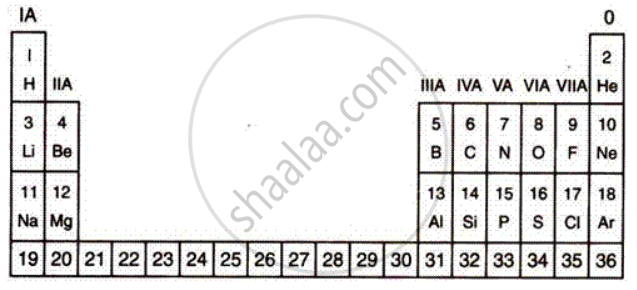
- Write the formula of the sulphate of the element with atomic number 13.
- What type of bonding will be present in the oxide of the element with atomic number 1?
- Which feature of the atomic structure accounts for the similarities in the chemical properties of the elements in group VIIA of the periodic table?
- Name the element which has the highest ionization potential.
- How many electrons are present in the valence shell of the element with atomic number 18?
- What is the name given to the energy released, when an atom in its isolated gaseous state accepts an electron to form an anion?
- What is the electronic configuration of the element in the third period which gains one electron to become an anion?
- Fill in the blanks:
The atomic size ______ as we move from left to right across the period, because the ______ increases, but the ______ remains the same.
The electronegativities (according to Pauling) of the elements in period 3 of the periodic table are as follows. The elements are arranged in alphabetical order:
| Al | Cl | Mg | Na | P | S | Si |
| 1.5 | 3.0 | 1.2 | 0.9 | 2.1 | 2.5 | 1.8 |
Arrange the elements in the order in which they occur in the periodic table from left to right. (The group 1 elements first, followed by the group 2 element and so on, up to group 7.)
Choose the word or phrase from the brackets which correctly completes the following statement:
The element below sodium in the same group would be expected to have a ______ (lower/higher) electro-negativity than sodium and the element above chlorine would be expected to have a ______ (lower/higher) ionization potential than chlorine.
On moving from left to right in a given period, the number of shells ______.
remains the same
increases
decreases
On moving down a group, the number of valence electrons ______. (remains the same/increases/decreases).
Parts (i) to (v) refer to changes in the properties of elements on moving from left to right across a period of the periodic table. For each property, choose the letter corresponding to the correct answer from the choices (a), (b), (c) and (d).
(i) The non metallic character of the elements:
(a) Decreases
(b) Increases
(c) Remains the same
(d) Depends on the period
(ii) The electro negativity
(a) Depends on the number of valence electrons
(b) Remains the same
(c) Decreases
(d) Increases
(iii) The ionization potential
(a) Goes up and down
(b) Decreases
(c) Increases
(d) Remains the same
(iv) The atomic size
(a) Decreases
(b) Increases
(c) Remains the same
(d) Sometimes increases and sometimes decreases
(v) The electron affinity of the elements in groups 1 to 7:
(a) Goes up and down
(b) Decreases and then increases
(c) Increases
(d) decreases
The elements of one short period of the periodic table are given below in order from left to right:
Li Be B C O F Ne
(a) To which period do these elements belong?
(b) One element of this period is missing. Which is the missing element and where should it be placed?
(c) Place the three elements, fluorine, beryllium and nitrogen, in the order of increasing electro negativity.
(d) Which one of the above elements belongs to the halogen series?
A group of elements in the periodic table is given below (Boron is the first member of the group and thallium is the last.)
Boron, Aluminium, Gallium, Indium, Thallium
Answer the following questions in relation to the above group of elements:
- Which element has the most metallic character?
- Which element would be expected to have the highest electronegativity?
- If the electronic configuration of aluminium is 2, 8, 3, how many electrons will be there in the outermost shell of thallium?
- The atomic number of boron is 5. Write the chemical formula of the compound formed when boron reacts with chlorine.
- Will the elements in the group to the right of this boron group be more metallic or less metallic in character? Justify your answer.
With reference to the variation of properties in the Periodic Table, which of the following is generally true?
Atomic size increases from left to right across a period.
Ionization potential increases from left to right across a period.
Electron affinity increases going down a group.
Electro-negativity increases going down a group.
The following questions refer to the Periodic Table.
Name the first and last element in period 2.
The following questions refer to the Periodic Table.
What happens to the atomic size of elements moving from top to bottom of a group?
The following questions refer to the Periodic Table.
Which of the elements has the greatest electron affinity among the halogens?
The following questions refer to the Periodic Table.
What is the common feature of the electronic configurations of the elements in group 7?
Supply the missing word from those in the brackets:
If an element has a low ionization energy then it is likely to be ______ (metallic/ non-metallic).
Supply the missing word from those in the brackets:
If an element has seven electrons in its outermost shell then it is likely to have the ______ (largest/ smallest) atomic size among all the elements in the same period.
The metals of group 2 from top to bottom are: Be, Mg, Ca, Sr, Ba. Which of these metals will form ions most readily and why?
What property of an element is measured by electro negativity?
Choose the correct answer:
Among the period 2 elements the one which has high electron affinity is
Lithium
Carbon
Fluorine
Neon
Consider the section of the periodic table given below:
| Group numbers | IA | IIA | IIIA | IVA | VA | VIA | VIIA | 0 |
| 1 | 2 | 13 | 14 | 15 | 16 | 17 | 18 | |
| Li | D | O | J | Ne | ||||
| A | Mg | E | Si | H | K | |||
| B | C | F | G | L |
Note: In this table B does not represent boron
C does not represent carbon
F does not represent fluorine
H does not represent hydrogen
K does not represent potassium
You must see the position of the element in the periodic table.
Some elements are given in their own symbol and position in the periodic table, while others are shown with a letter. With reference to the table answer the following:
- Which is the most electronegative?
- How many valence electrons are present in G?
- Write the formula of the compound between B and H.
- In the compound between F and J, what type of bond will be formed?
- Draw the electron dot structure for the compound formed between C and K.
Atomic number of an element is 16. State
- the period to which it belongs
- the number of valence electrons
- whether it is a metal or non-metal
Give reasons as to why the oxidising power of elements increases on moving from left to right along a period in periodic table.
Give the number of the group and the period of elements having three shells with three electrons in valence shell.
Fill in the blank from the choices given below
Across a period, the ionisation potential ____________.
increases
decreases
remains same
Down a group, electron affinity ______ [increases, decreases, remains same].
Choose the correct answer from the choice given:
In the periodic table, alkali metals are placed in the group __________
1
11
17
18
Select the correct answer:
Which of the following properties do not match with elements of the halogen family?
They have seven electrons in their valence shell.
They are highly reactive chemically.
They are metallic in nature.
They are diatomic in their molecular form.
Among the Period 2 elements, the element which has high electron affinity is
Lithium
Carbon
Chlorine
Fluorine
Identify the metallic oxide which is amphoteric in nature.
Calcium oxide
Barium oxide
Zinc oxide
Copper oxide
Potassium oxide
which element has the highest ionisation potential.
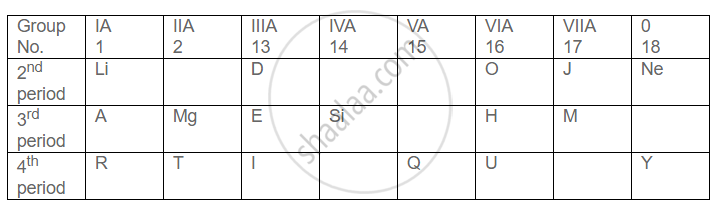
In the above table, H does not represent hydrogen.Some elements are given in their own symbol and position in the periodic table while others are shown with a letter. With refrence to the table answer the following questions.
1. Identify the most electronegative element.
2. Identify the most reactive element of Group I.
3. Identify the element from Period 3 with least atomic size.
4. How many valence electrons are present in Q?
5. Which element from group 2 would have the least ionisation energy?
6. Identify the noble gas of the fourth period.
7. In the compound between A and H, what type of bond would be formed and give its molecular formula.
Choose the correct answer from the choice given:
Ionisation potential increases over a period from left to right because the
Atomic radius and nuclear charge increase
Atomic radius and nuclear charge decrease
Atomic radius increases and nuclear charge decreases
Atomic radius decreases and nuclear charge increases
Choose the correct answer from the choice given:
An element A belonging to Period 3 and Group II will have
3 shells and 2 valence electrons
2 shells and 3 valence electrons
3 shells and 3 valence electrons
2 shells and 2 valence electrons
An element Z has atomic number 16. Answer the following
(a) State the period and group to which Z belongs
(b) Is Z a metal or a non-metal?
(c) State the formula between Z and hydrogen.
(d) what kind of a compund is this?
Among the elements given below, the element with the least electronegativity is:
Lithium
Boron
Carbon
Fluorine
The metals of Group 2 from top to bottom are Be, Mg, Ca, Sr and Ba.
- Which one of these elements will form ions most readily and why?
- State the common feature in their electronic configuration.
The metals of Group 2 from top to bottom are Be, Mg, Ca, Sr and Ba. State the common feature in the electronic configuration.
Arrange the following as per the instruction given in the bracket:
Cs, Na, Li, K, Rb (increasing order of metallic character).
Arrange the following as per the instruction given in the bracket:
Mg, Cl, Na, S, Si, (decreasing order of atomic size).
Arrange the following as per the instruction given in the bracket:
Na, K, Cl, S, Si (increasing order of ionization energy)
Arrange the following as per instruction given in the bracket.
Cl, F, Br, I (increasing electron affinity)
Choose the most appropriate answer from the following list of oxides which fits the description. Each answer may be used only once:
[SO2, SiO2, Al2O3, MgO, CO, Na2O]
- A basic oxide.
- An oxide which dissolves in water forming an acid.
- An amphoteric oxide.
- A covalent oxide of a metalloid.
Rewrite the following sentence by using the correct > (greater than) or < (less than) in the blank given
The ionization potential of potassium is _______ that of sodium.
> (greater than)
< (less than)
Rewrite the following sentence by using the correct > (greater than) or < (less than) in the blank given :
The electronegativity of iodine is ________ that of chlorine.
> (greater than)
< (less than)
Use the letters only written in the Periodic Table given below to answer the questions that follow: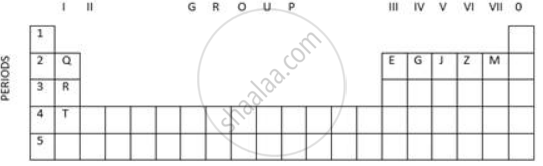
(a) State the number of valence electrons in the atom J.(b) Which element shown forms ions with a single negative charge?
(c) Which Metallic element is more reactive than R?
(d) Which element has its electrons arranged in four shells?
Fill in the blank by selecting the correct word from the option.
If an element has a low ionization energy then it is likely to be ________
metallic
non-metallic
Fill in the blank by selecting the correct word from the bracket.
If an element has seven electrons in its outermost shell then it is likely to have the _____ atomic size among all the elements in the same period.
largest
smallest
Fill in the blank from the choice given in bracket.
The energy required to remove on electron from a natural isolated gaseous atom and convert it into a positively charged gaseous ion is called ____________
electron affinity
ionization potential
electronegativity
Arrange the following as per the instruction given in the bracket
He,Ar,Ne (Increasing order of the number of electron shells)
Arrange the following as per the instruction given in the bracket
Na,Li,K (Increasing ionization energy)
Arrange the following as per the instruction given in the bracket
F,Cl,Br (Increasing electronegativity)
Arrange the following as per the instruction given in the bracket
Na, K, Li (Increasing atomic size)
Match the atomic number 2, 4, 8, 15 and 19 with each of the following:
- A solid non-metal belonging to the third period.
- A metal of valency 1.
- A gaseous element with valency 2.
- An element belonging to Group 2.
- A rare gas.
Give one word or a phrase:
The energy released when an electron is added to a neutral gaseous isolated atom to form a negatively charged ion.
Give a reason for the following:
Ionisation potential increases across a period, from left to right.
Give a reason for the following:
Alkali metals are good reducing agents.
In Period 3 of the Periodic Table, element B is placed to the left of element A. On the basis of this information, choose the correct word from the option to complete the following statement:
The element B would have ______ metallic character than A.
lower
higher
In Period 3 of the Periodic Table, element B is placed to the left of element A. On the basis of this information, choose the correct word from the option to complete the following statement:
The element A would probably have ______ electron affinity than B.
lesser
higher
In Period 3 of the Periodic Table, element B is placed to the left of element A. On the basis of this information, choose the correct word from the option to complete the following statement:
The element A would have ______ atomic size than B.
greater
smaller
Choose the correct answer from the options given below.
The most electronegative element from the following elements is:
Magnesium
Chlorine
Aluminium
Sulphur
Fill in the blank with the choices given in the options.
In Period 3, the most metallic element is ______.
sodium
magnesium
aluminium
Give the appropriate term defined by the statement given below:
The tendency of an atom to attract electrons towards itself when combined in a covalent compound.
Arrange the following according to the instruction given in the bracket:
K, Pb, Ca, Zn (in the increasing order of the reactivity).
Arrange the following as per instruction given in the bracket.
Li, K, Na, H (decreasing order of their potential ionisation)
Arrange the following according to the instruction given in the bracket:
F, B, N, O (In the increasing order of electron affinity).
Arrange the following according to the instruction given in the bracket:
Ethane, methane, ethene, ethyne (In the increasing order of the molecular weight) [H = 1. C = 12].
Study the extract of the Periodic Table given below and answer the questions that follow. Give the alphabet corresponding to the element in question.
DO NOT repeat an element.
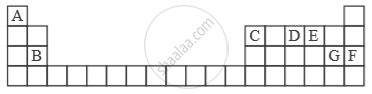
- Which element forms electrovalent compound with G?
- The ion of which element will migrate towards the cathode during electrolysis?
- Which non-metallic element has the valency of 2?
- Which is an inert gas?
The element with highest ionisation potential is ______.
Hydrogen
Caesium
Radon
Helium
A compound with low boiling point is ______.
Sodium chloride
Calcium chloride
Potassium chloride
Carbon tetrachloride
Give the appropriate term defined by the statement given below:
The tendency of an atom to attract electrons towards itself when combined in a covalent compound.
The following table represents the elements and atomic number. With reference to this, answer the following using only the alphabets given in the table.
| Element | Atomic number |
| P | 13 |
| Q | 7 |
| R | 10 |
- Which element combines with hydrogen to form a basic gas?
- Which element has an electron affinity zero?
- Name the element which forms an ionic compound with chlorine.
Name the following element.
An alkaline earth metal present in group 2 and period 3.
An element in period 3 whose electron affinity is zero.
Neon
Sulphur
Sodium
Argon
An element with the largest atomic radius among the following is ______.
Carbon
Nitrogen
Lithium
Beryllium
Metals are good ______.
Oxidising agents
Reducing agents
Give one word or phrase for the following:
The amount of energy released when an atom in the gaseous state accepts an electron to form an anion.
Give one word/a phase/term/process for the following statement:
The tendency of an element to form chains of identical atoms.
State the terms/process for the following:
The name of the process by which Ammonia is manufactured on a large scale.
State the terms/process for the following:
A type of salt formed by partial replacement of hydroxyl radicals with an acid radical.
Give one word or phrase for the following:
The ratio of the mass of a certain volume of gas to the mass of an equal volume of hydrogen under the same conditions of temperature and pressure.
Arrange the following as per the instruction given in the bracket:
Al, K, Mg, Ca (decreasing order of its reactivity)
Arrange the following as per the instruction given in the bracket:
N, Be, O, C (increasing order of non-metallic character)
Arrange the following as per the instruction given in the bracket:
P, Si, F, Be (decreasing order of valence electrons)
Define electronegativity
Give reason for the following:
Ionisation potential decreases down a group.
In the 2nd period Neon has maximum Ionization Potential because ______.
It has unstable electronic configuration.
It easily accepts electrons.
It easily loses electrons.
The outer most shell is completely filled.
Electron Affinity is maximum in ______.
Mg
Ar
Li
Br
Match the Column A with Column B.
| Column A | Column B | ||
| (a) | Water | 1. | Lithium |
| (b) | Alkali metal | 2. | Iodine |
| (c) | Halogen | 3. | Covalent compound |
| (d) | Calcium oxide | 4. | Acetic acid |
| (e) | Weak acid | 5. | Ionic compound |
| 6. | Sulphuric acid | ||
State the term for the following:
The tendency of an atom to pull a shared pair of electrons towards itself in a compound.
Arrange the following as per the instruction given in the bracket:
Carbon, Fluorine, Beryllium (decreasing order of atomic size).
Arrange the following as per the instruction given in the bracket:
Sulphuric acid, Phosphoric acid, Acetic acid (increasing order of number of replaceable H atoms per molecule).
Arrange the following as per the instruction given in the bracket:
Potassium, Lithium, Sodium (increasing order of ionization potential).
Identify the following:
An element in Period 1 which can be placed in both Group 1 and Group 17 of the Periodic Table.
Identify the following:
The element having electronic configuration 2, 8, 6.
Identify the following:
The most electronegative element of Period 3.
Solutions for 1: Periodic Properties and Variations of Properties: Physical and Chemical
Frank solutions for Chemistry Part 2 [English] Class 10 ICSE chapter 1 - Periodic Properties and Variations of Properties: Physical and Chemical
Shaalaa.com has the CISCE Mathematics Chemistry Part 2 [English] Class 10 ICSE CISCE solutions in a manner that help students grasp basic concepts better and faster. The detailed, step-by-step solutions will help you understand the concepts better and clarify any confusion. Frank solutions for Mathematics Chemistry Part 2 [English] Class 10 ICSE CISCE 1 (Periodic Properties and Variations of Properties: Physical and Chemical) include all questions with answers and detailed explanations. This will clear students' doubts about questions and improve their application skills while preparing for board exams.
Further, we at Shaalaa.com provide such solutions so students can prepare for written exams. Frank textbook solutions can be a core help for self-study and provide excellent self-help guidance for students.
Concepts covered in Chemistry Part 2 [English] Class 10 ICSE chapter 1 Periodic Properties and Variations of Properties: Physical and Chemical are Metallic Character, Non-metallic Character, Ionisation Potential (Ionisation Energy), Electron Affinity, Electronegativity, Summary Periodic Properties, Atomic Number and Mass Number, Comparison of Alkali Metals and Halogens, Modern Periodic Table, Salient Features of the Modern Periodic Table, Periodicity, Shells and Valency, Periodic Properties, Atomic Size.
Using Frank Chemistry Part 2 [English] Class 10 ICSE solutions Periodic Properties and Variations of Properties: Physical and Chemical exercise by students is an easy way to prepare for the exams, as they involve solutions arranged chapter-wise and also page-wise. The questions involved in Frank Solutions are essential questions that can be asked in the final exam. Maximum CISCE Chemistry Part 2 [English] Class 10 ICSE students prefer Frank Textbook Solutions to score more in exams.
Get the free view of Chapter 1, Periodic Properties and Variations of Properties: Physical and Chemical Chemistry Part 2 [English] Class 10 ICSE additional questions for Mathematics Chemistry Part 2 [English] Class 10 ICSE CISCE, and you can use Shaalaa.com to keep it handy for your exam preparation.
