Advertisements
Advertisements
Question
Among the elements of the second period, Li to Ne, pick out the element with the largest atomic size
Advertisements
Solution
The element with largest atomic size: Lithium (Li)
Notes
Concept Insight: Lithium has the largest atomic size since it is an alkali metal i.e., belongs to group 1 and we know that as we move from left to right in a period atomic size decreases. So lithium has largest size while fluorine has smallest size in second period.
APPEARS IN
RELATED QUESTIONS
Which is greater in size an atom or an anion?
Write the name and symbol of the element from the description.
The atom having the smallest size.
Study the radius of the element given below and answer the following questions.
| elements | K | Na | Rb | Cs | Li |
| Atomic radius (pm) | 231 | 186 | 244 | 262 | 151 |
a) Which of the above elements have the smallest atom?
b) In which group of the modern periodic table the above element are belongs?
c) What is the periodic trend observed in the variation of atomic radii down a group?
While going from top to bottom in a group the atomic radius ______.
Write information about the given atomic numbers in the table.
| Atomic Number | Electronic configuration | Group | Period | Element |
| 10 | ||||
| 20 | ||||
| 7 |
The electronic configuration of metal A is 2, 8, 18, 1.
The metal A when exposed to air and moisture forms B a green layered compound. A with con. H2 SO4 forms C and D along with water. D is a gaseous compound. Find A, B, C, and D.
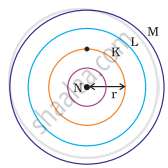
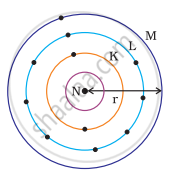
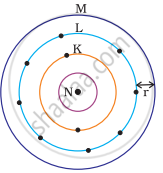
Which one of the following depict the correct representation of atomic radius(r) of an atom?
|
(i) |
(ii) |
|
(iii) |
(iv) |

Arrange the following in order of increasing radii:
N, O, P
Explain your choice.
In Period 3 of the Periodic Table, element B is placed to the left of element A. On the basis of this information, choose the correct word from the option to complete the following statement:
The element A would have ______ atomic size than B.
Give reason for the following:
The size of a Cl− ion is greater than the size of a Cl atom.
