Advertisements
Advertisements
Question
Arrange the following as per the instruction given in the bracket:
Carbon, Fluorine, Beryllium (decreasing order of atomic size).
Advertisements
Solution
Beryllium > Carbon > Fluorine
Explanation:
As we proceed along a period, the size of the atom decreases due to increased nuclear pull.
RELATED QUESTIONS
Answer the following in respect of element `31/15 P `
Give its formula with chlorine?
Give the trends in atomic size on moving across the period left to right.
Write the name and symbol of the element from the description.
The atom having the smallest size.
Among the elements of the second period, Li to Ne, pick out the element with the largest atomic size
Select the correct answer
Atomic radii of fluorine and neon in angstrom unit are
The electronic configuration of metal A is 2, 8, 18, 1.
The metal A when exposed to air and moisture forms B a green layered compound. A with con. H2 SO4 forms C and D along with water. D is a gaseous compound. Find A, B, C, and D.
Atomic number of a few elements are given below
10, 20, 7, 14
- Identify the elements
- Identify the Group number of these elements in the Periodic Table
- Identify the Periods of these elements in the Periodic Table
- What would be the electronic configuration for each of these elements?
- Determine the valency of these elements
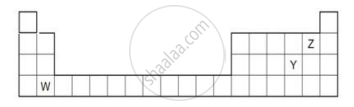
The diagram below shows part of the periodic table.
- Which elements would react together to form covalent compounds?
- Between the two elements W and Z, which will have a bigger atomic radius? Why?
An element with the largest atomic radius among the following is ______.
Arrange the following as per instruction given in the bracket.
Mg, Cl, Na, S, Si (decreasing order of atomic size)
