Advertisements
Advertisements
प्रश्न
Arrange the following as per the instruction given in the bracket:
Carbon, Fluorine, Beryllium (decreasing order of atomic size).
Advertisements
उत्तर
Beryllium > Carbon > Fluorine
Explanation:
As we proceed along a period, the size of the atom decreases due to increased nuclear pull.
संबंधित प्रश्न
Give reasons for the following:
The size of the anion is greater than the size of the parent atom.
Fill in the blanks.
Size of the atoms ______ from left to right across a period and ______ on descending in a group of normal elements.
Arrange the following as per the instruction given in the bracket
Na, K, Li (Increasing atomic size)
The size of an atom is indicated by its ______.
Write scientific reason.
In same period, boron and oxygen elements have different atomic size.
An element X has mass number 40 and contains 21 neutrons in its atom. To which group of the Periodic Table does it belong?
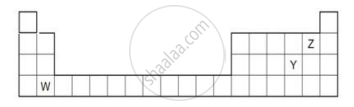
The diagram below shows part of the periodic table.
- Which elements would react together to form covalent compounds?
- Between the two elements W and Z, which will have a bigger atomic radius? Why?
In Period 3 of the Periodic Table, element B is placed to the left of element A. On the basis of this information, choose the correct word from the option to complete the following statement:
The element A would have ______ atomic size than B.
Which one of the following has the largest atomic radius?
Which one has the largest size?
