Advertisements
Advertisements
Question
The metals of Group 2 from top to bottom are Be, Mg, Ca, Sr and Ba.
- Which one of these elements will form ions most readily and why?
- State the common feature in their electronic configuration.
Advertisements
Solution
- Ba metal will form ions readily because the ionisation energy decreases down the group as the size increases.
- On moving down the group, the number of electrons in the outermost shell, i.e. valence electrons, remains the same. So, the valency in the group remains the same.
APPEARS IN
RELATED QUESTIONS
Give reasons for the following:
The size of the anion is greater than the size of the parent atom.
Fill in the blanks.
Size of the atoms ______ from left to right across a period and ______ on descending in a group of normal elements.
Arrange the following in increasing order of property indicated
I, I+, I- (atomic size)
Arrange the following as per the instruction given in the bracket
Na, K, Li (Increasing atomic size)
Right or wrong sentence.
Moving from left to right, the size of the atom decreases.
Carbon belongs to the second period and Group 14. Silicon belongs to the third period and Group 14. If the atomic number of carbon is 6, the atomic number of silicon is ______
Which of the following gives the correct increasing order of the atomic radii of O, F, and N?
An element X (atomic number 17) reacts with an element Y (atomic number 20) to form a divalent halide.
- Where in the periodic table are elements X and Y placed?
- Classify X and Y as metal (s), non-metal (s) or metalloid (s)
- What will be the nature of oxide of element Y? Identify the nature of bonding in the compound formed
- Draw the electron dot structure of the divalent halide
Atomic number of a few elements are given below
10, 20, 7, 14
- Identify the elements
- Identify the Group number of these elements in the Periodic Table
- Identify the Periods of these elements in the Periodic Table
- What would be the electronic configuration for each of these elements?
- Determine the valency of these elements
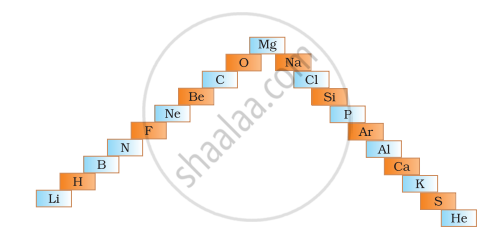
- In below ladder symbols of elements are jumbled up. Rearrange these symbols of elements in the increasing order of their atomic number in the Periodic Table.
- Arrange them in the order of their group also.