- Electric energy from a cell is used to do work on charges, which is converted into heat in a resistor or other forms, like motion in a motor.
- The work done (energy) in moving a charge Q across a potential difference VAB is:
Work = VAB × Q - Heat produced (H) in a resistor over time t is given by Joule’s Law of Heating:
H = I2 × R × t - According to Ohm’s Law:
VAB = I × R - Electrical power (P) is the rate of energy transfer and is calculated as:
P = VAB × I
Its unit is watt (W), where 1W = 1 volt × 1 ampere.
Definitions [20]
Definition: Heating effect of electric current
When a resistor is connected in an electrical circuit, heat is produced in it due to the current. This is known as the heating effect of current.
Define the following:
Electrolyte
The solution through which the electricity passes is called an electrolyte.
Define fuse.
Electric fuse is a safety device which is used in household wiring and in many appliances.
Define the magnetic effect of electric current.
A current-carrying conductor is always associated with a magnetic field around it is called the magnetic effect of current. It was first discovered by Hans Christian Oersted in 1820.
Definition: Magnetic Effect of Current
The phenomenon in which a current-carrying conductor produces a magnetic field around itself is called the magnetic effect of electric current.
Definition: Right Hand Thumb Rule
If a current-carrying straight conductor is held in the right hand such that the thumb points in the direction of the electric current, then the fingers curled around the conductor show the direction of the magnetic field.
This is called the Right-Hand Thumb Rule.
OR
If you hold a current-carrying conductor in your right hand with the thumb pointing in the direction of the current, then the curled fingers show the direction of the magnetic field (lines of force) around the conductor.
Definition: Solenoid
A long, cylindrical coil consisting of a large number of closely wound circular turns of insulated copper wire, in which a magnetic field is produced when current flows through it.
Definition: Fleming’s Left Hand Rule.
If the forefinger, middle finger, and thumb of the left hand are stretched mutually perpendicular to each other, with the forefinger indicating the direction of the magnetic field, the middle finger the direction of current, then the thumb gives the direction of the force (motion) on the conductor.
This is called Fleming’s Left-Hand Rule.
OR
If the thumb, index finger, and middle finger of the left hand are stretched perpendicular to each other, and:
- The index finger points in the direction of the magnetic field,
- Middle finger in the direction of the current,
- Then the thumb gives the direction of the force (motion) on the conductor.
Define electric motor.
lt is a device to convert electrical energy into mechanical energy. It is based on the principle that when a current-carrying coil is placed in a magnetic field, it experiences a force.
Definition: Electric Motor
A device changing electrical energy into mechanical energy is known as electric motor.
Definition: Electromagnetic Induction
The phenomenon in which electric current is generated in a conductor or closed coil due to a varying magnetic field is called electromagnetic induction.
Definition: Galvanometer
An electromechanical, sensitive instrument which is used to detect and measure small electric currents in a circuit is called a galvanometer.
Define the right-hand thumb rule.
If the current-carrying conductor is held in the right hand such that the thumb points in the direction of the current, then the direction of the curl of the fingers will give the direction of the magnetic field.
Definition: Faraday's Law of Induction
Whenever the number of magnetic lines of force (magnetic flux) passing through a coil changes, an electric current is induced in the coil. This current is called the induced current.
Definition: Fleming’s Right Hand Rule
If the thumb, index finger, and middle finger of the right hand are stretched perpendicular to each other, then:
- The thumb indicates the direction of motion of the conductor,
- The index finger shows the direction of the magnetic field,
- The middle finger gives the direction of the induced current.
Definition: Alternating Current (AC)
Alternating current is a current that changes in magnitude and direction after equal intervals of time.
Define the following:
Frequency
Frequency is the number of the complete cycle of variations, gone through by the ac in one second.
Define the following:
Rectifier
Rectifier: The device used to convert ac to dc is called a rectifier.
Definition: Direct Current (DC)
Direct current is a non-oscillatory current that flows in one direction in a circuit, from the cell to the cell.
Define an electric generator or a dynamo.
lt is a device to convert mechanical energy into electrical energy. It is based on the principle of electromagnetic induction that a current is induced in a closed circuit when the magnetic field passing through it changes.
Formulae [3]
Write the mathematical expression for Joule’s law of heating.
The mathematical expression of Joule’s Law of heating is: H = I2 Rt
Where,
H = Produced Heat
I = Current flowing through the device
t = Time taken
r = Resistance of the appliance
Formula: Shunt Resistance Formula
S = \[\frac{G\cdot I_g}{I-I_g}\]
If current I = nIg: S = \[\frac {G}{n-1}\]
Formula: Resistance of ammeter
\[R_A=\frac{S\cdot G}{S+G}=\frac{G}{n}\]
Theorems and Laws [5]
Write Fleming’s left hand rule.
Stretch the index finger, the middle finger, and the thumb of the left hand mutually perpendicular to each other. If the index finger is in the direction of the magnetic field and the middle finger points in the direction of the current, then the thumb will point towards the direction of the force on the conductor.
State Faraday’s laws of electromagnetic induction.
First law: Whenever there is a change of magnetic flux in a closed circuit, an induced emf is produced in the circuit. This law is a qualitative law as it only indicates the characteristics of induced emf.
Second law: The magnitude of the induced emf produced in the circuit is directly proportional to the rate of change of the magnetic flux linked with the circuit. This law is known as the quantitative law, as it gives the magnitude of the induced emf.
Faraday’s First Law: Whenever the magnetic flux linked with a circuit changes, an emf is induced in the circuit.
Faraday’s Second Law: The magnitude of the induced emf is equal to the rate of change of magnetic flux.
e = `-(d phi)/dt`
For a coil of N turns:
e = `-N (d phi)/dt`
Negative sign indicates Lenz’s law (direction opposes cause).
State Lenz’s Law.
It is stated that the direction of induced e.m.f. is always in such a direction that it opposes the change in magnetic flux.
e = `(d phi)/(dt)`
Consider a rectangular metal coil PQRS. Let ‘L’ be the length of the coil. It is placed in a partly magnetic field ‘B’. The direction of the magnetic field is perpendicular to the paper and into the paper. The ‘x’ part of the coil is in the magnetic field at instant t. If the coil is moved towards the right with a velocity v = `dx/dt` with the help of an external agent, such as a hand. The magnetic flux through the coil is:
Φ = BA = BLx
∴ Φ = BLx ...(1)
There is relative motion of a current through the coil. Let ‘i’ be current through the coil.
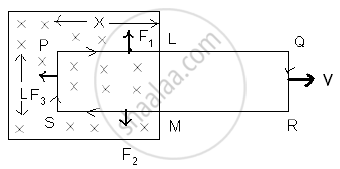
Three forces act on the coil.
F1 on conductor PL ∴ F1 = Bi x, vertically upward.
F2 on conductor MS ∴ F2 = Bi x, vertically downward.
F3 on conductor SP ∴ F3 = Bi L towards left.
F1 and F2 are equal and opposite and also on the same line. They will cancel each other; F3 is a resultant force. The external agent has to do work against this force.
∴ F3 = −Bi l ...(−ve sign indicates that force is opposite to dx.)
If dx is the displacement in time dt, then the work done (dw) = F3 dx.
∴ dw = − BiL dx
This power is an electrical energy ‘ei’ where ‘e’ is an induced e.m.f.
∴ ei = `-(B_i ldx)/(dt)`
∴ e = `-(BLdx)/(dt)`
∴ e = −BLv
∴ e = `-d/dt (BLx)`
∴ e = `(-d phi)/(dt)` ...[from eq (1)]
Lenz’s Law states that the direction of the induced electromotive force (EMF) and the resulting current in a conductor is always such that it opposes the change in magnetic flux that caused it.
Mathematically, Lenz’s Law is expressed as:
ε = `(-d phi_B)/dt`
Where,
ε = Induced EMF
ΦB = Magnetic flux
The negative sign indicates opposition to the change in flux.
Law: Faraday's Second Law or Lenz's Law
Statement:
The direction of the induced emf, or the induced current, in any circuit is such as to oppose the cause that produces it. This law is known as Lenz’s Law.
Explanation / Proof:
- When the north pole of a magnet is moved towards the coil, an induced current flows in the coil in such a direction that the near (left) face of the coil behaves like a north pole.
- Due to the repulsion between the like poles, the motion of the magnet towards the coil is opposed.
- When the north pole of the magnet is moved away from the coil, the induced current flows in such a direction that the near face of the coil becomes a south pole.
- The attraction between opposite poles then opposes the motion of the magnet away from the coil.
In both cases, the induced current opposes the magnet's motion, which is the cause of the current. Therefore, work has to be done to move the magnet, and this mechanical work appears as electrical energy in the coil.
Direction of Induced Current (Fleming’s Right-Hand Rule):
- Stretch the right-hand thumb, forefinger, and middle finger so that they are mutually perpendicular.
- The forefinger points in the direction of the magnetic field.
- The thumb points in the direction of motion of the conductor.
- The middle finger then gives the direction of the induced current.
Conclusion:
Lenz’s Law shows that the induced current always acts in such a direction as to oppose the cause that produces it. This ensures that mechanical energy is converted into electrical energy, and no energy is produced without work being done.
Law: Faraday's First Law or Neumann’s law
Statement:
When the magnetic flux through a circuit is changing, an induced electromotive force (emf) is set up in the circuit whose magnitude is equal to the negative rate of change of magnetic flux. This is also known as Neumann’s Law.
Mathematical Expression:
If ΔΦB is the change in magnetic flux in a time interval Δt, then the induced emf e is given by:
e = \[-\frac{\Delta\Phi_B}{\Delta t}\]
In the limiting case as Δt → 0:
e = \[-\frac{d\Phi_{B}}{dt}\]
- If dΦB is in weber (Wb) and dtdtdt in seconds (s), then the emf eee will be in volts (V).
- This equation represents an independent experimental law, which cannot be derived from other experimental laws.
For a tightly-wound coil of N turns, the induced emf becomes:
e = \[-N\frac{d\Phi_B}{dt}\] or e = \[-\frac{d(N\Phi_B)}{dt}\]
Here, NΦB is called the ‘number of magnetic flux linkages’ in the coil, and its unit is weber-turns.
Explanation:
Consider a magnet and a coil:
- When the north pole of a magnet is near a coil, a certain number of magnetic flux lines pass through the coil.
- If either the coil or the magnet is moved, the number of magnetic flux lines (i.e., the magnetic flux) through the coil changes.
Cases:
- Magnet moved away from the coil → Decrease in magnetic flux through the coil.
- Magnet brought closer to the coil → Increase in magnetic flux through the coil.
In both cases, an emf is induced in the coil during the motion of the magnet.
- Faster motion → Greater rate of change of flux → Higher induced emf.
- If both the magnet and coil are stationary, or both are moving in the same direction with the same velocity, there is no change in flux → No induced emf.
Special Case:
- If the coil is an open circuit (i.e., infinite resistance), emf is still induced, but no current flows.
- This shows that it is the change in magnetic flux that induces emf, not current.
Conclusion:
Neumann’s Law establishes that a changing magnetic flux through a circuit induces an emf, and the induced emf is proportional to the rate of change of flux, with a negative sign indicating the direction (as per Lenz’s law).
Key Points
Key Points: Electric Circuit
Key Points: Heating Effect of Electric Current
Key Points: Magnetic Field at the Axis of a Circular Current-carrying Loop
- A circular current loop produces a magnetic field whose axial value is B = \[\frac{\mu_0IR^2}{2(x^2+R^2)^{3/2}}\].
- At the centre of the loop (x = 0), this simplifies to B0 = \[\frac {μ_0I}{2R}\], and for N turns, B0 = \[\frac {μ_0NI}{2R}\].
- Perpendicular field components from opposite points on the loop cancel; only axial components add up.
- Direction follows the right-hand thumb rule; one face of the loop acts as a north pole, the other as a south pole.
- Straight wire segments (as in a semicircular arc problem) contribute zero field at a point lying on the line of the wire itself.
Key Points:
- A current-carrying conductor in a magnetic field experiences a force perpendicular to both the current and the field direction.
- Reversing current or reversing field polarity reverses the force direction.
- Formula: F = BIl sin θ; vector form \[\vec F\] = I\[\vec l\] × \[\vec B\].
- Force is zero when the wire is parallel to \[\vec{B}\] and maximum (Fmax = BIl) when perpendicular.
- Fleming's Left-Hand Rule (thumb = force, forefinger = field, middle finger = current) is the standard tool for direction in Indian board exams.
Key Points: Introduction to Electromagnetic Induction
- Electricity and magnetism are interrelated.
- Electric current can produce a magnetic field.
- A changing magnetic field can produce electric current.
- The production of electric current by a varying magnetic field is called electromagnetic induction.
- Michael Faraday showed in 1831 that a moving magnet can produce current in a conductor.
- The current produced due to electromagnetic induction is called induced current.
- Generators, transformers, induction motors, and wireless chargers work on electromagnetic induction.
Key Points: Electric Generator
- Electromagnetic induction can be used to generate a large current by rotating a coil in a magnetic field, converting mechanical energy into electrical energy.
- In an AC generator, a coil rotates between magnetic poles, and the induced current reverses direction every half-rotation, producing alternating current (AC).
- Carbon brushes and conducting rings connect the rotating coil to the external circuit; the current direction in the circuit reverses after each half-turn.
- Using a multi-turn coil significantly increases the magnitude of the generated current.
- A DC generator uses a split ring instead of two separate rings to maintain unidirectional current in the external circuit.
Important Questions [41]
- Match the Column ‘A’ with Column ‘B’.
- The unit of electrical power is _______.
- Two Tungsten Bulbs of Power 50 W and 60 W Work on 220 V Potential Difference. If They Are Connected in Parallel, How Much Current Will Flow in the Main Conductor?
- State Four Most Common Electrical Appliances Based on Heating Effect of Electric Current. Why Do We Use Finely Heated Platinum Wire in Surgery?
- Name Any Six Domestic Appliances Based on the Heating Effect of Electric Current.
- Give scientific reason : In the electric equipment producing heat e.g. iron, electric heater, boiler, toaster etc., an alloy such as Nichrome is used, not pure metals.
- Identify the figure and give its use.
- Identify the figure and give its use.
- Give a scientific reason. Tungsten metal is used to make a solenoid type coil in an electric bulb.
- Give a scientific reason: For electric power transmission, copper or aluminium wire is used.
- Answer the Following Question: What is the Heating Effect of the Electric Current? State Any Four Applications of It?
- Rewrite the Following Statement by Selecting the Correct Option: 1 a = ____________ Ma.
- Read the given passage and answer the following questions: The home electrical connection consists of ‘live’, ‘neutral’ and ‘earth’ wires. The ‘live’ and the ‘neutral’ wires
- Observe the Following Diagram and Choose the Correct Alternative :
- When the Resistance of a Conductor Increases, the Current ____________ .
- State the Effect on the Magnetic Needle in Oersted’S Experiment When:; (A) the Current is Passed Through the Wire. (B) the Current Through the Wire is Increased
- State the Right Hand Thumb Rule.
- What is a solenoid?
- Draw a neat diagram of a solenoid and name its various components.
- Name the following diagram and explain the concept behind it.
- Differentiate between conductors and insulators.
- Observe the given figure of Fleming's Left Hand Rule and write the labels of 'A' and 'B':
- Observe the Following Figure: If the Current in the Coil a is Changed, Will Some Current Be Induced in the Coil B? Explain.
- State Whether the Following Statements Are True Or False. an Electric Motor Converts Mechanical Energy into Electrical Energy.
- Tell the odd one out. Give a proper explanation. Loud speaker, Microphone, Electric motor, Magnet
- Name Any Four Appliances Where Electric Motor is Used.
- What is the Principle of Electric motor?
- Explain the Construction and Working of an Electric Motor.
- Draw Figure ‘Electric Motor’ and Working
- Label the Four Parts of an Electric Motor
- State Fleming’S Right-hand Rule.
- State Three Differences Between Direct Current and Alternating Current.
- The Device Used for Producing Electric Current is Called
- State Fleming’S Right Hand Rule.
- Answer the Following: State the Principles of the Electric Motor and Electric Generator.
- Name the following diagram and explain the concept behind it.
- Observe the given figure of Fleming’s Right Hand Rule and write the labels of A and B correctly.
- Identify the figure and give its use.
- Explain ‘Electric Generator’ with the Help of the Following Points: Diagram of an Ac Generator with Labelling Principle of an Electric Generator the Function of Slip Rings Any Two Uses of a General
- Identify the figure and explain its use.
- Observe the following diagram and answer the questions given below: Identify the above diagram. Write the principle on which the above appliance works. Write the working of the above appliance.
Concepts [15]
- Electric Circuit
- Heating Effect of Electric Current
- Magnetic Effect of Electric Current
- Right-hand Thumb Rule
- Applications of Biot-Savart's Law > Magnetic Field at the Axis of a Circular Current-carrying Loop
- Applications of Ampere’s Circuital Law > Magnetic Field of a Long Straight Solenoid
- Force on a Current-Carrying Conductor Placed in a Uniform Magnetic Field
- Fleming’s Left Hand Rule
- Electric Motor
- Introduction to Electromagnetic Induction
- Galvanometer
- Faraday's Laws of Electromagnetic Induction
- Fleming’s Right Hand Rule
- Alternating current (AC) and Direct Current (DC)
- Electric Generator
