Advertisements
Advertisements
Question
Answer the following question:
State the effect on the magnetic needle in Oersted’s experiment when:
(a) the current is passed through the wire.
(b) the current through the wire is increased
(c) the current through the wire is reversed.
Advertisements
Solution
- When a current is passed through the wire, the magnetic needle gets deflected.
- When the current through the wire is increased, the deflection of the magnetic needle increases.
- When the current through the wire is reversed, the magnetic needle is deflected in the opposite direction.
APPEARS IN
RELATED QUESTIONS
When the current is switched on through a wire, a compass needle kept nearby gets deflected from its north-south position. Explain.
Which effect of current can be utilised in detecting a current carrying wire concealed in a wall?
Name the scientist who discovered the magnetic effect of current.
What device reverses the current?
In the Activity shown below, how do we think the displacement of rod AB will be affected if
- current in rod AB is increased
- a stronger horse-shoe magnet is used
- length of the rod AB is increased?
|
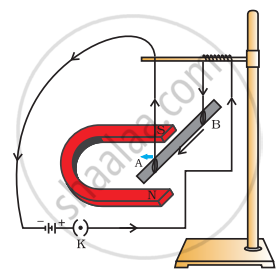
Observe the following diagram and choose the correct alternative:

(c) Considering the relationship in the first pair, complete the second paie :
AgCI : White :: CuI2 : ___________
Name any two appliances which works on the phenomenon of magnetic effect of electric current.
Draw a neat labelled diagram to show the magnetic effect of electric current.
A soft iron bar is introduced inside the current-carrying solenoid. The magnetic field inside the solenoid ____________.
What is that instrument which can detect the presence of electric current in a circuit?
A uniform magnetic field exists in the plane of paper pointing from left to right as shown in Figure. In the field an electron and a proton move as shown. The electron and the proton experience

Edison used a ______ wire coil is a vacuum glass and discovered the first electric bulb in 1879.
______ cells cannot be recharged after use.
Make four electromagnets with 20, 40, 60 and 80 turns. Connect them one by one to a battery of 2 cells. Bring the electromagnet near a box of pins. Count the number of pins attracted by it. Compare the strengths of the electromagnets.
