Advertisements
Advertisements
प्रश्न
Answer the following question:
State the effect on the magnetic needle in Oersted’s experiment when:
(a) the current is passed through the wire.
(b) the current through the wire is increased
(c) the current through the wire is reversed.
Advertisements
उत्तर
- When a current is passed through the wire, the magnetic needle gets deflected.
- When the current through the wire is increased, the deflection of the magnetic needle increases.
- When the current through the wire is reversed, the magnetic needle is deflected in the opposite direction.
APPEARS IN
संबंधित प्रश्न
When the current is switched on through a wire, a compass needle kept nearby gets deflected from its north-south position. Explain.
Will the compass needle show deflection when the switch in the circuit shown by figure is closed?

An electric bell has an electromagnet.
Fill in the following blank with suitable words:
If a coil is viewed from one end, and the current flows in a clockwise direction, then this end is a ........... pole.
What is Maxwell's corkscrew rule? For what purpose is if used?
The direction of current flowing in the coil of an electromagnet at its two ends X and Y are as shown below:
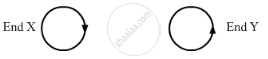
What is the polarity of end X?
What is the polarity of end Y?
Name and state the rule which you have used to determine the polarities.
What is the function of a split ring in an electric motor?
(ii) Global warming is a desirable aspect of the intensified greenhouse effect.
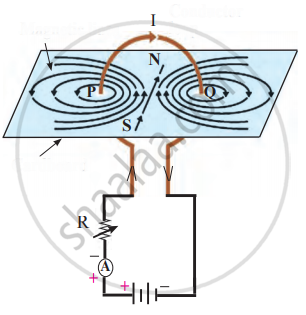
Identify the given figure, write the labels of it.
Unscramble the following words:
HTRCO
Why do we cover plug pin holes which are within the reach of children with cellotape or a plastic cover when not in use?
Boojho made an electromagnet by winding 50 turns of wire over an iron screw. Paheli also made an electromagnet by winding 100 turns over a similar iron screw. Which electromagnet will attract more pins? Give reason.
______ are also used to remove splinters of steel or iron in hospitals dealing with eye injuries.
What are MCBs? How do they work?
An electric bell contains an ______, consisting of coils of insulated wire wound around
iron rods.
A wire with green insulation is usually the live wire of an electric supply.
As shown in the diagram an aluminium rod 'AB' is suspended horizontally between the two poles of a strong horse shoe magnet in such a way that the axis of rod is horizontal and the direction of the magnetic field is vertically upward. The rod is connected in series with a battery and a key.
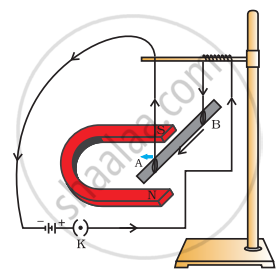
State giving reason:
- What is observed when a current is passed through the aluminium rod from end B to end A?
- What change is observed in a situation in which the axis of the rod 'AB' is moved and aligned parallel to the magnetic field and current is passed in the rod in the same direction?
Using an electromagnet, you can make a working model of a railway signal as shown in figure.

