Advertisements
Advertisements
Question
Read the following extract and answer the questions given below:
If you do not get lowered in your own eyes
While you raise yourself in those of others,
If you do not give in to gossips and lies
Rather heed them not, saying, 'who bothers?'
You may be the person I am looking for.
If you crave not for praise when you win
And look not for sympathy while you lose,
If cheers let not your head toss or spin
And after a set-back, you offer no excuse,
You may be the person I and looking for.
(1) What should be your reaction towards gossips and lies?
(2) Who are your role models? Why?
(3) Give the rhyming pairs of words from the first stanza.
(4) Which line is repeated in this extract and what is its effect?
Advertisements
Solution
- We should not give in to gossips and lies. We should not even pay attention to them. Clearly speaking we should not bother about them.
- My role model is my parents. Who are very simple and humble in their character. They do not seek praise while in achievements and do not expect sympathy while losing. They are ready to face any challenge which comes across in their life.
- eyes - lies
Others - brothers - “You may be the person I am looking for” - This line gives the importance of that person to whom the poet is looking for.
APPEARS IN
RELATED QUESTIONS
Answer the following question in 120-150 words :
Mrs. Hall is greedy but efficient in her business.
Attempt a character sketch of Mrs. Hall.
Answer any four of the following questions in 30 - 40 words each :
(a) What kind of gold did the people of Seemapuri look for in the garbage ? (Lost Spring)
(b) Why did Gandhi tell the court that he was involved in a 'conflict of duties' ?
(c) How do we get joy from life which is otherwise full of sorrows ? (A Thing of Beauty)
(d) For Aunt Jennifer, what do the tigers symbolise ?
(e) What made the chief astrologer place his finger on his nose ? (The Tiger King)
(f) On the seventh day after the American soldier was found by Dr. Sadao two things happened. Why did Hana feel scared of the second ?
In ‘The Diary of a Young Girl’ how did the Franks and others celebrate two festivals, Hanukkah and St. Nicholas Day in the Annexe ?
Describe the shifts in the narration of the events as indicated in the three sections of the text. Give a subtitle to each section.
|
The energy stored in coal and petroleum originally came to the earth from the sun. The bulk of the present-day supplies was laid down some 200 to 600 million years ago, when tropical conditions were widespread. Lush, swampy forests produced huge trees; warm coastal seas swarmed with microscopic forms of life. When these organisms died, much of their tissue was recycled as it is today — through scavenging and decay. But a significant amount of dead plant and animal material was covered with mud, which prevented complete decomposition. With the passage of time, layer upon layer of the fine sediment was deposited over the once-living material; the sheer weight turned the sediments to rock. Sandwiched between the layers, both coal and petroleum were produced and preserved under pressure. Coal was formed mostly of giant fern-like plants that have only small counterparts today. Coal may still be forming here and there on earth, but conditions are not right for the production of significant quantities. |
Underline the important words and phrases.
Tick the statement that is true.
The story hinges on a particular historical event.
The story begins with a description of the setting. How does this serve as a fitting prelude to the events described in the story?
Is drama a good medium for conveying a social message? Discuss.
What does the phrase ‘as if he were on needles’ mean? Can you think of another phrase with a similar meaning substituting the word ‘needles’?
Comment on the way in which the theme of the story has been introduced.
Examine the communication channels in the story between Basset and Paul's uncle.
Discuss in pairs or groups of four.
Replacing old machines with new is better than getting them repaired.
What is the central argument of the speaker?
Discuss in pairs
Ruskin's insistence on looking intensely at words, and assuring oneself of meaning, syllable by syllable – nay, letter by letter.
Why have the words, 'pretended' and 'seemed' been used in the lines:
...Pretended to believe every single word
of what the tiger king said.
And seemed to be taken in by all the lies.
How does the sense of these lines connect with the line 'Ajamil wasn't a fool'?
Read the following statement and mark those that apply to you.
I have a small group of close friends and have no wish to interact with anyone else.
Write down in your own words the way Laurie confirmed the names of the March sisters.
What strong qualities possessed by them, could have helped them achieve success and fame, all over?
Read the poem and fill in the table.
| Time of the day | Location | Poet’s Activity | Hawker’s Activities | Gardener’s Activities | Watchman’s Activities |
| Morning | __________ | __________ | __________ | __________ | __________ |
| Afternoon | __________ | __________ | __________ | __________ | __________ |
| Night | __________ | __________ | __________ | __________ | __________ |
The word 'report' means -
(a) Give a spoken or written account of something.
(b) Cover an event or subject as a journalist or reporter.
Stories can be told even in the form of poetry. Such poems are called Narrative poems. Narrative poems do not always follow rhythmic patterns of a fixed rhyme scheme. Such poems are written in a style called ‘Free Verse.’
Recall and name some narrative poems you have done/read earlier.
When we look at the sky, we find several objects. They stand for something or the other. Complete the following table by finding the significance of the given objects. One example is given to you.
| Celestial Bodies | Association |
| The Sun | Power, Heat, Energy, Commitment, etc. |
| The Moon | |
| The Rainbow | |
| The Stars |
Read the lesson and name the following.
The First surgeon to perform operations ______
Select a season of your choice and give the following details:
- Time of the year -
- Characteristics- crops, festivals, etc.
- Features/changes - climate/weather/temperature etc.
- Advantages/Disadvantages -
Say WHY. . . . . .
Ramanujan found the number 1729 very interesting.
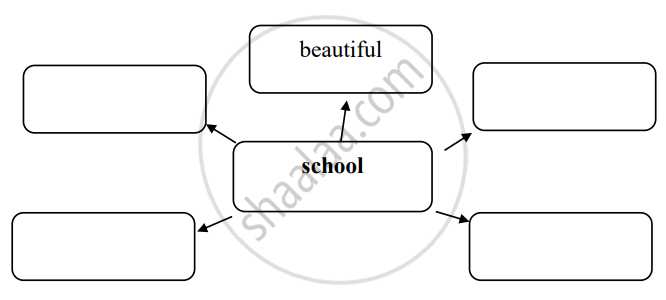
Complete the following web diagram.

Write in short about what your parents/guardians feel when they send you to school.
Read the description of the Kabaddi match and do the following:
Write, in your own words, what happened in the second half.
What characteristics are needed to be a good player of Kabaddi? What should you do to develop each? Discuss this in groups of 5 and write a composition on it.
Find one more example which shows that a beautiful appearance is not enough.
Imagine that you wish to organize a cultural event at your college. Prepare your own web-chart to indicate the qualities that you expect to have in a compere.
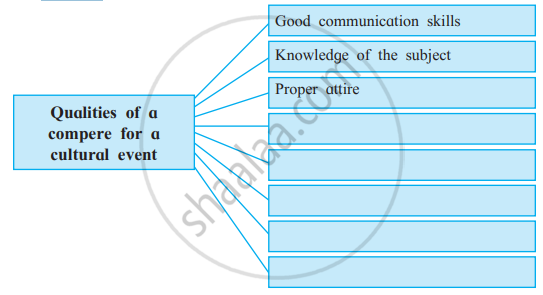
Read the story and write about the following in short.
Bushi Kiyo
Where does the story take place?
Read about the novel ‘Robinson Crusoe’ by Daniel Defoe and ‘Gulliver’s Travels’ by Jonathan Swift.
Discuss what a friendly and good-natured peacock would say to a crane. Write his speech. (5-8 lines.)
What were the three things that Sushruta discovered?
Portia’s suitors chose the gold and silver caskets.
Add ten more words to the list on your own. Each of the component words must be meaningful.
How did the students prepare for their stalls/presentations?
Make a chart to show the important points to remember while making a graphic presentation.
Complete the following table.
| No. | Utterance | Who said it | To whom | When |
| (a) | I touched it in the hall at the ministry. | ___________ | ___________ | ___________ |
| (b) | It will give us time to look some more. | ___________ | ___________ | ___________ |
| (c) | I might have needed it. | ___________ | ___________ | ___________ |
| (d) | You must have made a mistake. | ___________ | ___________ | ___________ |
| (e) | Well, I lost it. | ___________ | ___________ | ___________ |
| (f) | Mine was an imitation. | ___________ | ___________ | ___________ |
Prepare similar word chains using the following ideas.
wind - breeze __________________.
Complete the following sentence with reference to the passage.
At the back rose the high peak of Mount Ida, from which _______________.
Sayali’s mother did not want her to go on the trip.
Identify one example of a main clause and one example of a dependent clause from the content below:
Troy was filled with the sight of leaping flames and the sound of shouting and the noise of weapons and the cries of weeping women. The sleeping Trojans sprang out of their beds, but they were taken by surprise. Their enemies were right inside their walls, and many of the Trojans were killed before they could put on their armour and seize their weapons.
A bright light lit up the night sky as palaces and houses, temples and towers, went up in flames. The Trojans fought as well as they could, but it was all in vain. Old King Priam was killed with all his brave sons. Hector’s wife and his old mother and sister were carried off as slaves by the conquerors. Their fate was in contrast to Helen’s when King Menelaus rushed through the city, looking for her, and found her in her palace. She hung her head in shame and sorrow as she faced her former husband. Her voice was choked with emotion and she could not speak. But Menelaus forgave her and she went back with him, for it was only Aphrodite who had turned her heart away from her home and her husband and her child.
When morning came, nothing was left of the proud, rich city that had resisted attack for ten years.
From the play, find all the words that are related to the following:
knowledge and learning
Add other related words you know to the list.
Write the meaning of doth.
Using the information given in the passage, write a short note on the following in your mother tongue.
Gond art
Which lines are repeated in the poem? What do they mean?
How does the following character in the story live up to their name? Provide points from the story.
Tengumai Bopsulai
Write your own impressions about the news items given in (a), (b), (c), and (d) in the table below.
| News item | Good news Bad news | Reliable Unreliable | Interesting Uninteresting Boring | Others |
| (a) | ||||
| (b) | ||||
| (c) | ||||
| (d) |
Fill in the blank choosing the appropriate word/idiom from the lesson.
While arguing with his elders he had ______.
Who said the following, to whom, and when?
"Ah no, to thee I sing: he sings to God.”
Imagine the following and write about it in your own words:
What the world looks like to a baby.
Make a list of your favourite fruits and vegetables and note down the time of the year when they are available in plenty.
Choose a suitable heading for each announcement from those given below.
(Change in School Hours, Cleanliness, Story-telling Competition, Lost and Found, Warning, Football Match)
1.
|
6 July 2015 It has been observed by the Head Boy and Head Girl that certain classes do not clean up their classrooms before leaving. If any class is found untidy and littered after school, that class will be detained the next day after school hours up to 4 pm. Please take note of this. |
2.
| Tomorrow, that is, on the 10th of July, the school will close an hour earlier, as the teachers have to attend an important P. T. A. meeting. So please inform your parents to arrange to pick you up at 2 pm instead of 3 pm. |
3.
| On Sunday, 12th July 2015 there is a football match between classes VIII and IX, on the school ground. The match will begin at 9 am. All students are invited to come and cheer their favorite team. Please come on time, so that the players are not distracted. |
4.
|
The school has organized a Story-telling Competition for Classes V, VI, and VII from 21st to 25th of July. The competition will be held in the school hall at 10 in the morning. Children may select -
Three prizes will be given for each category. The time limit is 3-5 minutes. Those who wish to participate may contact Mrs. Sanjana Mohite for other details. They must register their names with her before the 16th of July. |
5.
|
Construction work to extend the school building will start next week. All students are cautioned not to cross over the fence at the construction site. It is dangerous and may cause you injury. Please stay away from that fence. |
6.
| A cycle key with a blue key chain has been found on the ground. Whoever has lost it can contact the clerk Mrs. Neena Pinto and see if it belongs to him/her. |
Was it right for the youngest brother to ask for a share in the money? Why?
Find two examples of the following from the lesson.
A Question
Write in short how the travellers crossed the first ditch.
What is ‘e-mail’ or electronic mail?
List all the pairs of antonyms you find in the passage.
Guess the meaning of the following word.
pleasing
Prospero ordered Ariel to bring ____________ to his place.
Identify the character or speaker.
I will soon move you.
Read the story again and write how these character reacted in these situation:
It’s Somu’s thoughtless ways that reduce me to tears. Mrs. Krishnan …………………....…..
Dr. Krishnan ……………..…......…….
An Anagram is a word or a phrase formed by rearranging the letters of a different word or phrase, typically using all the original letters exactly once.
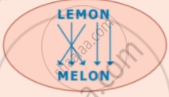
Now try to solve these anagrams
| 1. | ELBOW | |
| 2. | SECTION | |
| 3. | VIEWER | |
| 4. | RIPPLES | |
| 5. | NEEDLESS |
‘Finally the day had come’. Here the day refers to ______.
Write the name of the toy against the picture.

Hamid’s heart sank because the price of the tongs was______for him.
‘My tongs are like a tiger among toys.’ It means ______
How did the children react when they met each other at the ruins?
Read the comic strip and answer the following question.
Which website do you often access? Why?
What do you think are the two most important lessons that the speaker mentions?
Read the poem and fill in the blanks with the correct option.
It is better far to rule by ______, than ______.
- soft
- vain
- fear
- joy
- love
- heard
- toiled
- mild
- good
- sand
- life
- harsh
Do you think this was a good idea?
Read the poem aloud in groups.
Read the line and answer the question.
And quiet sleep and a sweet dream when the long trick’s over
What does the poet want to do after his voyage is over?
Identify the speaker/character.
Don't worry, Madam, it's only a warning.
Grandfather helped grandma out with the gardening because he______.
What does the teak tree give us?
Why did the girl scream?
How did Santhosh know that the river was clean?
| Mr. Murugan is a farmer. He has a small piece of land and two bulls. He takes good care of his bulls as they help him in farming. Every morning, he takes the bulls for grazing. When it rains he ploughs the land with the bulls. As he has no one to help he starts sowing the seed before sunrise. He irrigates the crop till it grows. He reaps and binds the crop then takes it to thrash the paddy. Finally, with the help of the bulls, he takes the paddy to his house. |
Choose the main idea of the passage.
They ate a bowl of __________.
Read scene I of the play carefully and answer the question below.
Match the following.
| Sr.No. | CHARACTER | TRAIT |
| a. | Father Wolf | with a grey nose…feeds her four cubs |
| b. | Tabaqui | the big one from Waingunga River with a lame foot |
| c. | Mother Wolf | the chief of the Wolves |
| d. | Shere Khan | begs for meat and thanks for the meal/warns the wolves about the arrival of Shere Khan |
Anitha shares her experience about______.
Vicky decided to ______ the robot at the end.
Choose the correct option from the given homophones.
You should never ______ to your parents.
Mother nature gives everything for all ______.
What was their new hobby?
Answer using Yes or No and pick sentence from the story to support your answer.
Did Robinson kill Friday?
The old man is _____.
Write the events won by these players.
 |
______ |
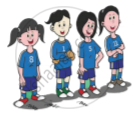 |
______ |
 |
______ |
Did they find a new country?
Appu felt hungry and ate a______.
What party is that?
Circle and write the adverbs.
He laughed merrily ______.
Fill in the blank
He has bat ______ ball.
Meena’s father was a fisher man.
List the things that humans should save.
Try your own.
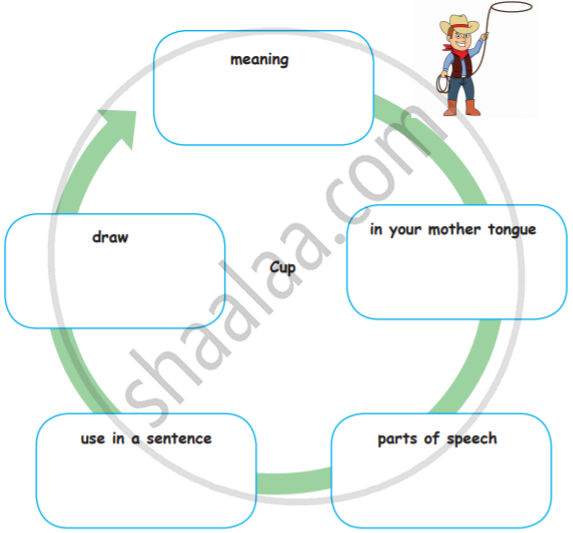
Write a paragraph on the topic ‘Park’.
Fill in the blank
Why did the king want a leader who knows to grow a plant?
______will often say to be honest.
Mugund loved wild animals.
What incident made Mugund make a wooden drum?
What happen to a child who shuts his ears?
Why does the poet feel that the nose is a funny thing?
Does the child in the poem like her nose? Why do you think so?
What did the boy wonder about?
Write the related words as shown in the example:
How does Tagore acknowledge Gandhi’s noble work?
Read the passage given below and make notes.
To match the best cities across the world, the Government of India initiated ‘smart cities’ to drive economic growth and improve the quality of life of people. The agenda under smart city promises to resolve urban sustainability problems. Urban forests provide a range of important ecosystem services that are critical for the sustainability of cities. Urban forestry, which is defined more as ‘Management of Trees’ contributes to the physiological, sociological and economic well-being of the society. Mangroves, lakes, grasslands, and forests in and around our cities, act as sponges that absorb the air and noise pollution and they present themselves as our cultural and recreational hotspots. However, these spots are rapidly being reclaimed and replaced in the name of development. Presence of urban green has shown to increase the economic value of the place.
Urban forests contribute to reduce the cost of building storm water drain systems for municipalities and neutralizing urban heat island effect. Plants not only provide shade but also help in regulating the micro-climate. They help regulate energy budgets, improve air quality, and curtail noise pollution. Trees, herbs, shrubs, and grasses arrest sedimentation and prevent other pollutants from entering our water systems. This will give a chance for our urban lakes and rivers to recover and help improve aquatic ecosystems. Biodiversity also gets a boost through the urban forestsand helps create corridors connecting the forest areas. High biodiversity areas can also help to build resilient ecosystems. Availability of forests within our urban areas gives an opportunity for children to connect to the natural environment and learn about native species.
What are the details not to be revealed in public domain?
Pick out word which mean the same as
keep a check on (para 3)
Being a bachelor, the stranger had no patience with children.
Arrange a ‘Jokes’ session in the classroom where each student tells a joke. The jokes must be told in English.
