Advertisements
Advertisements
Question
Does the poem talk of an exclusively personal experience or is it fairly universal?
Advertisements
Solution
Though the poem seems to talk exclusively of the personal experiences of a father, it is fairly universal in the problems that it addresses from the father’s perspective.
At the surface, the poem communicates the pain and helplessness of a father who wishes to mend the differences with his son in order to be with him. However, the theme of the poem is universal. Generation gap and lack of communication between parents and children are quite common these days. It speaks of the pain that parents go through due to being distanced from their children, both physically and emotionally.
APPEARS IN
RELATED QUESTIONS
Why do you think Professor Gaitonde decided never to preside over meetings again?
Discuss the following in pairs or in small groups.
Although Paul’s mother liked to be rich she did not approve of betting on horses.
Examine the communication channels in the story between Paul and his uncle.
Comment on the symbols used in ‘A Munda Song’. What aspect of the tribal worldview do they reflect?
Study each of the following sentences and notice the balance between its parts. Pick out other sentences in the text that reflect this kind of balance
a. It is right that a false Latin quantity should excite a smile in the House of Commons; but it is wrong that a false English meaning should not excite a frown there.
b. Let the accent of words be watched, by all means, but let the meaning be watched more closely still, and fewer will do the work.
Study the Note to Aspects of the Novel given at the end. Discuss the features that mark the piece as a talk as distinguished from a critical essay.
Read the extract 'Being Neighborly' and complete the following statement:
To Jo, the fine house seemed like ______.
Make a list of the preparations made for an assault on Tiger Hill.
Individual guns ___________.
Using a dictionary/internet note down the main difference between farm and granary.
Sue and Johnsy were very close friends.
‘The city now, doth, like garment wear’. The poet imagines that the city is wearing a beautiful garment. Hence, the figure of speech is personification. Find out more examples of personification from the poem.
Doctors who do special advanced study of specific parts of the body have special terms.
In your group try to match the specialist doctors with who / what they treat.
| Specialists | Who/What they treat | ||
| 1. | Dentist | a. | bone |
| 2. | Cardiologist | b. | brain/with spine |
| 3. | Ophthalmologist | c. | small kids |
| 4. | Orthopedic | d. | teeth |
| 5. | Pediatrician | e. | animals/birds |
| 6. | Neurologist | f. | eye |
| 7. | Veterinarian | g. | heart |
Fill in the gaps in the table of Degrees of Comparison.
| Positive | Comparative | Superlative | |
| (1) | ____________ | ____________ | oldest |
| (2) | ____________ | healthier | ____________ |
| (3) | near | ____________ | ____________ |
| (4) | ____________ | finer | ____________ |
| (5) | ____________ | ____________ | earliest |
| (6) | small | ____________ | ____________ |
| (7) | ____________ | faster | ____________ |
| (8) | high | ____________ | ____________ |
Fill in the gap, choosing a word from the bracket to make an appropriate comparison.
(tall / quiet / humble / merry / busy / slippery / fast / sly / slow / big)
as ______ as a lark
Answer the following question in short.
What did the bundle in silken cloth contain?
Apart from the children, no other human beings are mentioned in the poem. However, many natural elements are shown to act like persons. Name them and also write what they do.
Read the poem aloud. Recite any stanza of your choice from memory.
Give reasons :
Oberon and Titania fight for the custody of the Indian boy because - Titania wants ______________________.
Visit a library:
Read more stories from Japan, China, and Korea.
Answer the following question in one sentence.
Why does he ‘miss all the fun’?
Read the passage and answer the following:
When was the book written?
Recite the poem with proper rhythm and intonation.
Complete the following sentence with reference to the passage.
Nobody knows for certain who ___________________.
Write the rhyme scheme of the poem (Autumn).
Write the characteristics of a good listener.
Listen carefully and guess how the sentence would end.
When the teacher read the answer papers, she was ______.
Read the word. Write the words that combine to make it.
stepmother
Read the word. Write the words that combine to make it.
snowwhite
Write other meaningful words that begin/end with snowwhite.
Form groups of 5-8 and list the following.
Bad habits
- Form groups of 5–8. Then make pairs of groups. Decide which group will be hosts and which will be guests. Arrange mock parties in the classroom so that the roles of hosts and guests can actually be played out.
- Later on, hold groupwise discussions on how your party went. Make lists of the tips you followed and those you forgot to follow.
Guess the meaning of the following word.
pleasing
Read the story again and write how these character reacted in these situation:
You’re both quite mistaken.
Dr. Krishnan ........…………………….
Mrs. Krishnan……....…………………
Neerja leapt into action when she______.
Identify the speaker/character.
He'll have to be given artificial respiration and kept warm.
A turtle’s flippers help it to ______.
Gulliver was set free because the emperor______.
They went out through the broken windows.
What does it give to the farmer?
_________ is the memorial for the soldiers.
Find the rhyming word from the poem.
Country - ______.
Vicky was an active boy.
What does a DIY kid refer to?
Some words sound the same but their spelling and meaning are different. Such words are called homophones. There are many homophones.
Name the character or speaker.
“Learn well, live well!”
They fed fish with______.
Uthaman was skilled in _____.
Match the following.
| pale |  |
| tremble |  |
| fainted |  |
______was with Robinson.
Why did Tenzin cry every day?
Rani and Divya informed the happening to the ______.
Why did Manju’s parents leave the village?
What incident made Mugund make a wooden drum?
Do we worry when the progress is slow?
Replace the bold word/words with a word from the quiver and re-write the sentence –
In no time she hit the object she aimed at.
Are these sentence TRUE or FALSE
The poet tells the child to be afraid when it is dark.
What did the boy wonder about?
Read the following passage and do the activities.
A1. State whether the following sentences are True or false. [2]
- The king’s temperament also changed.
- The king was happy with prediction of the astrologer.
- The courtiers sought an audience with Tenali Raman.
- Courtiers advised the king to regulate his diet.
A2. Complete the web. [2]
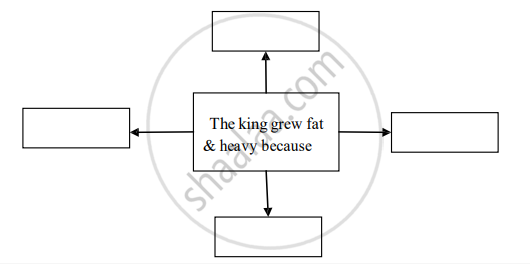
|
King Krishnadeva Raya would perform heavy exercises every morning. He regularly applied oil on his body and thereafter worked out till all the oil came out with the sweat. This was followed by a long ride on his horse. Once the king started leading a sedentary lifestyle, and he stopped exercising. He no longer went horse-riding either. The king overate and as a result grew fat and heavy. The king‟s temperament also underwent a sea change. Noticing this, the royal physicians cautioned the king against the ill effects of overeating and explained to him the risks posed by obesity. They advised the king to regulate his diet, exercise, and take care of his health. The repeated advice he got from the physicians to eat less made him so angry that one day he announced a reward for anyone who could find him an easy cure. But there was one condition: those who failed would have their heads off. None dared to advise the king in this regard. The situation became precarious and as usual Tenali Raman was approached by the courtiers for a remedy. Tenali heard the problem and assured the courtiers of a viable solution. The next day, an astrologer predicted that the king had only a month left to live. When the king came to know of this, he was furious. The astrologer was ordered by the king to be imprisoned for a month so that his prediction could be put to test and so the hapless forecaster was sent to prison. |
A3. Find out describing words from the passage for the words given below. [2]
- exercise - ...........
- lifestyle - ...........
- ride - ...........
- physician - ...........
A4. Do as directed. [2]
- King Krishnadeva Raya would perform heavy exercises every morning.
(Use ‘used to’) - They advised the king to regulate his diet. (Pick out the infinitive)
A5. What are the benefits of daily exercise? [2]
Now, read the following passage on “Laughter Therapy” and answer the questions that follow.

- Laughing is an excellent way to reduce stress in our lives; it can help you to cope with and survive a stressful life. Laughter provides full-scale support for your muscles and unleashes a rush of stress-busting endorphins. Since our bodies cannot distinguish between real and fake laughter, anything that makes you giggle will have a positive impact.
- Laughter Therapy aims to get people laughing, in groups and individual sessions and can help reduce stress, make people and employees happier and more committed, as well as improve their interpersonal skills. This laughter comes from the body and not the mind.
- Laughter Yoga (Hasya yoga) is a practice involving prolonged voluntary laughter. It aims to get people laughing in groups. It is practiced in the early mornings in open-parks. It has been made popular as an exercise routine developed by Indian physician Madan Kataria, who writes about the practice in his 2002 book ‘Laugh for no reason'. Laughter Yoga is based on the belief that voluntary laughter provides the same physiological as well as psychological benefits as spontaneous laughter.
- Laughter yoga session may start with gentle warm-up techniques which include stretching, chanting, clapping, eye contact and body movements to help break down inhibitions and encourage a sense of playfulness. Moreover, laughter is the best medicine. Breathing exercises are used to prepare the lungs for laughter followed by a series of laughter exercises that combine a method of acting and visualization techniques. Twenty minutes of laughter is sufficient to augment physiological development.
- A handful of small-scale scientific studies have indicated that laughter yoga has some medically beneficial effects, including cardiovascular health and mood. This therapy has proved to be good for depressed patients. This laughter therapy also plays a crucial role in social bonding.
Answer the following.
a. How does laughter help one to cope with stress?
b. Which word in the text (para 2) means the same as ‘dedicated'?
c. Why do you think voluntary laughter provides the same physiological as well as psychological benefits as spontaneous laughter?
d. ‘Laughter is the best medicine’. Explain.
e. Given below is a set of activities. Which of these are followed in the ‘Laughter Yoga’ technique?
- sitting on the ground with legs crossed
- body movements
- clapping
- closed eyes
- breathing exercises
- chanting
- stretching of arms and legs
- bending backwards
- running/jogging
- eye contact
f. ‘Laughter therapy also plays a crucial role in social bonding’. How?
