Advertisements
Advertisements
Question
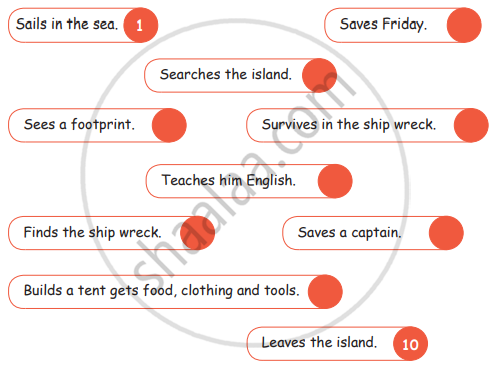
Arrange the actions of Robinson by numbering from 1 to 10.
Advertisements
Solution
| 1. Sails in the sea. |
| 2. Searches the island. |
| 3. Finds the ship wreck. |
| 4. Builds a tent gets food, clothing and tools. |
| 5. Survives in the ship wreck. |
| 6. Sees a footprint. |
| 7. Saves Friday. |
| 8. Teaches him English. |
| 9. Saves a captain. |
| 10. Saves a captain. |
APPEARS IN
RELATED QUESTIONS
Mention three reasons why the author’s grandmother was disturbed when he started going to the city school.
Adi Song for the Recovery of Lost Health' is in Miri Agom while Adi Agom is the Adi community's language for routine conversation. How does this reflect upon the high level of language sensitivity of the Adi? Can you think of other parallels in modern languages between the literary variety and the colloquial variety?
Read the extract 'Being Neighborly' and complete the following statement:
In order to tidy the room, Jo __________________.
Write down in your own words the way Laurie confirmed the names of the March sisters.
Make a list of functions/events/programs/activities organized in your junior college. Choose three events and plan a program schedule of your own. Prepare a script as well to show the associating role of the compere for a particular event. Make your own sequence and design a template for the same.
_______ broke out in the near by villages.
A country should have inner boundaries. Justify.
Identify the character/speaker.
"Grow the fish at home, Anbu."
Three waves hit the village.
Read the following passage and do the activities:
A1. Fill in the blanks: (2)
- ______ percent of our daily communication is non-verbal.
- Eye contact is another type of ______ communication.
- Frequent blinking is a sign of the person feeling ______.
- One can readily detect _______.
|
According to some experts, a staggering 93 percent of our daily communication is non-verbal. Facial expressions are easy to decipher. One can readily detect happiness, sadness, anger. Physicians can tell a patient is doing well (or not) by looking at his/her face. Eye contact is another type of non-verbal communication, which can tell a lot about the other person. The eyes convey a range of emotions-happiness, sadness, boredom, surprise, confidence .......... even emotional interest. Staring at someone's forehead may intimidate the recipient, staring at the mouth is sometimes interpretated as a sign of emotional interest. In fact, staring into someone's eyes is a sign of lying, and so is looking away. In certain cultures, lack of eye contact is taken as a sign of respect. If body language is to be defined, it is a combination of facial expression, gestures, eye contact, body movements and posture and voice. Frequent blinking is a sign of the person feeling distressed or uncomfortable. If the pupils are dilated, it ofter indicates interest, even emotional interest. The lips also reflect our body language, and lip biting indicates worry and/or anxiety; tightening of the lips may be an indication of disapproval. Slightly turned-up lips indicate happiness and slightly turned-down lips indicate sadness. |
A2.

A3. Find the antonyms of: (2)
- verbal × ______
- entertaining × ______
- sender × ______
- comfortable × ______
A4. Do as Directed: (2)
- The eyes convey a range of emotions. (Frame a 'Wh' question in order to get the underlined part as answer).
- Physicians can tell about a patient's wellness. (Rewrite using 'able to')
A5. Personal Response: (2)
Non-verbal communication plays an important role in our daily life. Comment.
