Advertisements
Advertisements
Question
Identify the lines that reveal the critical tone of the poet towards the felling of the tree.
Advertisements
Solution
There are many expressions in the poem that reveal the critical tone of the poet towards the felling of the tree:
“Its scraggy aerial roots fell to the ground”
“Sawing them off for seven days and the heap was huge”
“Insects and birds began to leave the tree”
“Fifty men with axes chopped and chopped”
“We watched in terror and fascination this slaughter”
APPEARS IN
RELATED QUESTIONS
Read the extract given below and answer the questions that follow:
Wear skins peeped through by bones and spectacles of steel
With mended glass, life bottle bits on stones.
(b) Explain: 'slag heap'.
(c) What future awaits these children?
(d) Name the figure of speech used in the third line.
Read the passage given below and answer the questions that follow:
The term dietary fibres refers collectively to indigestible carbohydrates present in plant foods. The importance of these dietary fibres came into the picture when it was observed that the people having diet rich in these fibres, had low incidence of coronary heart disease, irritable bowel syndrome, dental caries and gall stones.
The foodstuffs rich in these dietary fibres are cereals and grains, legumes, fruits with seeds, citrus fruits, carrots, cabbage, green leafy vegetables, apples, melons, peaches, pears etc.
These dietary fibres are not digested by the enzymes of the stomach and the small intestine whereas most of other carbohydrates like starch and sugar are digested and absorbed. The dietary fibres have the property of holding water and because of it, these get swollen and behave like a sponge as these pass through the gastrointestinal tract. The fibres add bulk to the diet and increase transit time in the gut. Some of these fibres may undergo fermentation in the colon.
In recent years, it has been considered essential to have some amount of fibres in the diet. Their beneficial effects lie in preventing coronary heart disease, and decreasing cholesterol level. The fibres like gums and pectin are reported to decrease postprandial (after meals) glucose level in blood. These types of dietary fibres are recommended for the management of certain types of diabetes. Recent studies have shown that the fenugreek (Methi) seeds, which contain 40 per cent gum, are effective in decreasing blood glucose and cholesterol levels as compared to other gum containing vegetables.
Some dietary fibres increase transit time and decrease the time of release of ingested food in colon. The diet having less fibres is associated with colon cancer and the dietary fibres may play a role in decreasing the risk of it.
The dietary fibres hold water so that stools are soft, bulky and readily eliminated. Therefore high fibre intake prevents or relieves constipation.
The fibres increase motility of the small intestine and the colon and by decreasing the transit time there is less time for exposure of the mucosa to harmful toxic substances. Therefore, there is a less desire to eat and the energy intake can be maintained within the range of requirement. This phenomenon helps in keeping a check on obesity. Another reason in helping to decrease obesity is that the high-fibre diets have somewhat lower coefficients of digestibility.
The dietary fibres may have some adverse effects on nutrition by binding some trace metals like calcium, magnesium, phosphorus, zinc and others and therefore preventing their proper absorption. This may pose a possibility of nutritional deficiency especially when diets contain marginal levels of mineral elements. This may become important constraints on increasing dietary fibres. It is suggested that an intake of 40 grams dietary fibres per day is desirable.
(Extracted from ‘The Tribune’)
(a) On the basis of your reading of the above passage make notes on it in points only, using recognizable abbreviations wherever necessary. Also suggest a suitable title.
(b) Write a summary of the above in about 80 words.
We 'draw up a deed'. Complete the following phrase with an appropriate word.
________a loan
Why is the quality of pity earth-bound while the other two passions are elevating?
What does the line 'I never writ, nor no man ever loved' imply?
The quill is the central element of the poem – what does it symbolise?
Select any one of the famous personalities mentioned in ‘Warming up 1’ on page no. 5. From the library or internet find out their success story. Write it in your own words in about 20 to 30 lines of your notebook.
Give your write-up a suitable title.
Think and answer in your own words.
What is the difference between a hawker and a shopkeeper?
Say where . . . . . . .
______ does Beauty’s smile begin?
The description of the character is given below. Identify the character from the play. Find some sentences which support your choice.
He is the centre of the play.
Draw a diagram to show how life returned to the island. Label the diagram.
(Use the technique of drawing diagrams when you study science, geography, etc.)
Are there any stories/legends about the moon or special names for the moon in your language? Talk to your friends and family members and collect this information.
Answer the following question in one sentence.
What does the title of the poem say?
Write about the various wheel-like objects you see at home, in school, and on the road.
Write a recipe for the stone soup.
What themes would you like to add to the themes given in this passage?
Write a short note on the following:
The ‘four signs’ that Prince Siddharth beheld.
Read the passage and answer the following:
Where does the story take place?
Read the passage and name the following.
He was killed by a poisoned arrow that entered his heel.
Find three lines, that contain images of nature in the autumn season.
During daytime
- _______________________
- _______________________
- _______________________
Answer the following question and write in short, why the parody sounds funny.
Why does the bee work hour after hour?
From the passage, find all the words and phrases used to describe the ‘monster’.
Which other things in nature can say –
'For men may come and men may go,
But I go on for ever.'
Write in your own words.
In which professions is a person forced to stay away from his home/ homeland for a long time? Try to guess why the poet is forced to stay away from his home?
Read the poem and answer the following.
Which are the two different places where strawberries grow?
In what season does the story take place?
Why did Holena and her mother go out in the snow themselves?
Think about what you do and you must learn to do when you speak. Make a list of such 'Do's' and Don'ts' for yourself.
Ask your parents or other grown-ups to show you some used notes. Observe them carefully. Have they been used properly? Write your observations.
What is meant by being ‘offline’?
Find out what 'Braille' is.
Guess the meaning of on the wing.
How was the young seagull’s first attempt to fly?
What made the reporter gaze at the author?
Complete the following table with information from the anecdote about Mr. Scotti’s short trip.
| Name | Nicholas Scotti |
| Occupation | |
| Reason for his trip | |
| Means of transport | |
| Destination |
With their treasure, the boys would buy ______ in Eidgah.
Write the name of the toys against each picture.

What did Usha buy in the market? List them.
What is inclusion? Why is it important?
| soft | vain | fear | joy | love | heard | toiled | mild | good | sand | life | harsh |
The ______, the______, which it may bring.
Read the following article about the amazing similarities between the assassination of John F. Kennedy and Abraham Lincoln; then underline the passive forms.
Abraham Lincoln was elected to Congress in 1846. Voters elected John F. Kennedy to Congress in 1946.
Lincoln was elected president in 1860. Voters elected Kennedy president in 1960.
Both men were particularly concerned with civil rights.
Both wives lost their children while living in the White House.
Lincoln was shot on a Friday. Someone shot Kennedy on a Friday.
Lincoln was shot in the head. The gunman shot Kennedy in the head.
Lincoln’s secretary was called Kennedy. Kennedy’s secretary was called Lincoln.
Lincoln was assassinated by a Southerner. A Southerner assassinated Kennedy.
Lincoln was succeeded by a Southerner named Johnson. A Southerner named Johnson succeeded Kennedy.
Andrew Johnson, who succeeded Lincoln, was born in 1808.
Lyndon Johnson, who succeeded Kennedy, was born in 1908.
John Wilkes Booth, who assassinated Lincoln, was born in 1839. Lee Harvey Oswald, who assassinated Kennedy, was born in 1939.
Both assassins were known by their three names and both names are composed of fifteen letters.
Lincoln was shot at a theatre named “Ford”. The gunman shot Kennedy in a car called a “Lincoln” that the company Ford made.
Booth ran from the theatre and was caught in a warehouse. Oswald ran from a warehouse and the police caught him in a theatre.
Booth was assassinated before his trial. Someone assassinated Oswald before his trial.
Complete the mind map given below

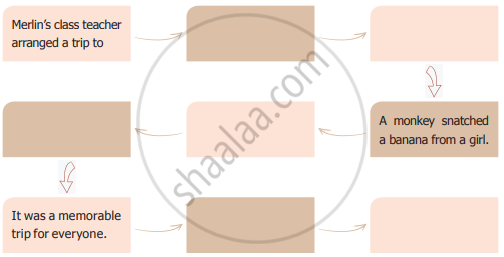
Recall Merlin’s memories and complete the story map.
_______ broke out in the near by villages.
Arrange the pictures by using numbers.

What day is it?
Why do we discover a mystery?
Identify the character or the speaker.
“Oh no! What shall I do now?”
Recite the poem ‘Mother Nature’.
Who was Akilan’s inspiration?
______was with Robinson.
Rani and Divya informed the happening to the ______.
Why did Manju’s parents leave the village?
Ani valued honesty.
What will help you say the truth?
Write the word with same meaning.

Flat
What did the boy make with the trunk of the tree?
Pick out word which mean the same as
keep a check on (para 3)
Read the passage below:
| 1. | Our history makes it evident that the Indian Plastics Industry made a vigorous beginning in 1957 but it took more than 30 years for it to pervade Indian lifestyles. In 1979, "the market for plastics' was just being seeded by the state-owned Indian Petro-Chemicals and it was only in 1994 that plastic soft drink bottles became a visible source of annoyance. |
| 2. | In the same year, people in other cities were concerned about the state of public sanitation and also urged regulatory bodies to ban the production, distribution and use of plastic bags. However, the challenge was greater than it appeared at first. |
| 3. |
The massive generation of plastic waste in India is due to rapid urbanisation, spread of retail chains, plastic packaging from grocery to food and vegetable products, to consumer items and cosmetics. The projected high growth rates of GDP and continuing rapid urbanisation suggest that India's trajectory of plastic consumption and plastic waste is likely to increase.
|
| 4. | According to the United Nations Environment Programme (UNEP) report of 2018, India stands among few other countries like France, Mongolia and several African countries that have initiated total or partial nationallevel bans on plastics in their jurisdictions. On World Environment Day in 2018, India vowed to phase out single-use plastics by 2022, which gave a much needed impetus to bring this change |
| 5. | In this context, thereafter ten states (Andhra Pradesh, Chhattisgarh, Gujarat, Himachal Pradesh, Karnataka, Madhya Pradesh, Meghalaya, Odisha, Rajasthan and Tamil Nadu) are currently sending their collected waste to cement plants for co-processing, twelve other states/UTs are using plastic waste for polymer bitumen road construction and still four other states are using the plastic waste for waste-to-energy plants and oil production. A world of greater possibilities has now opened up to initiate appropriate and concrete actions to build up the necessary institutions and systems before oceans turn, irreversibly into a thin soup of plastic. |
| 6. | However there is no one single masterstroke to counter the challenges witnessed by the staggering plastic waste management in the country. The time is now to formulate robust and inclusive National Action Plans and while doing so, the country will establish greater transparency to combat the plastic jeopardy in a more sustainable and holistic way. |

Based on your understanding of the passage answer any six out of the seven questions given below:
- What does the writer mean by 'visible source of annoyance'?
- Why did people demand a ban on plastics?
- What created a demand for plastics in India?
- With reference to the graph write one conclusion that can be drawn about the production of plastics in 2019 (approximately).
- What does the upward trend of the graph indicate?
- What does the line, oceans turning 'irreversibly into a thin soup of plastic', suggest?
- What step must be taken to combat the challenges of plastic waste management? What will be its impact?
