Advertisements
Advertisements
प्रश्न
Identify the lines that reveal the critical tone of the poet towards the felling of the tree.
Advertisements
उत्तर
There are many expressions in the poem that reveal the critical tone of the poet towards the felling of the tree:
“Its scraggy aerial roots fell to the ground”
“Sawing them off for seven days and the heap was huge”
“Insects and birds began to leave the tree”
“Fifty men with axes chopped and chopped”
“We watched in terror and fascination this slaughter”
APPEARS IN
संबंधित प्रश्न
Attempt the following in 150-200 words.
Bring out the importance of the diary in Anne's life.
Attempt the following in 150-200 words.
What was the incident of the Frost King? How did it affect Helen?
Read the following extract and then do all the activities that follow :
I rain into a stranger as he passed by
“Oh, excuse me please” was my reply.
He said, “please excuse me too; wasn't even watching for you.”
We were very polite, this stranger and I.
We went on out way and we said good-bye.
But at home a different story is told.
How we treat out loved ones, young and old.
Later that day, cooking the evening meal,
My daughter stood beside me very still.
When I turned, I nearly knoked her down.
“Move out of the way,” I said with a frown.
She walked away, her little heart broken.
I didn't realize how harshly I'd spoken.
While I lay awake in bed,
God's still small voice came to me and said,
“While Dealing with a stranger, common courtesy you use,
But children you love, you seem to abuse.”
A1. Order-
The incidents narrated in the extract are arranged in a jumbled manner here, Rearrange them in a proper order as they occur in the extract:
(i) The poet and the stranger went on their way saying good-bye.
(ii) Seeking excuse politely from the stranger, she went her way.
(iii) The poet ran into a stranger on the road.
(iv) The poet yelled at her daughter.
A2. Poetic device:
Make a list of rhyming pairs from the second stanza and note down the rhyme scheme of the same stanza.
A3. Personal Response:
Understanding and politeness are the essentials of out everyday life. Explain your views in brief.
A4. Creativity -
Frame two poetic lines on the following situation using a rhyming pattern with the help of clues given:
“While introducing great personalities, we praise them highly and talk about their qualities, but while speaking
about our friends we may not follow the same trend.”
While introducing great personalities, — a
------------------------------------ — a
But while speaking about our friends, — b
------------------------------------ — b
Why is the quality of pity earth-bound while the other two passions are elevating?
There are intervals of silence in the interaction between the landlady and the prospective tenant. What are the reasons for this?
Pick out words from the poem to fill in the web diagram. They should be related to the theme in the web.
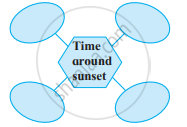
Discuss in groups, reasons/ consequences/ effects:
The cherry blossomed.
Discuss with your partner and complete the web, highlighting the sad and gloomy aspects of life mentioned in the first part of the poem.

Write 3 to 4 lines about the following in your own words.
First Cardiac Surgery
Select a season of your choice and give the following details:
- Time of the year -
- Characteristics- crops, festivals, etc.
- Features/changes - climate/weather/temperature etc.
- Advantages/Disadvantages -
Fill in the gap, choosing a word from the bracket to make an appropriate comparison.
as ______ as a worm
Imagine that you wish to organize a cultural event at your college. Prepare your own web-chart to indicate the qualities that you expect to have in a compere.
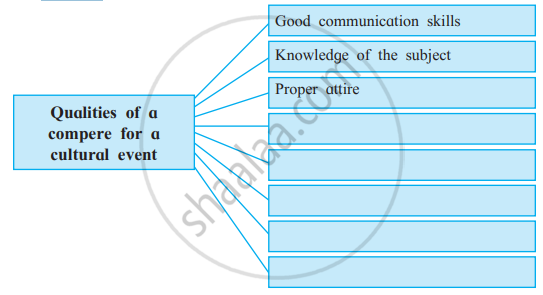
Give reasons :
Oberon and Titania fight for the custody of the Indian boy because - Titania wants ______________________.
Read the story and write about the following in short.
Bushi Kiyo
Choose any one of the seven States. Find more information about it and prepare a leaflet or brochure to invite people to visit it.
Write one line about the following with the help of the poem.
wind in the autumn evening
Explain the idea of ‘Conservation of Nature through Livelihood’ briefly, using the example given here.
Correct the following sentence using facts from the passage.
The great heroes avoided one another.
Identify one example of a main clause and one example of a dependent clause from the content below:
Troy was filled with the sight of leaping flames and the sound of shouting and the noise of weapons and the cries of weeping women. The sleeping Trojans sprang out of their beds, but they were taken by surprise. Their enemies were right inside their walls, and many of the Trojans were killed before they could put on their armour and seize their weapons.
A bright light lit up the night sky as palaces and houses, temples and towers, went up in flames. The Trojans fought as well as they could, but it was all in vain. Old King Priam was killed with all his brave sons. Hector’s wife and his old mother and sister were carried off as slaves by the conquerors. Their fate was in contrast to Helen’s when King Menelaus rushed through the city, looking for her, and found her in her palace. She hung her head in shame and sorrow as she faced her former husband. Her voice was choked with emotion and she could not speak. But Menelaus forgave her and she went back with him, for it was only Aphrodite who had turned her heart away from her home and her husband and her child.
When morning came, nothing was left of the proud, rich city that had resisted attack for ten years.
Sayali did not understand the mistake she had made.
Gather more information about the following from your Science textbook, the internet, and other sources.
Gravitational force
Complete the following diagram.
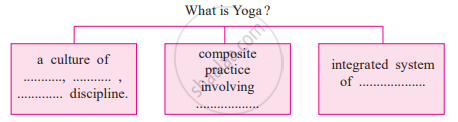
Read the poem again. Does it have a uniform rhyme scheme throughout?
Write down the rhyme scheme of every stanza separately.
- 1st stanza ______
- 2nd stanza ______
- 3rd stanza ______
- 4th stanza ______.
Find from the Internet and write down.
Which character from the play sings this song?
Read the word. Write the words that combine to make it.
anywhere
Discuss how you will measure the worth of a sports event.
What is a password?
Who were the narrator neighbours?
What do you understand by the mother’s act of throwing the shoe?
Identify the speaker/character.
‘ It’s Somu’s thoughtless ways that reduce me to tears’
Why was it a struggle for the children to dry their clothes?
Take a stanza from the poem. Write it in the blanks and find the rhyme scheme.
| Lines from the poem | Rhyme scheme (a/b/c/d) |
Read the lines and answer the questions.
Deep inside the mountain
the adventures hide themselves.
Where do adventures hide?
Tackling the Issues
Ask the class to discuss solutions to an issue that plagues contemporary society at large or just your community—for example, homelessness, violence, environmental degradation, hunger.
Half the class should mention idealistic solutions to the chosen issue; the other half should mention only realistic approaches to solving the problem.
See if, in listening to both sides, someone can come up with a proposal that is both realistic and unconventional—an idea that hasn't been tried yet.
Vasantha made a lot of noise because ______
Identify the speaker/character.
A man fell into the sea. Please save him.
What made the trip a memorable one?
What is the difference between this toy train and a normal train?
Complete the sentence given below with word/phrase.
The rains came and poured______.
Work in pair, find answer for the question and share in the class.
What does the summer bring?
_____ is called the red planet.
What is a sol? How many sols make a year?
Try your own.
Flag day is observed on the _________.
Jaswant was captured alive.
Did Tabaqui receive a warm welcome from the pack of wolves? How do you know?
What will you do if someone ensnares birds?
______hem the border.
What did the five friends call themselves?
Choose the correct answer.

Read the advertisement and answer the question given below.

What is the advertisement about?
Leafcutter ants grow fungus.
Read the passage three times on your own. Colour a Piggy bank each time you read.
Piggy bank is a coin box used by children. The real use of a piggy bank is to store coins. Piggy banks look like pigs. They come in many shapes and sizes. In Tamil, they are known as Hundial. It is a red, mud pot. We can drop the coins into the pot. Once the pot is full, we must break the pot and use the coins. Start saving with your hundial today!

Chris enjoyed doing all sorts of things except, writing and ______.art
What did he claim to know?
Read the following passage and do the activities.
A1. State whether the following sentences are True or false. [2]
- The king’s temperament also changed.
- The king was happy with prediction of the astrologer.
- The courtiers sought an audience with Tenali Raman.
- Courtiers advised the king to regulate his diet.
A2. Complete the web. [2]
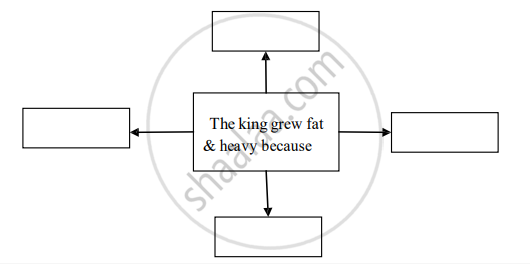
|
King Krishnadeva Raya would perform heavy exercises every morning. He regularly applied oil on his body and thereafter worked out till all the oil came out with the sweat. This was followed by a long ride on his horse. Once the king started leading a sedentary lifestyle, and he stopped exercising. He no longer went horse-riding either. The king overate and as a result grew fat and heavy. The king‟s temperament also underwent a sea change. Noticing this, the royal physicians cautioned the king against the ill effects of overeating and explained to him the risks posed by obesity. They advised the king to regulate his diet, exercise, and take care of his health. The repeated advice he got from the physicians to eat less made him so angry that one day he announced a reward for anyone who could find him an easy cure. But there was one condition: those who failed would have their heads off. None dared to advise the king in this regard. The situation became precarious and as usual Tenali Raman was approached by the courtiers for a remedy. Tenali heard the problem and assured the courtiers of a viable solution. The next day, an astrologer predicted that the king had only a month left to live. When the king came to know of this, he was furious. The astrologer was ordered by the king to be imprisoned for a month so that his prediction could be put to test and so the hapless forecaster was sent to prison. |
A3. Find out describing words from the passage for the words given below. [2]
- exercise - ...........
- lifestyle - ...........
- ride - ...........
- physician - ...........
A4. Do as directed. [2]
- King Krishnadeva Raya would perform heavy exercises every morning.
(Use ‘used to’) - They advised the king to regulate his diet. (Pick out the infinitive)
A5. What are the benefits of daily exercise? [2]
Now read the following article on the emerging career options in the modern era and answer the questions that follow.
The students at the higher secondary level in schools start thinking of suitable courses to take up at the university level based on their aptitude, ability, and interests. While considering the higher education options, they should also plan the career path they wish to take. In today’s complex job scenario, there is a mismatch between demand and supply. On one hand, we have qualified professionals desperately trying to find a job, while on the other hand, there are many professions that need suitable talented employees. But such skilled employees are unavailable. Therefore, the need of the hour is that students have an understanding of the emerging career options. and globalisation has widened the scope of career options in the twenty–first century. Let us consider some popular careers.
Fashion Designing
The current cosmopolitan and fashion–conscious wave that has taken over our country has opened up a huge arena for careers in fashion. These careers encompass designing clothes, costumes, jewellery, footwear, wardrobe, cosmetics, accessories and the like.
Culinary Arts
With food and cookery shows being a major trend across the world, culinary arts, a sub-domain of the hospitality sector, has now become the most sought-after career.
Paramedical sciences
In recent times, there has been a great demand in the health care industry. Paramedical professionals who support medical practitioners in areas such as optometry, pathology, nursing, physiotherapy, and dentistry are much sought after.
Media, Journalism and Advertising
In this information era, print and entertainment media have become a force to reckon with. This arena has become a huge career playground because youngsters are attracted to it as the exposure and reach are greater through such mass media. We notice that radio and TV channels, internet companies, and advertising agencies are increasingly recruiting qualified professionals.
Hotel Management
The hotel industry is the fastest-growing industry in India. The number of international travellers (both for business and leisure) is increasing. The hospitality and service industry offers career options such as house keeping, front-desk executives, tourism management, etc.
Sports Management
With multinational companies supporting sports, careers in sports offer enormous scope. One need not be a player or an athlete to shine in a sports career because the field of sports offers various career options such as technical trainers, commentators, sports journalists, dieticians, referees, etc. Conducting sports events successfully, organizing the event laudably, preparing the ground for the event are all part of sports management.
- When do students start thinking about their career path?
- How can students build a strong career?
- What are the integral aspects of a successful career?
- What is meant by ‘culinary art’?
- Why is media a popular career option?
- Name some paramedical courses mentioned in the passage.
- Why is the hotel industry seen as the fastest growing in India?
- Does one have to be a player to opt for a career in the field of sports? Answer giving reasons.
- Pick one word from the passage which is the opposite of ‘modern’.
- Which word in the passage means ‘composed of people from many parts of the country’?
Read the following passage and do the activities:
A1. Fill in the blanks: (2)
- ______ percent of our daily communication is non-verbal.
- Eye contact is another type of ______ communication.
- Frequent blinking is a sign of the person feeling ______.
- One can readily detect _______.
|
According to some experts, a staggering 93 percent of our daily communication is non-verbal. Facial expressions are easy to decipher. One can readily detect happiness, sadness, anger. Physicians can tell a patient is doing well (or not) by looking at his/her face. Eye contact is another type of non-verbal communication, which can tell a lot about the other person. The eyes convey a range of emotions-happiness, sadness, boredom, surprise, confidence .......... even emotional interest. Staring at someone's forehead may intimidate the recipient, staring at the mouth is sometimes interpretated as a sign of emotional interest. In fact, staring into someone's eyes is a sign of lying, and so is looking away. In certain cultures, lack of eye contact is taken as a sign of respect. If body language is to be defined, it is a combination of facial expression, gestures, eye contact, body movements and posture and voice. Frequent blinking is a sign of the person feeling distressed or uncomfortable. If the pupils are dilated, it ofter indicates interest, even emotional interest. The lips also reflect our body language, and lip biting indicates worry and/or anxiety; tightening of the lips may be an indication of disapproval. Slightly turned-up lips indicate happiness and slightly turned-down lips indicate sadness. |
A2.

A3. Find the antonyms of: (2)
- verbal × ______
- entertaining × ______
- sender × ______
- comfortable × ______
A4. Do as Directed: (2)
- The eyes convey a range of emotions. (Frame a 'Wh' question in order to get the underlined part as answer).
- Physicians can tell about a patient's wellness. (Rewrite using 'able to')
A5. Personal Response: (2)
Non-verbal communication plays an important role in our daily life. Comment.
Look up the following entries in the Language Study pages given at the end.
- stress
- intonation
- sound
- consonant
- vowel
