Advertisements
Advertisements
प्रश्न
What impression of the character of Iona do you get from this story?
Advertisements
उत्तर
Iona was an old cab driver; he lost his young son. Being lonely, he was reduced to a phantom figure. He desperately wished to talk and share his sentiments with someone. He was so shattered that he tried to talk to any or everybody. He lamented his loss, despair and melancholy encompassed him. He was plunged in the thoughts of his son so much that he was totally unaware of his surroundings, even the snow. He drove his sledge rashly and brandished his horse more than necessary. He lost control over his emotions and went one blabbing his loss in front of even the ones who would be least interested to know. He tried talking to his passengers, the policemen, and the three drunkards. He was afraid of his withered age and that his son was gone. He knew it would be difficult for him to earn his livelihood. He even made a remark to the horse that had his young son been alive, they would not have suffered and would have had plenty of food to live on. His state was of a typical old man who loses his young son and feels helpless and only grieves.
APPEARS IN
संबंधित प्रश्न
Tick the statement that is true.
The story hinges on a particular historical event.
Look at the words given in the box below
|
snigger |
wriggle |
sneak |
squeak |
|
squawk |
titter |
pant |
chuckle |
|
giggle |
jeer |
chortle |
guffaw |
|
sigh |
sidle |
boo |
shriek |
|
scramble |
croak |
straggle |
plod |
|
gasp |
|
|
|
Now classify them according to their closeness in meaning to the words given below
|
A |
B |
C |
D |
E |
|
snigger |
wriggle |
squeak |
jeer |
sigh |
Why is the quality of pity earth-bound while the other two passions are elevating?
What is the emphasis placed by Ruskin on accuracy?
Make groups and discuss the following:
What fatal dangers/problems did mankind face centuries ago, but are no longer a threat today?
Make groups and discuss the following:
What inspired them to spend the best part of their lives to research and share their findings?
Divide the story into parts. Make 4 groups in your class. Each group should take one of the 4 parts to convert the story into a play and enact your part.
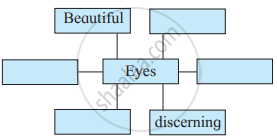
Complete the web with the help of adjectives used to describe eyes and nose in all respects. Two are done for you.

Go through the poem and state whether the following statement is true or false.
Planners paint beautiful pictures of the upcoming changes in the city that charm the citizens.
Match the terms in ‘A’ with their explanation in ‘B’.
| 'A' | 'B' | ||
| (1) | tooth- extraction | (a) | a cut made for surgery |
| (2) | cardiac | (b) | having length, breadth, and depth |
| (3) | sedative | (c) | plastic surgery |
| (4) | tumor | (d) | related to the heart |
| (5) | incision | (e) | a control unit for a robotic surgery |
| (6) | a console | (f) | removing a decayed tooth |
| (7) | 3-D | (g) | a substance that makes a person sleep |
| (8) | Cushing clip | (h) | an extra growth in the body |
| (i) | a device to stop blood loss in neurosurgery |
Fill in the gap, choosing a word from the bracket to make an appropriate comparison.
as ______ as a worm
Suggest what you would do in the following situation:
One particular friend of yours is always late for college, social functions, movies, etc. and delays everyone.
Can you name different types of fabrics? Which is the most expensive fabric you know? Talk to your parents or to a textile shop assistant. Collect samples of as many types as you can and paste them into your scrapbook. Name each type.
Draw a diagram to show a volcanic eruption from its description given in this passage. Label the diagram. Show the following in it :
Volcano; earth’s crust; crack in the earth’s crust; hot molten rock; red, hot lava; smoke; ash; burning chunks of rock.
Find two examples of the word made by using the following suffix.
-ness
Guess the meaning of the following from the context.
Dawn wakes the starling.
Read the passage and answer the following:
Why is the tollbooth called a ‘phantom’ tollbooth?
Form groups of five and discuss:
There are many things that seem small, minor, or insignificant to some people but the same may be the cause of great pain, suffering for others. Can you list such things? What can you do to provide help on those occasions?
Write a review of your favorite book. Use the following points:
- Title of the book
- Author/Authors
- The central idea or story
- The important characters
- Some special features of the book
- Why it is your favourite book.
Prepare similar word chains using the following ideas.
size - big _______________.
Find the meaning of the following word.
adorning
Read the poem aloud using proper intonation.
Rewrite the following line in your own words.
.......... ‘till off they flash
Singing sweetly their delight.’
Read the following.
- Skipper: captain of a ship or boat.
- Dipper: This word has two meanings. Dipper means a container for taking out water. Also, there are two constellations called Little Dipper (Little Bear) and Big Dipper (Big Bear) in the sky.
- Milky Way: The band of light consisting of stars that spreads across the sky at night.
____________ had provided Prospero formerly with books and provisions.
How was Gonzalo helpful to Prospero when he left Milan?
What do you understand by the mother’s act of throwing the shoe?
Use this passage to play the game. You can collect information on other famous personalities and play too.
Charlie Chaplin was born on April 16, 1889, in London England. His birth name was Charles Spencer Chaplin, though he had many nicknames growing up such as Charlie, Charlot, and The Little Tramp. His father, Charles Chaplin, and his mother, Hannah Chaplin, were inducted into the music hall of fame, leading the way to his exposure even as a young boy. His first onstage moment was when he was 5 years old; he sang a song that was intended to be sung by his own mother; she had become ill at the time of the performance, so little Charlie Chaplin stood instead and performed for his mother.

Charlie Chaplin came to the United States in 1910, at the age of 21. He was brought to New York, which was known to be a great place to start out for anyone trying to become a professional actor. Two years later, in 1913, Chaplin signed his very first contract at Keystone and it was no time before he headed to Hollywood. His first movie premiered in 1914, “Making a Living,” and went on to make over 35 movies total in that year alone. Charlie Chaplin grew to become one of the most popular and successful actors of all time. The moment that really kicked off his long career was in 1921 when he starred in, and produced, his first full-length film called “The Kid.” From then on, most people all over the world knew Charlie Chaplin and loved his movies. He had a great career and life, dying on December 25, 1977, in Vevey, Switzerland. He had apparently died of natural causes in his sleep from old age.
An Anagram is a word or a phrase formed by rearranging the letters of a different word or phrase, typically using all the original letters exactly once.

Now try to solve these anagrams
| 1. | ELBOW | |
| 2. | SECTION | |
| 3. | VIEWER | |
| 4. | RIPPLES | |
| 5. | NEEDLESS |
Why did Anne want to exchange the book ‘Camera Obscura’?
Read the data below and answer the following question.
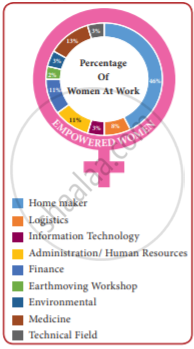
Choose the correct answer.
In which field of work is women’s involvement the second highest?
Write the names of the characters in this story.
1. ______ 2. ______ 3. ______
He exercised with Louise every day.
Give a picturesque view through which the train travels.
Did he hire Kiouni? Why?
The captain presented a gift to Vasantha because ______
Mithali Raj was not encouraged to play cricket by her family members.
Why did the crowd gather by the side of the pond?
Match the planet with its feature.
| 1. | Mars | blue ice giant |
| 2. | Saturn | red storm |
| 3. | Jupiter | red planet |
| 4. | Neptune | ring and moons |
Which planet has rings around it?
What were Anandhan and Yazhini watching in the television?
How does it welcome all?
Choose the odd one out.
Look at the picture and Choose the correct word.

Master trained Akilan on a ______.
Uthaman was skilled in _____.
The old man was carrying _____.
Choose the best answer.
Suddenly there was a______.
______are the real wealth.
Read the advertisement and answer the question given below.

When does the offer end?
Fill in the blank with rhyming word.
tree- ______
Write the word with same meaning.

dustbin- ______.
Write the word with same meaning.

purse- ______
The Delhi government did not allow blind children to study Science after ____________.
Why does the poet feel that the nose is a funny thing?
Are these sentence TRUE or FALSE
The poet says that stars will always shine at night.
What is the best time to water the plants?
When should we not water the plants?
On the basis of your understanding of the given passage, make notes in any appropriate format.
The Sherpas were nomadic people who first migrated from Tibet approximately 600 years ago, through the Nangpa La pass and settled in the Solukhumbu District, Nepal. These nomadic people then gradually moved westward along salt trade routes. During 14th century, Sherpa ancestors migrated from Kham. The group of people from the Kham region, east of Tibet, was called “Shyar Khamba”. The inhabitants of Shyar Khamba, were called Sherpa. Sherpa migrants travelled through Ü and Tsang, before crossing the Himalayas. According to Sherpa oral history, four groups migrated out of Solukhumbu at different times, giving rise to the four fundamental Sherpa clans: Minyagpa, Thimmi, Sertawa and Chawa. These four groups have since split into the more than 20 different clans that exist today
Sherpas had little contact with the world beyond the mountains and they spoke their own language. AngDawa, a 76-year-old former mountaineer recalled “My first expedition was to Makalu [the world’s fifth highest mountain] with Sir Edmund Hillary’’. We were not allowed to go to the top. We wore leather boots that got really heavy when wet, and we only got a little salary, but we danced the Sherpa dance, and we were able to buy firewood and make campfires, and we spent a lot of the time dancing and singing and drinking. Today Sherpas get good pay and good equipment, but they don’t have good entertainment. My one regret is that I never got to the top of Everest. I got to the South Summit, but I never got a chance to go for the top.
The transformation began when the Sherpa Tenzing Norgay and the New Zealander Edmund Hillary scaled Everest in 1953. Edmund Hillary took efforts to build schools and health clinics to raise the living standards of the Sherpas. Thus life in Khumbu improved due to the efforts taken by Edmund Hillary and hence he was known as ‘Sherpa King’.
Sherpas working on the Everest generally tend to perish one by one, casualties of crevasse falls, avalanches, and altitude sickness. Some have simply disappeared on the mountain, never to be seen again. Apart from the bad seasons in 1922, 1970 and 2014 they do not die en masse. Sherpas carry the heaviest loads and pay the highest prices on the world’s tallest mountain. In some ways, Sherpas have benefited from the commercialization of the Everest more than any group, earning income from thousands of climbers and trekkers drawn to the mountain. While interest in climbing Everest grew gradually over the decades after the first ascent, it wasn’t until the 1990s that the economic motives of commercial guiding on Everest began. This leads to eclipse the amateur impetus of traditional mountaineering. Climbers looked after each other for the love of adventure and “the brotherhood of the rope” now are tending to mountain businesses. Sherpas have taken up jobs as guides to look after clients for a salary. Commercial guiding agencies promised any reasonably fit person a shot at Everest.
Should children be discouraged from playing online games?
