Advertisements
Advertisements
प्रश्न
How does the poet bring out the immortality of the bird?
Advertisements
उत्तर
While the poet is grieving on the unpleasant aspects of human life, he cherishes the nightingale's song and feels elated and finds peace in it. He praises the beauty of it. He calls the bird immortal for its humming is not to fade away as humans wither with age and death. He wishes to fly to the nightingale, wants to die and live with the bird. However, Keats soon realises that what he imagines is impossible. Keats is bewitched by nightingale's singing and he sings in praise of this bird whose ageless humming has been heard by the emperors and clowns and even Ruth and by all since times immemorial and will be there to be heard by posterity. Spellbound, he further embellishes and adds the beauty to the bird's song by his personification. Enchanted by the evergreen beauty of the sound of this bird, Keats delays the inevitability of death and lives the immortality of the bird, though not for long.
APPEARS IN
संबंधित प्रश्न
Read the following passage carefully and do the given activities:
A.1) True or False:
Write the statements and state whether they are true or false:
(i) Those who choose to live well must help others.
(ii) If neighbors grow inferior corn, cross-pollination will steadily improve the quality.
(iii) The farmer grew award-winning corn.
(iv) The reporter discovered that the farmer didn’t share his seed corn with his neighbors.
There once was a farmer who grew award-winning corn. Each year he entered his corn in the state fair where it won a blue ribbon. One year a newspaper reporter interviewed him and learned something interesting about how he grew it. The reporter discovered that the farmer shared his sweet corn with his neighbors. “How can you afford to share your best seed corn with your neighbors when they are entering corn in competition with yours each year?” the reporter asked.
“Why sir”, said the farmer, “didn’t you know? The wind picks up pollen from the ripening corn and swirls it from field to field. If my neighbors grow inferior corn, cross-pollination will steadily degrade the quality of my corn. If I am to grow good corn, I must help my neighbors grow good corn.” He is very much aware of the connectedness of life. His corn cannot improve unless his neighbor's corn also improves. So it is with our lives. Those who choose to live in peace must help their neighbors to live in peace. Those who choose to live well must help others to live well, for the value of a life is measured by the lives it touches.
The lesson for each of us is this: if we are to grow good corn, we must help our neighbors grow good corn.
A.2) Consequences:
Write the consequences:
(i) The farmer shares the corn.
(ii) The farmer doesn’t share the corn.
A.3) Antonyms:
Find out the words opposite in meaning from the passage:
(i) superior x _______
(ii) lost x _______
(iii) improve x _______
(iv) inconstantly x _______
A.4) Language study:
(i) We must help our neighbors. (Replace the modal auxiliary showing advice).
(ii) The wind picks up pollen from ripening corn and swirls it field to field. (Use “not only…….. but also” and rewrite)
A.5) Personal Response:
What do you learn from the story? Suggest a suitable title.
Mention three ways in which the author’s grandmother spent her days after he grew up.
The story revolves around characters who belong to a tribe in Armenia. Mourad and Aram are members of the Garoghlanian family. Now locate Armenia and Assyria on the atlas and prepare a write-up on the Garoghlanian tribes. You may write about people, their names, traits, geographical and economic features as suggested in the story.
Examine the communication channels in the story between Basset and Paul's uncle.
How does Shelley's attitude to science differ from that of Wordsworth and Keats?
How do the patterns of creativity displayed by scientists differ from those displayed by poets?
Study the Note to Aspects of the Novel given at the end. Discuss the features that mark the piece as a talk as distinguished from a critical essay.
Read the following statement and mark those that apply to you.
I have a small group of close friends and have no wish to interact with anyone else.
Say why the speaker of the poem wishes to be a -
watchman
Write the Rhyming word and Scheme of the 2nd stanza.
“Old man,” said a fellow pilgrim near,
“Why waste your time in building here?
Your journey ends with the close of the day You never again will pass this way.
You have crossed the chasm deep and wide Why build ye here at even tide?”
State whether the following statement is True or False. Correct the false statement by finding evidence from the poem to support your remark.
The cherry tree did not take long to grow.
Suppose you suffer from a long - term illness (one or two weeks), what should you do and what should you avoid? Fill up the table of Dos and Don’ts.
| Dos | Don’ts |
| (1) Go to a doctor for diagnosis | (1) Do not ____________ |
| (2) ____________ | (2) Do not avoid medication on time. |
| (3) Take a suitable diet | (3) Avoid ____________ |
| (4) ____________ | (4) Avoid physical stress and exertion. |
| (5) Rest in a properly ventilated room. | (5) Do not ____________ |
| (6) Have cheerful thoughts, courage, positive attitude | (6) Do not lose ______ and ______ |
Discuss in your class.
What are the advantages of learning science?
Expand the idea inherent in the following proverb :
One should eat to live, not live to eat - Franklin.
Read the description of the Kabaddi match and do the following:
Write, in your own words, what happened in the second half.
Read aloud the speech in which Thiruvalluvar explains how the fabric was made. Present the process in the form of a chart. Draw pictures for the chart and label them.
Comment on the versatility and the aptness of the stage settings, as per the requirement of the play “A Midsummer-Night’s Dream!”
Answer the following question in one sentence.
Why does he ‘miss all the fun’?
Read the following proverb that has a biblical reference.
‘Do unto others as you would have others do unto you.’ Now find at least 5 other proverbs/ axioms/quotations which convey the same message. Search the internet/dictionary of proverbs.
Turn the story into a play as a group activity and present the scenes in the classroom.
What changes do we see in the life of human beings when the season changes? Write with reference to their clothes.
‘And calls our Best away’ is a gentle way of expressing the unpleasant idea of a loved one dying. It is an example of euphemism. Think and write down 3 or 4 ways in which we can express the idea of ‘death’ in a tactful and gentle manner.
- _________________
- _________________
- _________________
- _________________
‘Unke, Munke, Timpetoo,
I wish, my wish is coming true.’
Try to compose two other funny magical chants that have rhyming lines.
Say whether you agree or disagree.
The wolf could not trace Bertha because she was behind a myrtle bush.
Who said the following, to whom, and when?
“He dwells within a cave of Himalaya.”
Find the meaning of the following word.
adorning
Describe the following with the help of the (The Twelve Months) story.
Springtime
What was the businessman looking for? Why?
List the characters in the play.
Birds and animals
Discuss the following in group.
Do’s and Don’ts for young children.
Guess the meaning of weary.
What is meant by browsing or surfing?
How was the young seagull’s first attempt to fly?
Describe the struggles underwent by the young seagull to overcome its fear of flying.
Read the following line from the poem and answer the question that follow.
Not hurrying to, nor turning from the goal; Not mourning for the things that disappear
- Why do you think the poet is not in a hurry?
- What should one not mourn for?
Read the incident again and answer the following question.
Why were the other passengers in the flight gazing at the writer?
The taxi driver took away the narrator’s suitcase.
What other various pets did Somu have?
What made John Shepherd-Barron to come up with the idea of ATM?
Read the data below and answer the following question.
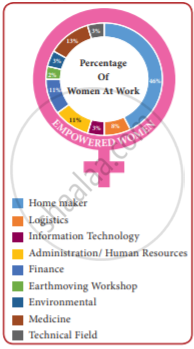
Choose the correct answer.
In which field of work is women’s involvement the second highest?
Read the data below and answer the following question.
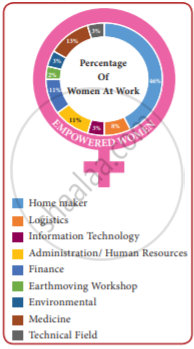
Choose the correct answer.
What is the difference between the percentage of women working in logistics and Medicine?
What did Suresh ask Usha? Why?
What do you think are the two most important lessons that the speaker mentions?
Let no ______ tone be______.
- soft
- vain
- fear
- joy
- love
- heard
- toiled
- mild
- good
- sand
- life
- harsh
Write down the word that alliterate in the poetic line below
That spreads treasures on a tree.
What challenges does Alice face and how does she overcome them?
Fill in the table
| Problems Faced By Mr. Fogg And His Team | Solution |
| The train stopped in the middle of the forest. | |
| They couldn’t hire the elephant. | |
| They were in need of an elephant driver. |
Why did the farmer have to travel far?
Why did Yazhini want to join the military?
The Chinese troops attacked the lonely Indian post located in ______.
______is a Do It Yourself kid.
Recite the poem ‘Mother Nature’.
How were her strokes?
Match the words with the pictures.
| Robinson |  |
| cannibals |  |
| Friday |  |
| footprint |  |
Who is incharge of this case?
Name the animal and sound it makes.
Who wins the world at the end?
Read the passage 3 times and colour the medal each time.
The school was decorated for the Annual Sports Day. The children came to the running track to cheer the runners. The next event was 800 meters running. Megala was in the race. She wanted to win the race, but the other runners were district and divisional winners. The race started. All had to finish two laps. At the end of the first lap, Megala was in the fifth place. Suddenly, she fell on the ground. Everyone ran to help her. But before that she got up and started to run. All children and teachers cheered her. She had come last, but the headmaster gave her a special prize.

Make groups of 10-15. In this game, each person writes three sentences about himself/herself, two of which are true and the third one is a lie. Read aloud your sentences, while others guess which two are true and which is a lie.
Examples: Hello, everyone! I am Sonali. I have a brother and a sister. I live in Amalner. We have a pet dog at home.
In the game ‘Two Truths, One Lie!’, it is necessary to use details which can be verified to see whether they are true or false. For example, you cannot use sentences like ‘I once had a blue sweater.’
