Advertisements
Advertisements
प्रश्न
How do the patterns of creativity displayed by scientists differ from those displayed by poets?
Advertisements
उत्तर
Poets are the bards celebrating the nature surrounding them. While, scientists are the ones to harvest nature and its mechanism and mark inventions. Poets such as Wordsworth and Keats criticise humans of exploiting nature. Whereas, scientists on the other hand utilize the given resources of nature to create and invent. However, it is not that there is an enmity between poets and scientists. Shelley said, undoubtedly the promoters of utility, in this limited sense, have their appointed office in society They make space and give time.Here we have Darwin, who enjoyed literature immensely, however, until he was thirty. He said later,' My mind seems to have become a kind of machine for grinding general laws out of large collections of facts but why this should have caused the atrophy of that part of the brain alone on which the higher tastes depend.Thus, it can be understood, while the poets celebrate the present and arrest it making it all immortal, the scientists create and invent leading us to a tomorrow, thus, marking a difference.
APPEARS IN
संबंधित प्रश्न
A1. True or False
State whether the following statements are true or false:
(i) A new research suggests that eating healthy food and getting proper sleep helps children to succeed in school.
(ii) Kids in the age group of 6-12 years should get an average sleep of little less than 7 hours.
(iii) Kids should start their day with yogurt, fruits and veggies.
(iv) Children should have consistent sleeping habit.
A new research suggests that eating healthy food and getting proper sleep can help children succeed in school. According to research, when kids go to school without eating breakfast, their cognitive function can be affected.
According to study, kids should start the day with fruits, proteins and whole grains and they should avoid sugary cereals because they cause a sugar high. If the kids do need to eat something prior to dinner, parents should offer healthy choices like yogurt, fruits and veggies or baked chips. Children have also been advised to drink water instead of soda as-it lacks nutritional value. Moreover, research suggests that children need a good night's sleep for theiroverall school performance. It is said that. lack of sleep can lead to problems with attention and memory in the classroom, affect impulse control and mood regulation lead to.
anxiety and even depression.
While kids aged 6-12 years should get nine hours sleep nightly, adolescents from the age of 13 to 18 years should get an average sleep of little more than seven hours per night. However, the research suggests that catching up on lost sleep on the weekend can make matters worse and recommended a consistent bedtime seven days a week.
A2. Find
Fill in the blocks with the following given in the passage:
(i) Two things to be avoided by children:
(ii) Lack of sleep due to mood regulation leads to:
A3. Select
Select the correct word from the brackets and complete the statements given below:
(anxiety, consistent, impulse, attention)
(i) Last minutes study causes......... to the students.
(ii) Stress affects the.............. for a quick action.
(iii) Saina has shown ........... improvement in her performance.
(iv) Students should pay ..............in class.
A4. Language study
(i) Pick out anyone sentence from the passage where a modal auxiliary indicating advice is used.
(ii) Pick out the correct conjunctions from the given sentences:
(a) Kids should avoid sugary cereals because they cause a sugar high.
(b) It is said that lack of sleep can lead to problems.
A5. Personal response
We should eat healthy food. Explain..
How does Anne criticize the attitude of the grown-ups in her diary?
Anne's father was close to her. What did she like about him? Why?
Answer any four of the following questions in 30 - 40 words each:
(a) What does the poet's smile in the poem, 'My Mother at Sixty-six' show?
(b) Listening to them, I see two distinct worlds ... ." In the context of Mukesh, the bangle maker's son, which two worlds is Anees Jung referring to ?
(c) Though the sharecroppers of Champaran received only one-fourth of the compensation, how can the Champaran struggle still be termed a huge success and victory?
(d) Which article in McLeery's suitcase played perhaps the most significant role in Evans' escape and how?
(e) Why does Derry’s mother not want him to go back to visit Mr. Lamb?
(f) What considerations influenced the Tiger King to get married?
Read the follow ing extract and answer the questions given below:
Not gold but only men can make
A people great and strong;
Men who for truth and honor's sake
Stand fast and suffer long.
Brave men who work while others sleep,
Who dare while others fly...
They build a nation's pillars deep
And lift them to the sky.
(1) What makes a nation strong?
(2) According to you, what makes India a strong and powerful nation?.
(3) Write down the rhyme scheme used in the extract.
(4) What does the phrase 'others fly ... ' mean?
(a) crushing/destructive (pars 1)
(b) used to (pare 2)
(c) searching (pare 4)
Talk to your partner about the following.
Would you agree that the author’s grandmother was a person strong in character? If yes, give instances that show this.
Discuss the following statement in groups of two pairs, each pair in a group taking opposite points of view.
The methods of inquiry of history, science, and philosophy are similar.
Astrologers' perceptions are based more on hearsay and conjecture than what they learn from the study of the stars. Comment with reference to the story.
What do you think are the reasons for the references made to the English people and the British monarchy?
There lies a great difference between text book medicine and the world of practising physician. Discuss.
What was the reason for the anxiety of Paul's mother as he grew older?
The peacock is a colourful bird. How does the poem capture the various colours that its plumage displays?
'Now I hold Creation in my foot' – explain the centrality of this assertion in the poem. What makes the hawk's assertion of its invincibility so categorical?
The poetic effect is achieved in the poem through understatement and asides. Discuss this with examples.
What were the lessons of life learnt in her younger days that Kumudini carried into her adult life?
Read the following statement and mark those that apply to you.
Someone has extended a hand of friendship towards me and I have not accepted it.
Read the extract 'Being Neighborly' and complete the following statement:
Jo entered the old stone house carrying _______________.
Read the extract and state whether the following statement is true or false. Correct the false statement.
Newer hybrid crops have a great appetite for chemicals.
Read the story and complete the following.
Revathi was confident of proving her ownership of her pot of plants because, ____________.
Study the pictures below and note down the differences.
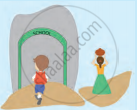
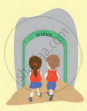
Compare and contrast the two opposing human feelings as expressed by the poet.
The tongue justifies the possession of the spectacles on behalf of the nose. Pick up the expressions from the poem that argues in favour of the Nose and complete the following web diagram.

Discuss in your group and write down the most important reason, why Pediatrician and Veterinarians have, a tougher job to diagnose their patients' illnesses.
Read the lesson and name the following.
A sack around the heart ______
Read the following word and use it in a sentence of your own.
Renown
Write a short note on the following:
Care of animals in the regime of Emperor Ashoka
Complete the following using your own idea:
His head was too big to ______.
Write the conditions that Portia put down to warn Shylock.
Draw word webs for the following. Begin with the given word and go on writing as many other words associated with it, as you can. Use these words to write other related words to form a word web.

Does the poet expect anything in return? What is the poet’s reward?
Prepare similar word chains using the following ideas.
waterbody - pool ____________.
Write in your own words.
What message does the poem convey?
Write other meaningful words that begin/end with footprint.
Find out the difference between the fingerspelling method, sign language and Braille.
Have you ever seen a bird making its first-ever attempt to fly?
What were the various sounds the brothers heard when they went downstairs?
What made the reporter gaze at the author?
Identify the speaker/character.
‘ Remember the tiny penknife he gave me last year’.
What other various pets did Somu have?
Why did Mrs. Jhunjhunwalla buy the painting?
Which theory of Ramanujan helps the ATMs to dispense cash?
Read the line and answer the question.
And quiet sleep and a sweet dream when the long trick’s over
What does the poet want to do after his voyage is over?
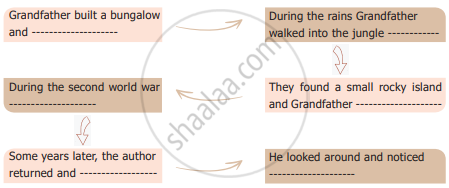
Read the story on your own. Discuss in a group and complete the story map below.
| A story map is the main events of the story given in a flow chart. |
What is as sharp as a blade?
Who was challenged for a race?
Match the dialogue to the character.
| "I will do all the work myself." |  |
| "First, you charge my battery." |  |
| "I have bought you a robot." |  |
How do the wheels go?
Write the rhyming word.
Nature - ______.
The hen-pigeon returned home when it started to _______.
Master trained Akilan on a ______.
Choose and write the adverbs to complete the sentence.

She won the game _____
Find and write the clues.
Clue for lost teeth ______.
Meena went to ______ her father.
Tenzin is from ______.
Speak and win.
Join in one of the two groups. Choose two characters. Support or oppose any one of the characters. Say some sentences for the one you support and say some sentences against the other one, to win.
| I support | I oppose |
Hundial is a______ pot.
Does the brush bend to her will?
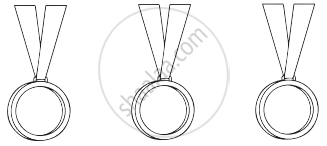
Read the passage 3 times and colour the medal each time.
The school was decorated for the Annual Sports Day. The children came to the running track to cheer the runners. The next event was 800 meters running. Megala was in the race. She wanted to win the race, but the other runners were district and divisional winners. The race started. All had to finish two laps. At the end of the first lap, Megala was in the fifth place. Suddenly, she fell on the ground. Everyone ran to help her. But before that she got up and started to run. All children and teachers cheered her. She had come last, but the headmaster gave her a special prize.
The pretty little fir tree was happy with gold leaves but______.
