Advertisements
Advertisements
प्रश्न
What is the central argument of the speaker?
Advertisements
उत्तर
A In the essay patterns of creativity, S. Chandrasekhar tries to figure out the reason for the difference in the patterns of creativity among the practitioners in the arts and practitioners in the sciences. He did not answer it, rather, he made an assortment of remarks that bore the answer. He cites examples explaining how poets and scientists view each other defining the difference in their views. There are poets such as Wordsworth and Keats who are worshippers of nature, who believe that humans sabotage nature by the technological advancement. However, there are poets like Shelley, who do poetry on science. It is difficult to segregate the views and put them into water tight compartments. Darwin, for instance enjoyed literature immensely as it gave him utmost joy, but only till the age of 30. W. B. Yeats, in praise of Shelley's A Defence of Poetry, called it the profoundest essay on the foundation of poetry in the English language The author of the essay, Chandrasekhar wonders in the end that why is there no such A Defence of Science written by a scientist of equal endowment. Perhaps the answer to the question he knew already.
APPEARS IN
संबंधित प्रश्न
What were Helen’s memories of Radcliffe?
Attempt a character sketch of Margot Frank as shown in ‘The Diary of a Young Girl’.
Talk to your partner about the following.
Describe the changing relationship between the author and his grandmother. Did their feelings for each other change?
What has the camera captured?
The story is called ‘The Adventure’. Compare it with the adventure described in ‘We’re Not Afraid to Die...’
We 'draw up a deed'. Complete the following phrase with an appropriate word.
________a deaf ear to
Adi Song for the Recovery of Lost Health' is in Miri Agom while Adi Agom is the Adi community's language for routine conversation. How does this reflect upon the high level of language sensitivity of the Adi? Can you think of other parallels in modern languages between the literary variety and the colloquial variety?
'Whose roots lay deeper than our lives' – what aspect of human behaviour does this line reflect?
Make a list of the preparations made for an assault on Tiger Hill.
Throughout the last week of June 1999, 18 Grenadiers ____________.
In Gujarat, the kite - festival is celebrated to welcome the Spring.
The poem is a Petrarchan Sonnet. The poem is divided into two parts -
- An Octave
The first part comprising eight lines. - A sestet
The second part comprising six lines.
Read the first four lines of the poem. The rhyme scheme is a b b a. Read the rhyme scheme for the next four lines. It is a b b a. Now read the first three lines of the sestet and note the rhyme scheme. It is c d c. The rhyme scheme of the last three lines is d c d. This is the common design of a Petrarchan Sonnet.
This is a Petrarchan Sonnet. Complete the given table by giving examples from the poem.
| Features | Examples / Lines |
| Objects used | |
| Praise/blames | |
| Metaphor | |
| Simile | |
| Personification | |
| Number of lines | |
| Rhyme scheme |
Human beings can learn from honey bees ______.
The ______ bees make honey from nectar.
Draw a character sketch of Oberon as an enemy of his wife but a friend of the lovers.
Visit a library:
Read stories about Gautama Buddha. Relate one story in the class.
List the phrases that indicate sorrow or pain.
Read the poem : ‘Where lies the land...’ by A. C. Clough.
Write about Malti and Rima using the following points:
 |
 |
| Appearance... | Appearance... |
| Studies... | Studies... |
| Singing... | Singing... |
| Attitude to others... | Attitude to others... |
| Weak points... | Weak points... |
Use details from the story and your own imagination when you write the above descriptions.
Complete the following sentence with reference to the passage.
They may be composed and sung or recited for many years before __________________.
Write about how you take care of your books.
Prepare a ‘PowerPoint’ presentation, using one slide for each of the above points. Present your review in a PPT format in the classroom.
List the various ways of avoiding the errors mentioned in the passage.
Imagine the following and write about it in your own words:
What the world looks like to a fish.
Sit quietly for some time. Close your eyes and listen carefully to all the sounds that you hear. Can you guess what sounds they are, who or what is making that sound? Note down what you heard.
Find out how the following game is played.
Table Tennis
Form a group of 4 or 5. Make a ‘storyboard’ for the story ‘Three Sacks of Rice’.
Arrange the story in the form of a sequence of pictures.
Decide what you will show in each picture; what words/lines you will write with each picture to explain what happens in it.
You can also add ‘speech balloons’ for the people in the pictures.
Read the word. Write the words that combine to make it.
snowwhite
What examples of plentiful things does the poet give?
Which event in the story tells us that the lion was brave?
How did Helen Keller help other blind people?
Marco Polo, Christopher Columbus, Ibn Battuta, Amerigo Vespucci, Xuanzang, Ferdinand Magellan, Bartolomeu Dias, Herodotus, Captain James Cook, Vasco De Gama.
What is common among these individuals? Browse Internet or refer books and share some information about them.
Read the following line from the poem and answer the question that follow.
So let the way wind up the hill or down, O'er rough or smooth, the journey will be joy: Still seeking what I sought when but a boy, New friendship, high adventure, and a crown,
- How is the way of life?
- How should be the journey of life?
- What did the poet seek as a boy?
Based on your reading, rearrange the following sentences in the correct sequence.
- Since all her methods failed, finally she gave him a pain-killer.
- He told his aunt that Peter had no aunt, so he gave him the medicine.
- The pain-killer triggered adverse reactions on Peter.
- It jumped out of the open window.
- Tom was dull and depressed.
- This incident upset Aunt Polly and she questioned him.
- But, Tom gave that painkiller to the cat Peter.
- So, Aunt Polly tried different types of remedies on him.
The captain presented a gift to Vasantha because ______
What does the teak tree give us?
Mother did not ask for______.
Read the questions related to the three sports stars you have read about and tick the appropriate boxes.
 |
 |
 |
|
| 1. Who won the Olympic 2016 silver medal in badminton? | |||
| 2. Who is the role model for her siblings? | |||
| 3. Whose mother tongue is Tamil? | |||
| 4. Whose attitude is 'never-say-die spirit'? | |||
| 5. Which player works in the Police Department? | |||
| 6. Which player holds the record for the highest individual score in cricket? |
Fill in the blanks to complete the summary.
Ever since their introduction, ______, and their unique rhythms have ______ poets. In this poem the poet shares his experience ______ with us. He presents natural scenes seen from ______ a railway carriage. The ______ is regular and steady but ______ from the window of the train is constantly changing. The poem’s rhythm and phrases bring ______ of a railway journey. The poet looks out of the window at the ______ images outside. Every line we see here is a quick account of something seen for ______. The line that best sums up is the final one: "Each a glimpse and gone forever!"
A tiny bird looked for a place to lay her eggs.
How do we see the earthworm often?
What is Amar Jawan Jyoti?
Read scene I of the play carefully and answer the questions below.
Tabaqui acts as ______ to the pack of wolves.
Who is the guest?
What will you do if someone ensnares birds?
Name the character or speaker.
“Believe yourself.”
Identify the character/speaker.
He set the fish free.
______is good at cooking.
What did the archer want to show to the crowd?
Answer the following yes or no question.
Did Appu share guava?
What is the name of the girl?
Robinson sailed England after ______ years.
Divide the following word.
man
Name the character or speaker.
"Do you have a fever?"
Kani took Teddy out for a ____.
Why did Nasruddin take someone else’s name each time he missed the target?
Choose the right word.
“Eat the leaves of the tamarind tree, and you’ll also sing like ______.
Why did he go there?
The passage given below is on Kabbadi. Read the passage and complete the activities that follow.
Kabbadi (கபடி - in Tamil) is a contact team sport that originated in Tamil Nadu, India. It is the national sport of Bangladesh. It is also popular in South Asia and is the state game of the Indian states of Tamil Nadu, Kerala, Andhra Pradesh, Bihar, Haryana, Karnataka, Maharashtra, Punjab, and Telangana.

Kabbadi is played between two teams of seven players: the objective of the game is for a single player on offence referred to as a 'raider', to run in to the opposing teams half of a court, tag out as many of their defenders as possible, and return to their own half of the court–all without being tackled by the defenders. Points are scored for each player tagged by the raider, while the opposing team earns a point for stopping the raider. Players are taken out of the game if they are tagged or tackled, but can be 'revived' for each point scored by their team from a tag or tackle. The raider should hold his breath and utter the words like 'kabbadi kabbadi, hututu hututu, chadu kudu' etc. while the opponents try to catch him. If he stops uttering these words, he is considered out.
The game is known by its regional names in different parts of the subcontinent, such as Kabbadi or Chedugudu in Andhra Pradesh, Kabbadi in Kerala and Telangana, Hadudu in Bangladesh, Bhavatik in Maldives, Kauddi or Kabbadi in the Punjab Region, Hu-Tu-Tu in Western India and Hu-Do-Do in Eastern India and Chadakudu in South India. The highest governing body of Kabbadi is the International Kabbadi Federation.
Given below is the visual presentation of the first paragraph.
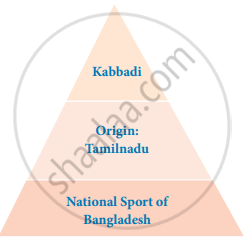
i) Represent the other paragraphs in a visual form of your choice(flow chart, mind-map, pie-chart, etc.).
ii) Choose the correct option.
1. A contact sport usually involves a ______contact between players.
- violent
- gentle
- physical
2. Kabbadi is a game played between ______.
- seven teams of two players
- two teams of seven players
- four teams of seven players
3. A single ______.
- player on offence is referred to as a raider
- offence is referred to as a raider
- raider is an offence by the player
iii) Answer the following.
- How does a raider score points for his team?
- When does a raider concede a point to the opponent team?
- Can a player be revived when he/she is out of the game? Explain your answer.
- Kabbadi is called by different names in different parts of India. Do you know how Pallankuzhi is called in Karnataka, Andhra Pradesh and Kerala?
