Advertisements
Advertisements
प्रश्न
What is the central argument of the speaker?
Advertisements
उत्तर
A In the essay patterns of creativity, S. Chandrasekhar tries to figure out the reason for the difference in the patterns of creativity among the practitioners in the arts and practitioners in the sciences. He did not answer it, rather, he made an assortment of remarks that bore the answer. He cites examples explaining how poets and scientists view each other defining the difference in their views. There are poets such as Wordsworth and Keats who are worshippers of nature, who believe that humans sabotage nature by the technological advancement. However, there are poets like Shelley, who do poetry on science. It is difficult to segregate the views and put them into water tight compartments. Darwin, for instance enjoyed literature immensely as it gave him utmost joy, but only till the age of 30. W. B. Yeats, in praise of Shelley's A Defence of Poetry, called it the profoundest essay on the foundation of poetry in the English language The author of the essay, Chandrasekhar wonders in the end that why is there no such A Defence of Science written by a scientist of equal endowment. Perhaps the answer to the question he knew already.
APPEARS IN
संबंधित प्रश्न
Describe Miss Stapleton's first encounter with Sir Henry in about 125 words
How did Griffin meet his end ?
When and how did the people of Iping grow suspicious of the invisible man ?
Answer the following question in 150-200 words:
Attempt a character sketch of Mr. Gilman.
What has not changed over the years? Does this suggest something to you?
What kind of a person do you think the narrator is?
Read the play out in parts. Enact the play on a suitable occasion.
Identify some of the improbable images the author has used to effect greater humour.
'Whose roots lay deeper than our lives' – what aspect of human behaviour does this line reflect?
Read the following statement and mark those that apply to you.
I have a small group of close friends and have no wish to interact with anyone else.
Find from the lesson word/phrase that mean the following.
colours .............
Make a list of archaic words from the poem and give their modern equivalents.
Imagine that you are the peasant. Compose a short prayer to God, after having received the plate of gold. Write it using stylish handwriting.
Read other poems by Leigh Hunt, especially 'Abou Ben Adhem'.
Compare the messages in that poem with those in 'The Plate of Gold'. What do you observe?
In Gujarat, the kite - festival is celebrated to welcome the Spring.
Read the story and choose the appropriate meaning.
Struggling artists ____________
Expand the idea inherent in the following proverb:
A Bad workman blames his tools.
Read the description of the Kabaddi match and do the following:
Choose any one event and draw a diagram to show what happened.
Read the story aloud (or present it) in groups of three - the narrator, the peacock, and the crane.
Read aloud the speech in which Thiruvalluvar explains how the fabric was made. Present the process in the form of a chart. Draw pictures for the chart and label them.
Give reasons :
Oberon and Titania fight for the custody of the Indian boy because - Oberon wants __________________.
Explain the following statement with reference to the context.
You ought to be ashamed of yourself.
‘Smart Answers’: Form a large group. Each person asks the next one a question to get him to say ‘yes’ or ‘no’. He/She can use appropriate statements, requests, or even other questions as a response. But if he/she says ‘yes’ or ‘no’, he/she is out. Otherwise, he/she continues the game. Questions cannot be repeated.
Visit a library: Find poems about animals. Copy them and recite them to your friends.
What does the poet want to do?
Prepare similar word chains using the following ideas.
size - small _______________.
List the lines that begin with 'Here' or 'And here'.
Also, list the sentences or phrases that begin with ‘And there’.
These phrases and sentences tell us about things that appear one after the other as the carriage moves. Can we tell which ones are closer to the train and which ones are at a distance? How?
Write the symbol that is used in the poem to represent the following idea.
Some other time.
Make a list of your favourite fruits and vegetables and note down the time of the year when they are available in plenty.
Find the meaning of the following word.
rated
How was Gulliver tied down on the seashore?
Discuss the following in group.
Do people admit that they have bad habits?
Complete the given tabular column with the suitable plural forms.
| chair | - | |
| box | - | |
| Eskimo | - | |
| lady | - | |
| radius | - | |
| formula | - | |
| child | - | |
| deer | - | |
| loaf | - | |
| hero | - |
Write a paragraph on ‘The Grumble Family’ and their attitude towards other folks.
Which theory of Ramanujan helps the ATMs to dispense cash?
Read the data below and answer the following question.
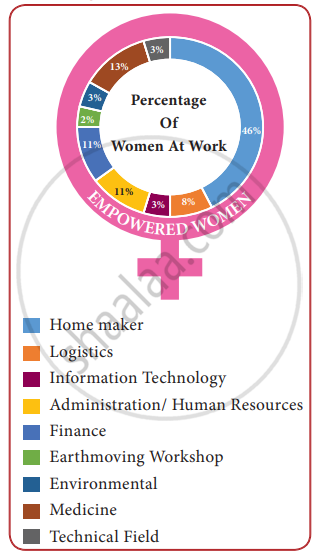
Choose the correct answer.
What is the data about?
Read the letter again and write a few lines on each of the following.
- things that the coach taught….
- transformation in the child……..
- things that amazed the writer……..
Find a sentence/word from the text which express the following.
One of the qualities of the teacher.
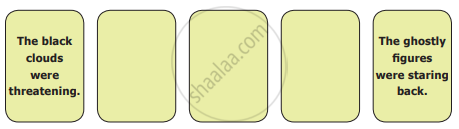
Two scary events from this section are listed here. Write the events that take place in between in the correct order.
Read these lines and answer the question given below.
The laughter and beauty of women long dead;
Explain the meaning of the above line.
Why was the elephant owner happy with the deal?
Read the following lines and answer the questions.
It’s a slow, unwavering, ingrained trait
With the patience to work and the strength to wait.
- What is an ‘ingrained trait’?
- Why does a courageous man need patience?
Read the following lines and answer the questions.
It’s part of his hours, his days and his years,
Back of his smiles and behind his tears.
What does ‘tears’ mean?
Turtles are different from tortoises.
Why did the author leave town?
What did she sell to support her family?
What made the trip a memorable one?
Complete the sentence given below with word/phrase.
The hole in the ground was filled______.
The battle of Nauranang lasted for three days.
Jaswant was captured alive.
Who asked the Robot to charge the phone?
Why did she pick up her pace?
The old man was carrying _____.
Circle the animals which are in the voyage.

Choose the champion of the year.
Ani grew the seeds well.
Choose the right word.
This famous tree is in ______.
Now, read the following biographical extract on Sujatha Rangarajan, a Sciencefiction writer, and answer the questions that follow.
- Sujatha is the allonym of the Tamil author S. Rangarajan and it is this name that is recognised at once by the Tamil SciFi reading community. You might have seen the Tamil movie ‘Endiran’ where the robot Chitti exhibits extraordinary talents in an incredible manner. The robot could excel a human being in any act, beyond one’s imagination. Jeeno, a robotic dog which appeared in Sujatha’s science fiction novel “En Iniya Iyandhira” (My Dear Robot) formed the basis of Chitti’s character. Like Chitti, Jeeno was an allrounder who could cook, clean and fight. High-tech computer technology terms are used in the story. Jeeno, a pet robot, plays an important role throughout the story. As the story proceeds, it behaves and starts to think on its own like a human and instructs Nila, a human being, on how to proceed further in her crises.
- In the preface of ‘En Iniya Iyandhira’, the writer states the reason for his attraction to the genre: “Science gives us the wonderful freedom to analyse thousands and thousands of alternative possibilities. While using it, and while playing with its new games, a writer needs to be cautious only about one thing. The story should draw some parallels or association from the emotions and desires of the present humankind. Only then it becomes interesting. Jeeno, the robot dog, was intelligent. But the character became popular only because of the robot’s frequently displayed human tendencies.” It is no wonder that all his works echo these words and will remain etched in the minds of the readers who enjoy reading his novels to have a wonderful lifetime experience.
- It was Sujatha, who set the trend for sci-fi stories. He had tracked the origin from Mary Shelly’s Frankenstein to his short stories. He has written 50 sci-fi short stories and these were published in various Tamil magazines. His stories have inspired many readers to extend their reading to English sci-fi writers like Isaac Asimov. The themes were bold, even if there was a dependence on a very well-established characterization of English fiction. Sujatha opened up a new world to us with his writings on holograms, computers and works like ‘En Iniya Iyanthira’ inspire many to study computer science.
- He has been one of the greatest writers for more than four decades. He combined reasoning and science in his writings. Being a multifaceted hi-fi and sci-fi humanistic author, he expressed his views distinctively. He was the one who took Tamil novels to the next level. As an MIT alumnus and an engineer at BHEL, he was very good at technology. He could narrate sci-fi stories impressively. His readers always enjoyed reading all his detective and sci-fi novels which featured the most famous duo ‘Ganesh’ and ‘Vasanth’.
- Sujatha has played a crucial role as a playwright for various Tamil movies which have fascinated movie lovers. Hence, it is fathomable that the writer’s perspective of future India enthuses every reader and paves a new way to reading sci-fi stories in English.
A. Answer the following questions in a sentence or two.
- How was Jeeno different from other robots?
- What precaution should one take while writing Science fiction stories?
- What inspired Sujatha’s themes?
- Why were Sujatha’s sci-fi stories impressive?
B. Find words from the passage which mean the same as the following.
- difficult to believe (para 1)
- a style or category of art, music or literature (para 2)
- having many sides (para 4)
- capable of being understood (para 5)
Why is it not advisable to play online games?
