Advertisements
Advertisements
प्रश्न
Read the play out in parts. Enact the play on a suitable occasion.
Advertisements
उत्तर
A classroom activity
APPEARS IN
संबंधित प्रश्न
Answer the following question in 120-150 words:
What kind of life did Silas lead at Lantern Yard?
What do elephants do to prevent water from evaporating ?
Read the text below and summarise it.
The Great Desert Where Hippos Once Wallowed
The Sahara sets a standard for dry land. It’s the world’s largest desert. Relative humidity can drop into the low single digits. There are places where it rains only about once a century. There are people who reach the end of their lives without ever seeing water come from the sky.
Yet beneath the Sahara are vast aquifers of fresh water, enough liquid to fill a small sea. It is fossil water, a treasure laid down in prehistoric times, some of it possibly a million years old. Just 6,000 years ago, the Sahara was a much different place.
It was green. Prehistoric rock art in the Sahara shows something surprising: hippopotamuses, which need year-round water.
“We don’t have much evidence of a tropical paradise out there, but we had something perfectly liveable,” says Jennifer Smith, a geologist at Washington University in St Louis.
The green Sahara was the product of the migration of the paleo-monsoon. In the same way that ice ages come and go, so too do monsoons migrate north and south. The dynamics of earth’s motion are responsible. The tilt of the earth’s axis varies in a regular cycle — sometimes the planet is more tilted towards the sun, sometimes less so. The axis also wobbles like a spinning top. The date of the earth’s perihelion — its closest approach to the sun — varies in cycle as well.
At times when the Northern Hemisphere tilts sharply towards the sun and the planet makes its closest approach, the increased blast of sunlight during the north’s summer months can cause the African monsoon (which currently occurs between the Equator and roughly 17°N latitude) to shift to the north as it did 10,000 years ago, inundating North Africa.
Around 5,000 years ago the monsoon shifted dramatically southward again. The prehistoric inhabitants of the Sahara discovered that their relatively green surroundings were undergoing something worse than a drought (and perhaps they migrated towards the Nile Valley, where Egyptian culture began to flourish at around the same time).
“We’re learning, and only in recent years, that some climate changes in the past have been as rapid as anything underway today,” says Robert Giegengack, a University of Pennsylvania geologist.
As the land dried out and vegetation decreased, the soil lost its ability to hold water when it did rain. Fewer clouds formed from evaporation. When it rained, the water washed away and evaporated quickly. There was a kind of runaway drying effect. By 4,000 years ago the Sahara had become what it is today.
No one knows how human-driven climate change may alter the Sahara in the future. It’s something scientists can ponder while sipping bottled fossil water pumped from underground.
“It’s the best water in Egypt,” Giegengack said — clean, refreshing mineral water. If you want to drink something good, try the ancient buried treasure of the Sahara.
Staff Writer, Washington Post
The story revolves around characters who belong to a tribe in Armenia. Mourad and Aram are members of the Garoghlanian family. Now locate Armenia and Assyria on the atlas and prepare a write-up on the Garoghlanian tribes. You may write about people, their names, traits, geographical and economic features as suggested in the story.
Discuss the following in pairs or in groups of four:
'It is time to realise that unless we modify the established notion of literature as something written, we will silently witness the decline of various Indian oral traditions'
Comment on the lines that make you visualise the colourful image of the peacock.
Find proof from the poem for the following.
The poet’s minute observations of the steady growth of the cherry tree.
In our country engineering, teaching, and medical fields are much sought after. Other professions, occupations though they make a significant contribution to society, do not get their due.
| (a) | Farmer | highly unpredictable economic gains |
| (b) | Conservancy workers | ________________ |
| (c) | ________________ | ________________ |
| (d) | ________________ | ________________ |
| (e) | ________________ | ________________ |
Pick out a word from the poem to complete the sentence meaningfully.
Stephen Hawking was a ______ (famous) Astrophysicist.
Using points from the lesson, give the details of the following in a short paragraph.
The kite Bazar of Ahmedabad.
Correct the following statement.
Sue ignored Johnsy completely.
In the following sentence, point out the Main Clause and Subordinate Clause. Encircle the Subordinator.
Old Behrman was a painter, who lived on the ground floor.
Say WHY. . . . . .
Ramanujan found the number 1729 very interesting.
Read the passage and answer the following question:
Who designed the PVC medal?
Comment on the given statement after reading the given dialogue -
It’s a pity some honest man not to be better of that ________________________________________________.
Read aloud/Enact the play.
Expand the following ideas in a paragraph or two:- Courage and resourcefulness are the keys to overcome problems.
Visit a library: Find poems about animals. Copy them and recite them to your friends.
Bassanio borrowed money from Shylock in Antonio’s name.
Find out the following with the help of your teacher and the internet.
Seasonal Rains (monsoon) in India and other countries.
Read aloud a couple of stanzas of the poem ‘Invictus’ and ‘Please Listen’. In what ways do they differ? Think and fill up the table with ‘Yes’ or ‘No’.
| Invictus | Please Listen | |
| Rhyming lines | ______ | ______ |
| Steady rhythm | ______ | ______ |
| Uniformity in the length of lines | ______ | ______ |
| Uniformity of the number of lines in each stanza. | ______ | ______ |
| Figurative language | ______ | ______ |
Pick out Archaic words from the poem and give their modern equivalents.
| Archaic Words | Modern Equivalents | |
| (a) | ||
| (b) | ||
| (c) | ||
| (d) | ||
| (e) |
Name the following.
Ruler of Germany.
List the polite expressions we use such as ‘Pardon’.
List all the words and phrases in this story that indicate 'time'.
How do we come to know that Kasim was a generous man?
Why was the narrator sorry to have paid attention to the footsteps?
Read the following lines from the poem and answer the question given below.
There's a family nobody likes to meet;
They live, it is said, on Complaining Street
- Where does the family live?
- Why do you think the street is named as ‘Complaining Street’?
What happened when Somu left Zigzag with the Krishnans?
What do Tamil Nadu folk dances and folk arts represent?
How did Hamid’s friends enjoy the games in the fair?
Two scary events from this section are listed here. Write the events that take place in between in the correct order.
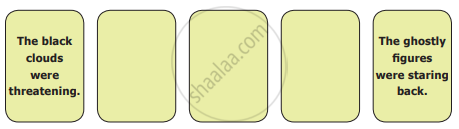
What story did grandfather tell them about the haunted hill?
Why does the poet tell us to speak gently to young children?
Find out the rhyme scheme employed in the fourth stanza.
Why did the governments of India, America and Pakistan – honour Neerja?
When the author returned from England to Dehradun, he found Grandfather's dream had come true because the______.
Where did Raj’s mother send him?
Find out the idiom that relates to ‘whatever the circumstances’, from the first paragraph.
We do not really see the landscape from a normal train because the______.
Read the lines and answer the question given below.
Here is a child who clambers and scrambles,
All by himself and gathering brambles;
- Where do you think the child is?
- What does ‘gathering brambles’ mean?
Complete the sentence given below with word/phrase.
The buffalo ______ in the hole.
In the Earth, we get water from ______.
Try your own.
Choose the correct option from the given homophones.
You should never ______ to your parents.
They use ______ as bait.
What did the archer want to show to the crowd?
Who guessed the location of the real necklace?
People ran off when the seawater receded.
Read the advertisement and answer the question given below.

What is the advertisement about?
Who made the tree become a monster?
Kamali gave her savings to______.
Mostly piggy banks look like______.
Read the passage 3 times and colour the trees for each time.
Trees help us in many ways. The colour green is calming and heals your worries. By planting and caring for trees, we help improve our surroundings, as they give fresh air. When air is dirty the people of Delhi suffered a lot. But people of Madhubani district in Bihar have shown how art can be used to make our air clean. So that people made paintings on trees to stop people from cutting the trees.

Choose the right word.
Chintha Chettu is a tamarind ______.
Choose the right word.
This famous tree is in ______.
Why did the animals think that the jackal was a king?
Read the following passage and do the activities.
A1. State whether the following sentences are True or false. [2]
- The king’s temperament also changed.
- The king was happy with prediction of the astrologer.
- The courtiers sought an audience with Tenali Raman.
- Courtiers advised the king to regulate his diet.
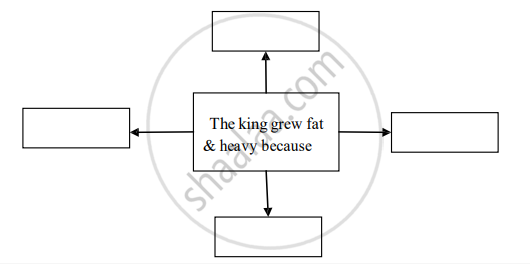
A2. Complete the web. [2]
|
King Krishnadeva Raya would perform heavy exercises every morning. He regularly applied oil on his body and thereafter worked out till all the oil came out with the sweat. This was followed by a long ride on his horse. Once the king started leading a sedentary lifestyle, and he stopped exercising. He no longer went horse-riding either. The king overate and as a result grew fat and heavy. The king‟s temperament also underwent a sea change. Noticing this, the royal physicians cautioned the king against the ill effects of overeating and explained to him the risks posed by obesity. They advised the king to regulate his diet, exercise, and take care of his health. The repeated advice he got from the physicians to eat less made him so angry that one day he announced a reward for anyone who could find him an easy cure. But there was one condition: those who failed would have their heads off. None dared to advise the king in this regard. The situation became precarious and as usual Tenali Raman was approached by the courtiers for a remedy. Tenali heard the problem and assured the courtiers of a viable solution. The next day, an astrologer predicted that the king had only a month left to live. When the king came to know of this, he was furious. The astrologer was ordered by the king to be imprisoned for a month so that his prediction could be put to test and so the hapless forecaster was sent to prison. |
A3. Find out describing words from the passage for the words given below. [2]
- exercise - ...........
- lifestyle - ...........
- ride - ...........
- physician - ...........
A4. Do as directed. [2]
- King Krishnadeva Raya would perform heavy exercises every morning.
(Use ‘used to’) - They advised the king to regulate his diet. (Pick out the infinitive)
A5. What are the benefits of daily exercise? [2]
Now, read the following biographical extract on Sujatha Rangarajan, a Sciencefiction writer, and answer the questions that follow.
- Sujatha is the allonym of the Tamil author S. Rangarajan and it is this name that is recognised at once by the Tamil SciFi reading community. You might have seen the Tamil movie ‘Endiran’ where the robot Chitti exhibits extraordinary talents in an incredible manner. The robot could excel a human being in any act, beyond one’s imagination. Jeeno, a robotic dog which appeared in Sujatha’s science fiction novel “En Iniya Iyandhira” (My Dear Robot) formed the basis of Chitti’s character. Like Chitti, Jeeno was an allrounder who could cook, clean and fight. High-tech computer technology terms are used in the story. Jeeno, a pet robot, plays an important role throughout the story. As the story proceeds, it behaves and starts to think on its own like a human and instructs Nila, a human being, on how to proceed further in her crises.
- In the preface of ‘En Iniya Iyandhira’, the writer states the reason for his attraction to the genre: “Science gives us the wonderful freedom to analyse thousands and thousands of alternative possibilities. While using it, and while playing with its new games, a writer needs to be cautious only about one thing. The story should draw some parallels or association from the emotions and desires of the present humankind. Only then it becomes interesting. Jeeno, the robot dog, was intelligent. But the character became popular only because of the robot’s frequently displayed human tendencies.” It is no wonder that all his works echo these words and will remain etched in the minds of the readers who enjoy reading his novels to have a wonderful lifetime experience.
- It was Sujatha, who set the trend for sci-fi stories. He had tracked the origin from Mary Shelly’s Frankenstein to his short stories. He has written 50 sci-fi short stories and these were published in various Tamil magazines. His stories have inspired many readers to extend their reading to English sci-fi writers like Isaac Asimov. The themes were bold, even if there was a dependence on a very well-established characterization of English fiction. Sujatha opened up a new world to us with his writings on holograms, computers and works like ‘En Iniya Iyanthira’ inspire many to study computer science.
- He has been one of the greatest writers for more than four decades. He combined reasoning and science in his writings. Being a multifaceted hi-fi and sci-fi humanistic author, he expressed his views distinctively. He was the one who took Tamil novels to the next level. As an MIT alumnus and an engineer at BHEL, he was very good at technology. He could narrate sci-fi stories impressively. His readers always enjoyed reading all his detective and sci-fi novels which featured the most famous duo ‘Ganesh’ and ‘Vasanth’.
- Sujatha has played a crucial role as a playwright for various Tamil movies which have fascinated movie lovers. Hence, it is fathomable that the writer’s perspective of future India enthuses every reader and paves a new way to reading sci-fi stories in English.
A. Answer the following questions in a sentence or two.
- How was Jeeno different from other robots?
- What precaution should one take while writing Science fiction stories?
- What inspired Sujatha’s themes?
- Why were Sujatha’s sci-fi stories impressive?
B. Find words from the passage which mean the same as the following.
- difficult to believe (para 1)
- a style or category of art, music or literature (para 2)
- having many sides (para 4)
- capable of being understood (para 5)
Should children be discouraged from playing online games?
