Advertisements
Advertisements
प्रश्न
Read the following sentence aloud. Write who said it and to whom.
“I would rather not go to the party.”
Advertisements
उत्तर
Mathilde said these words to her husband.
संबंधित प्रश्न
Read the passage given below and answer the questions that follow:
1. Air pollution is an issue which concerns us all alike. One can willingly choose or reject a food, a drink or a life comfort, but unfortunately there is little choice for the air we breathe. All, what is there in the air is inhaled by one and all living in those surroundings.
2. Air pollutant is defined as a substance which is present while normally it is not there or present in an amount exceeding the normal concentrations. It could either be gaseous or a particulate matter. The important and harmful polluting gases are carbon monoxide, carbon dioxide, ozone and oxides of sulphur and nitrogen. The common particulate pollutants are the dusts of various inorganic or organic origins. Although we often talk of the outdoor air pollutions caused by industrial and vehicular exhausts, the indoor pollution may prove to be as or a more important cause of health problems.
3. Recognition of air pollution is relatively recent. It is not uncommon to experience a feeling of 'suffocation' in a closed environment. It is often ascribed to the lack of oxygen. Fortunately, however, the composition of air is remarkably constant all over the world. There is about 79 per cent nitrogen and 21 per cent oxygen in the air − the other gases forming a very small fraction. It is true that carbon dioxide exhaled out of lungs may accumulate in a closed and over-crowded place. But such an increase is usually small and temporary unless the room is really air-tight. Exposure to poisonous gases such as carbon monoxide may occur in a closed room, heated by burning coal inside. This may also prove to be fatal.
4. What is more common in a poorly ventilated home is a vague constellation of symptoms described as the sick-building syndrome. It is characterized by a general feeling of malaise, head-ache, dizziness and irritation of mucous membranes. It may also be accompanied by nausea, itching, aches, pains and depression. Sick building syndrome is getting commoner in big cities with the small houses, which are generally over-furnished. Some of the important pollutants whose indoor concentrations exceed those of the outdoors include gases such as carbon monoxide, carbon dioxide, oxides of nitrogen and organic substances like spores, formaldehydes, hydrocarbon aerosols and allergens. The sources are attributed to a variety of construction materials, insulations, furnishings, adhesives, cosmetics, house dusts, fungi and other indoor products.
5. By-products of fuel combustion are important in houses with indoor kitchens. It is not only the brining of dried dung and fuelwood which is responsible, but also kerosene and liquid petroleum gas. Oxides of both nitrogen and sulphur are released from their combustion.
6. Smoking of tobacco in the closed environment is an important source of indoor pollution. It may not be high quantitatively, but significantly hazardous for health. It is because of the fact that there are over 3000 chemical constituents in tobacco smoke, which have been identified. These are harmful for human health.
7. Micro-organisms and allergens are of special significance in the causation and spread of diseases. Most of the infective illnesses may involve more persons of a family living in common indoor environment. These include viral and bacterial diseases like tuberculosis.
8. Besides infections, allergic and hypersensitivity disorders are spreading fast. Although asthma is the most common form of respiratory allergic disorders, pneumonias are not uncommon, but more persistent and serious. These are attributed to exposures to allergens from various fungi, molds, hay and other organic materials. Indoor air ventilation systems, coolers, air-conditioners, dampness, decay, pet animals, production or handling of the causative items are responsible for these hypersensitivity − diseases.
9. Obviously, the spectrum of pollution is very wide and our options are limited. Indoor pollution may be handled relatively easily by an individual. Moreover, the good work must start from one’s own house
(Extracted from the Tribune)
(a) (i) What is an air pollutant? (1)
(ii) In what forms are the air pollutants present? (2)
(iii) Why do we feel suffocated in a closed environment? (1)
(iv) What is sick building syndrome? How is it increasing? (2)
(v) How is indoor smoking very hazardous? (1)
(vi) How can one overcome the dangers of indoor air pollution? (2)
(b) Find the words from the above passage which mean the same as the following: (3)
(i) giddiness (para 4)
(ii) constant (para 8)
(iii) humidity (para 8)
Answer any four of the following questions in 30-40 words each:
(a) Why did Franz not want to go to school that day?
(b) What was Sophie's ambition in life? How did she hope to achieve that?
(c) What kind of pain does Kamala Das feel in 'My Mother at Sixty-six'?
(d) How can 'mighty dead' be things of beauty?
(e) Why was the Maharaja once in danger of losing his kingdom?
(f) What was the basic plot of each story told by Jack?
Answer any four of the following in 30 – 40 words each:
(a) How did his experience at the YMCA swimming pool affect Douglas?
(b) What hospitality did the peddler receive from the crofter?
(c) Aunt Jennifer;s efforts to get rid of her fear proved to be futile. Comment.
(d) What does Stephen Spender want to be done for the children of the school in a slum?
(e) What kind of life was enjoyed by crown prince Jung Bahadur till he reached the age of twenty?
(f) Where, when and how did Dr. Sadao meet Hana?
Chimps making their own fishing rods is an indication that
Read the following passage and do the activities:
A1 True or False:
Rewrite the following statements and state whether they are ‘true’ or ‘false’.
(i) Mashelkar’s mother did menial work to bring him up.
(ii) Mashelkar’s father died when he was twelve.
(iii) Mashelkar was born in a very rich family.
(iv) Tatas added much value to Mashelkar’s life.
I start with my greatest guru-my mother. I was born in a very poor family and my father died when I was six. We moved to Mumbai and my mother did menial work to bring me up. Two meals a day was a tough challenge. I studied under street lights and I walked barefoot until, I think, I was twelve. I remember when I passed the seventh standard and I wanted to go into the eighth standard, our poverty was such that even to secure 21 rupees for secondary school admission became a big challenge. We had to borrow from a lady, who was a housemaid in Chaupati in Mumbai. That was the tough life I had.
In fact, I remember, my passing the SSC Examination-i.e. 11th standard. Those days it used to be not 10th standard or 12th standard but 11th standard. I stood 11th among 1,35,000 but I was about to leave higher education and find a job. What helped me was the scholarship by Sir Dorab Tata Trust. It was just 60 rupees per month and would you believe that 60 rupees per month from Tatas added so much value to my life that I have been able to stand here today before you to speak to you.
I am on the Board of Tatas now and it is very interesting that the same Bombay House where I used to go to collect that 60 rupees per month now one goes and sits there like a Director on the Board of Tata Motors. The turn that these 40 years have taken is very interesting. It has all been possible because of the chance I got to do higher studies at the insistence of my mother. She gave me the values of my life. She was one of the noblest parents I have met in my life.
So, my greatest guru was my mother. My second guru was Principal Bhave, about whom I made a mention earlier. He taught us Physics. Because it was a poor school, I remember, it had to innovate to convey to the young students the message of Science.
A2 Complete:
Complete the following sentences and write:
(i) Mashelkar was inspired by his greatest guru _______
(ii) Mashelkar studied under _______
(iii) Principal Bhave taught _______
(iv) The scholarship by _______ Trust helped him in higher education.
A3 Find the meaning:
Choose the appropriate meaning of the underlined words from the given alternatives:
(i) We moved to Mumbai and my mother did menial work.
(a) skilled
(b) hard
(c) unskilled
(d) of low status
(ii) Because it was a poor school, it had to innovate to convey to the young students the message of science.
(a) do a cheap experiment
(b) introduce new things
(c) avoid
(d) try hard
(iii) I got to do higher studies at the insistence of my mother.
(a) firm saying
(b) being inspired
(c) being inspected
(d) being instigated
(iv) That was the tough life I had.
(a) difficult
(b) soft
(c) cheap
(d) simple
A4 Match:
Match the following sentences with their tags:
| 'A' | 'B' | ||
| (i) | I stood 11th among 1,35,000 |
(a) | aren’t I? |
| (ii) | I am on the Board of Tatas | (b) | didn’t we? |
| (iii) | It was a poor school | (c) | didn’t I? |
| (iv) | We moved to Mumbai | (d) | wasn’t it? |
A5 Personal Response:
“Mother is the greatest Guru.” Discuss.
Tick the statement that is true.
The story is an account of real events.
What do you understand of the natures of Ramanand and Azam Khan from the episode described?
What does the reference to raw mythology imply?
Answer in your own words.
Read and write down 5 points which prove that Tomba, (Lanthoi’s father) firmly believes in gender equality.
Discuss in your group and write down the most important reason, why Pediatrician and Veterinarians have, a tougher job to diagnose their patients' illnesses.
Make a list of functions/events/programs/activities organized in your junior college. Choose three events and plan a program schedule of your own. Prepare a script as well to show the associating role of the compere for a particular event. Make your own sequence and design a template for the same.
The characters are a part of the stage setting. How does this reflect when the characters of the play range from the Duke and the Indian boy to the faeries?
In each of the following line, spot the sound that is used repeatedly -
- There’s a silver house in the lovely sky.
- As round as a silver crown
- It takes two weeks to build it up. And two to pull it down.
Are there any stories/legends about the moon or special names for the moon in your language? Talk to your friends and family members and collect this information.
Link the items in the three columns properly.
| A | B | C |
| The past | A sea beneath a cloudless sun | A pleasant time which has ended |
| The present hour | A soft and mild autumn evening | An exciting, thrilling time which has no end. |
| The future | A green and flowery spray Where a young bird sits | A time, full of life in which you gather strength |
Think of a play/skit which you have seen enacted on the stage and which has impressed you. Write the following details about it.
| Name of the play/skit: | ______________ |
| Important characters: | ______________ |
| Any famous actors/actresses: | ______________ |
| Theme: | ______________ |
| Climax: | ______________ |
| Ending: | ______________ |
| Use of lights and special effects if any: | ______________ |
| Use of background music and sound effects if any: | ______________ |
| Use of sets: | ______________ |
| The costumes, make up, etc. of the characters: | ______________ |
| How well the actors present the play and behave on the stage: | ______________ |
| Your own opinion about the play: | ______________ |
List the adverbs/adverbial phrases used in the passage.
What did Gopal Bhand want to tell the husband and wife?
Name the following.
Captain of the Indian Team.
What common qualities did the three brothers have?
Describe Gulliver’s walk around the city.
Guess the meaning of the following word.
beautify
What challenges does Alice face and how does she overcome them?
Look at the number pattern. Fill the blank in the middle of the series or end of the series.
ELFA, GLHA, ILJA, ______, MLNA
What qualities of Mr. Phileas Fogg are highlighted in this extract? Support your answer with suitable examples.
The terrorists asked Neerja to collect the passports of the passengers because ______.
The horses were four and a half inches tall.
The girl admitted to her brother that she was badly frightened.
| Mr. Murugan is a farmer. He has a small piece of land and two bulls. He takes good care of his bulls as they help him in farming. Every morning, he takes the bulls for grazing. When it rains he ploughs the land with the bulls. As he has no one to help he starts sowing the seed before sunrise. He irrigates the crop till it grows. He reaps and binds the crop then takes it to thrash the paddy. Finally, with the help of the bulls, he takes the paddy to his house. |
Choose the main idea of the passage.
Jaswant Singh Rawat was awarded ______.
Why did the old man disguise himself as a beggar?
How does Raju help his mother?
Fortune knocks with its best who _______ for their guest.
Match with their storing places.
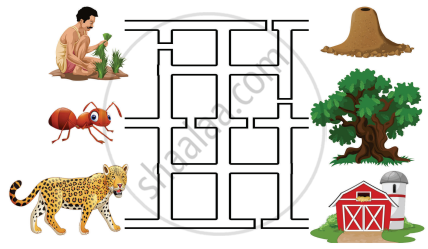
______ was helpful for his father to drive out the wild animals.
Why did he rub the circle again and again?
What do you think birds say to each other in the morning?
Why did Nasruddin take someone else’s name each time he missed the target?
Are these sentence TRUE or FALSE
The poet says that stars will always shine at night.
What did Pinocchio say in the end?
