Advertisements
Advertisements
Question
Read the following sentence aloud. Write who said it and to whom.
“I would rather not go to the party.”
Advertisements
Solution
Mathilde said these words to her husband.
RELATED QUESTIONS
Answer any four of the following questions in 30 - 40 words each :
(a) What kind of gold did the people of Seemapuri look for in the garbage ? (Lost Spring)
(b) Why did Gandhi tell the court that he was involved in a 'conflict of duties' ?
(c) How do we get joy from life which is otherwise full of sorrows ? (A Thing of Beauty)
(d) For Aunt Jennifer, what do the tigers symbolise ?
(e) What made the chief astrologer place his finger on his nose ? (The Tiger King)
(f) On the seventh day after the American soldier was found by Dr. Sadao two things happened. Why did Hana feel scared of the second ?
Read the follow ing extract and answer the questions given below:
Not gold but only men can make
A people great and strong;
Men who for truth and honor's sake
Stand fast and suffer long.
Brave men who work while others sleep,
Who dare while others fly...
They build a nation's pillars deep
And lift them to the sky.
(1) What makes a nation strong?
(2) According to you, what makes India a strong and powerful nation?.
(3) Write down the rhyme scheme used in the extract.
(4) What does the phrase 'others fly ... ' mean?
Talk to your partner about the following.
The author’s grandmother was a religious person. What are the different ways in which we come to know this?
Discuss in groups of four.
The accounts of exotic places in legends and the reality.
Try rewriting the lecture as a formal essay and examine Forster’s statement: 'since the novel is itself often colloquial, it may possibly withhold some of its secrets from the graver and grander streams of criticism’.
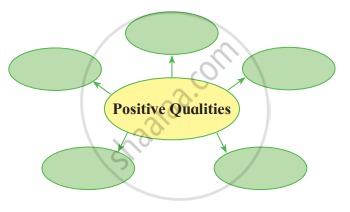
Find from the poem, positive qualities to fill up the web.
Arrange the following set of words in the alphabetical order in your notebook.
ship, small, successful, scoldings, stone, saving, someone, stood, streets, still, screamed, sat, seemed, saint, share.
Write the Rhyming word and Scheme of the 2nd stanza.
“Old man,” said a fellow pilgrim near,
“Why waste your time in building here?
Your journey ends with the close of the day You never again will pass this way.
You have crossed the chasm deep and wide Why build ye here at even tide?”
Trees are revered because:
- They give us joy.
- _________________
- _________________
- _________________
- _________________
Pick out some sentences from the lesson that convey a general truth.
Sue was a rich girl.
In the following sentence, point out the Main Clause and Subordinate Clause. Encircle the Subordinator.
Old Behrman was a painter, who lived on the ground floor.
Draw a picture of the scene described in the poem.
The description of the character is given below. Identify the character from the play. Find some sentences which support your choice.
He is a brave but irresponsible person.
The description of the character is given below. Identify the character from the play. Find some sentences which support your choice.
He is smart as well as brave.
Find the meaning of ‘Charity begins at home’. Find other sayings which have a similar meaning.
Write a short note on the following:
Care of animals in the regime of Emperor Ashoka
Using your imagination, and information from other sources, describe anyone stalls in detail.
Using the following points frame a character sketch of the narrator. Support each character trait with instances from the lesson.
- Diffident and timid
- Unusual behavior
- Ignorant about banking
- Nervous and careless
- Economical.
The following thing is mentioned in the poem.
Classify it as a happy and sad thing.
flowers - falling leaves
WWW is a short form of World Wide Web.
Find ten other short forms related to ICT (Information and Communication Technology).
Miranda was brought to the island ____________ years ago.
Identify the character or speaker
I must finish my task before I take my rest.”
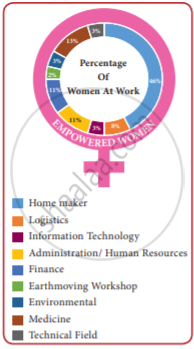
Read the data below and answer the following question.
Choose the correct answer.
Identify the three jobs where the same percentage of women work.
Why do we need trees? List four reasons that Grandfather gives.
Write the story in your own words
Read the passage three times and colour a bull for each time.
Mr. Murugan is a farmer. He has a small piece of land and two bulls. He takes good care of his bulls as they help him in farming. Every morning, he takes the bulls for grazing. When it rains he ploughs the land with the bulls. As he has no one to help he starts sowing the seed before sunrise. He irrigates the crop till it grows. He reaps and binds the crop then takes it to thrash the paddy. Finally, with the help of the bulls, he takes the paddy to his house.

Whom did Vicky want to do all his work?
Where did we visit a mermaid?
Write the rhyming word.
culture - ______.
Whose hospitality is described in the poem?
Pick and write the adverbs to complete the sentence.
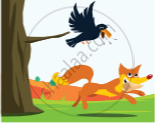
A jackal cheated the crow ______.
Circle and write the adverbs.
I drink coffee thrice a day. ______
What did Rani want to become?
Which creatures wake up in the morning before the child does?
While listening to the story, what did Alice see?
What was the most important thing that Helen finally understood?
Choose the right word.
The tamarind tree grows over Tansen’s ______.
What did the animals do when they saw the blue jackal?
