Advertisements
Advertisements
Question
The three stanzas depict three different phases. What are they?
Advertisements
Solution
The first stanza refers to the childhood days of the poet’s mother when she was twelve years old or so. The stanza depicts a photograph of her mother when she went for a beach holiday with her cousins and uncle.
The second stanza refers to the poet’s childhood days when her mother had become an adult. It depicts her mother recalling her childhood days while looking at the old photograph of hers (mentioned in the first stanza).
In the last stanza, the poet’s adult life is described in which her mother is not with her anymore. She has been dead for almost twelve years. The stanza depicts the poet’s looking at the same photograph and recollecting her mother’s laughter. The loss of her mother puts her in utter grief. She has no words to describe the terrible pain of her mother’s death.
APPEARS IN
RELATED QUESTIONS
Life is a gift to be used every day,
Not to be smothered and hidden away,
It isn’t a thing to be stored in the chest
Where you gather your keepsakes and treasure your best;
It isn’t a joy to be sipped now and then
And promptly put back in a dark place again
Life is a gift that the humblest may boast of
And one that the humblest may well make the most of
Get out and live it each hour of the day,
Wear it and use it as much as you may,
Don’t keep it in niches and corners and grooves,
You’ll find that in service its beauty improves.
(1) What do we treasure in a chest?
(2) How does the poet went us to use the gift of life?
(3) Do you agree that life should be measured un deeds and not in years? Why?
(4) Which words in the poem mean the following :
(a) Kept from developing
(b) Hollow places in a wall
(5) Life is a gift to be used every day. [Name and explain the figure of speech]
Read the passage and complete the activities given below
B1 Complete the table :
A few facts about the Mehendi rituals during marriage ceremonies are given below :
Write them into appropriate columns :
(i) A simple family affair.
(ii) Song and dance performances accompanied by lavish food and entertainment.
(iii) Creative family members, apply Mehendi to the bride.
(iv) Beauticians are appointed to apply Mehendi to the bride.
Fill in the table as :
| Yesteryears | Present times |
| (i) | (i) |
| (ii) | (ii) |
Mehendi enjoys special attention during the wedding. In India, the day before the wedding is devoted exclusively to the elaborate ritual of applying Mehendi on the hands and feet of the bride. This practice is followed in Arab countries as well, except that it is held a few days prior to the wedding day. Songs are woven around the healing properties and lucky omens associated with mehndi are sung by the bride’s family and friends. An age-old belief handed down to generations lays great emphasis on the color of the bride’s Mehendi – a darker color suggests bountiful love and affection from the future in-laws and husband, and for this reason, brides take the pain to ensure that only the best quality henna is used for her wedding day.
The ritual of adorning the bride with henna is a sacred one and in some communities requires the initiation by the mother-in-law. A popular game during marriage function is the search for their names, by the bride and groom hidden within the elaborate pattern on the bride’s hands.
In certain parts of India, the bridegroom has his hands decorated with henna. The Mehendi function during marriages has evolved from simple family affairs of yesteryears to elaborate events of today. A lavish spread of food and entertainment in the form of song and dance performances have transformed it from a small function to a gala prelude. In earlier days, the task of applying Mehendi on the bride was the sole prerogative of creative family members. The demand for intricate and different style now, sees this job outsourced to beauticians skilled in this art. Beauty salons charge according to the style and complexity of pattern desired by the clients.
B2 What is the age-old belief related to the bride’s Mehendi color and its significance?
B3 Find the words :
Find the words from the passage :
| Noun | Verd | Adjectives |
| (i) attention | attend | _______________ |
| (ii) creation | _________________ | creative |
A lot of money is spent nowadays on marriage ceremonies. What is your opinion about it?
Read the following extract of the poem and complete the activities given below :
B1 State which of the following statements are
True or False :
(i) The elderly are nearest to our own exalted personality.
(ii) The elderly are those persons whose growth is stunted.
(iii) We should know our elderly people well, in order to receive guidance.
(iv) The elderly hold on to the frivolous aspects of life.
Elderly people should be around us. Justify.
(b) abb
(c) abba
Tick the item that is closest in meaning to the following phrase.
to meet one's match
Explain the associations that the colour 'white' has in the story.
The significance of reading an autobiography lies in drawing lessons from another life. What is the significance of Kumudini's account for us as readers?
How does the poet tossed back from ecstasy into despair?
Discuss in groups and share your answer with the class.
Can you name the famous musician in Emperor Akbar’s court, who could perform miracles, when he sang different Ragas?
Answer in your own words.
Why did she decide to keep her new knowledge ‘a secret’?
The best punishment is ‘forgiveness’. Discuss the sentence in light of the text you have read. You can make use of the following points.
(a) Forgiveness provides an opportunity to change the behaviour.
(b) Forgiveness leads to repentance.
(c) A person may commit a mistake/crime impulsively or under the force of strong emotions.
(d) ________________________
(e) ________________________
Make a list of the preparations made for an assault on Tiger Hill.
Individual guns ___________.
Find from the lesson word/phrase that mean the following.
colours .............
Justify the verdict delivered in the poem.
I can support my answer with the help of the following suitable arguments:
- _______________________
- _______________________
- _______________________
Doctors who do special advanced study of specific parts of the body have special terms.
In your group try to match the specialist doctors with who / what they treat.
| Specialists | Who/What they treat | ||
| 1. | Dentist | a. | bone |
| 2. | Cardiologist | b. | brain/with spine |
| 3. | Ophthalmologist | c. | small kids |
| 4. | Orthopedic | d. | teeth |
| 5. | Pediatrician | e. | animals/birds |
| 6. | Neurologist | f. | eye |
| 7. | Veterinarian | g. | heart |
Fill in the gap, choosing a word from the bracket to make an appropriate comparison.
(tall / quiet / humble / merry / busy / slippery / fast / sly / slow / big)
as ______ as an eel
How are fabrics used in our daily life? List all the things that are made up of fabrics in your home. (At least 25)
Write a short note on the following:
The living world on Rakata
Shakespeare’s poetry has come to be valued for its own sake on the stage. Comment with reference to the play ‘A Midsummer Night’s Dream.’
Discuss and write 1-2 lines about the following,
Why Bushi told Yonamine not to travel at night.
What does the poet pray for? Why?
Complete the following using your own idea:
His head was too big to ______.
What two basic rules were followed in the Science Fair?
Find, in your science textbook, the topics of the stalls handled by students of VI A.
(Write the page number.)
Make a time table of your daily routine
- On a school day
- On a holiday, and
- During examinations.
Start at the time you normally get up and list your activities
hourly: 7 am to 8 am, and so on.
Write a review of your favorite book. Use the following points:
- Title of the book
- Author/Authors
- The central idea or story
- The important characters
- Some special features of the book
- Why it is your favourite book.
Link the items in the three columns properly.
| A | B | C |
| The past | A sea beneath a cloudless sun | A pleasant time which has ended |
| The present hour | A soft and mild autumn evening | An exciting, thrilling time which has no end. |
| The future | A green and flowery spray Where a young bird sits | A time, full of life in which you gather strength |
Discuss:
Is it necessary to develop a good accent? Why? What efforts can you take to improve your pronunciation? With your teacher’s help, find out how to use online dictionaries for the purpose.
Prepare similar word chains using the following ideas.
size - small _______________.
Write the following:
The sights mentioned in the third stanza.
Use the following outline to develop a story as a group activity. Then write the story individually.
Family returns home late at night ______ hear converstation between thieves from inside the locked house ______ family gets ready to counter ______ attack ______ father opens the door ______ all enter ______ no one is seen ______ but TV is on detective serial midway.
Read the poem and answer the following.
Which strawberries are plump and juicy?
Look at the speaker in each picture. Say whether each one is a good speaker. Give reasons for your answer.
 |
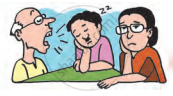 |
 |
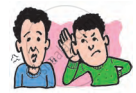 |
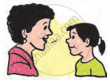 |
What does the poet want to know from the goldfish?
Guess the meaning of the following word.
beautify
"That's one small step for a man, one giant leap for mankind." Neil Armstrong - Discuss
Identify the character or speaker.
Now pray tell me, sir, your reason for raising this sea-storm?
What do you understand by the mother’s act of throwing the shoe?
Why should we speak gently?
Learning About Nature
Learn about caterpillars and butterflies. Read a book about a caterpillar turning into a butterfly. You can get one from the library or go online and find information with pictures.
Imagine you are a marketing executive for a company in a specific industry (toothpaste, soup, hair care products, automobiles, etc) and are developing a product with a brand name that refers to a character from the story.
For example: You want to sell bandages that have little pictures of Don Quixote on them. Your company’s name is Kure-All and you decide to call them “Kure-All Quixote Bandages”.
The slogan might be: “Had a tough day with windmills? When you take a fall, use Kure-All.”
You can use exciting words, a catchy new slogan and a jingle among other things to promote sales of your item.
Sea turtles come to rest on land.
Female Olive Ridleys come ashore at night to lay eggs.
A sea turtle camouflages its nest by tossing sand on it to ______.
Gulliver took the small creatures in his hand and crushed them.
Which line tells you that the girl was faster than the boy?
We don’t use _________ in the soil.
Read scene I of the play carefully and answer the question below.
Whom does Mother Wolf talk about? How does she describe him?
Vicky's father bought a______ robot
Choose the correct option from the given homophones.
What did you ______ at the store?
Write the rhyming word.
away
______was with Robinson.
Guess how would the sparrow pull the elephant and the crocodile.
Do you think you treat everyone equally? Justify with an example.
Why did Jana chase the squirrel?
Moles dig ______ to catch earth worms.
Replace the bold word/words with a word from the quiver and re-write the sentence –
Nasruddin was surely not a good archer.
Choose the right word.
The tamarind tree grows over Tansen’s ______.
