Advertisements
Advertisements
प्रश्न
The three stanzas depict three different phases. What are they?
Advertisements
उत्तर
The first stanza refers to the childhood days of the poet’s mother when she was twelve years old or so. The stanza depicts a photograph of her mother when she went for a beach holiday with her cousins and uncle.
The second stanza refers to the poet’s childhood days when her mother had become an adult. It depicts her mother recalling her childhood days while looking at the old photograph of hers (mentioned in the first stanza).
In the last stanza, the poet’s adult life is described in which her mother is not with her anymore. She has been dead for almost twelve years. The stanza depicts the poet’s looking at the same photograph and recollecting her mother’s laughter. The loss of her mother puts her in utter grief. She has no words to describe the terrible pain of her mother’s death.
APPEARS IN
संबंधित प्रश्न
Answer any four of the following in 30-40 words each:
(a) Why was the peddler amused at the idea of the world being a rattrap?
(b) Why did Gandhiji agree to a settlement of mere 25 percent?
(c) Aunt Jennifer's efforts to get rid of her fear proved to be futile. Comment.
(d) What does Stephen Spender want to be done for the children of the school in a slum?
(e) How did the ten-day-old baby (the future Tiger King) react to the prediction about his future made by the astrologers?
(f) Why was Dr. Sadao not sent abroad along with the troops?
Answer any four of the following in 30 − 40 words each:
(a) "It is his karam, his destiny." What is Mukesh's family's attitude towards their situation?
(b) What were the terms of the indigo contract between the British landlords and the Indian peasants?
(c) How will 'keeping quiet' protect our environment?
(d) Which objects of nature does Keats mention as sources of joy in his poem, 'A Thing of Beauty'?
(e) Why did the Tiger King decide to get married?
(f) What was Sadao's father's dream for him? How did Sadao realise it?
In ‘The Diary of a Young Girl’ how did the Franks and others celebrate two festivals, Hanukkah and St. Nicholas Day in the Annexe ?
A1 Web :
Complete the following web with the help of the passage :
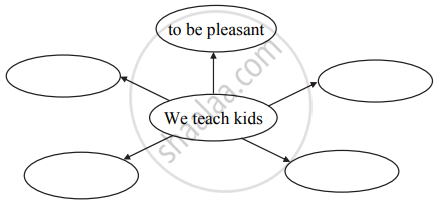
My dictionary tells me that personality is the “Personal or individual quality that makes one person be different and act differently from another.” Personality is, “the total physical, intellectual and emotional structure of an individual, including abilities, interests, and attitudes.”
There are many benefits to having a pleasant personality. There is only one opportunity to make a first impression, and all of us instinctively make decisions or judgments about an individual within the first few seconds of crossing paths. With that in mind, I believe when we teach our kids to smile, to be pleasant and cheerful, to be courteous and respectful of others, to pleasantly respond to requests or questions, we are helping them develop a personality that will open many doors for them. Once the doors are opened, the character will keep them open; but personality, not character, is on display in the first few seconds. Therefore, it’s important to develop a pleasant personality and use it for life.
A2 Personality :
Personality of an individual is recognized by :
(i) _______ (ii) _______
(iii) _______ (iv) _______
A3 Vocabulary :
Find out words for the following from the passage and write:
(i) polite =
(ii) relating to feelings =
(iii) to do anything naturally without thinking =
(iv) a chance to do something =
A4 Complete the following table :
| Noun | Adjective | Adverb |
| – | different | differently |
| Instinct | – | instinctively |
Select any word from the table and use it meaningfully in a sentence of your own.
A5 Personal Response :
Why do you thing, personality development is necessary?
Answer the following question in 150-200 words:
Why did Anne like her father more than she liked her mother?
Notice these expression in the text. Infer their meaning from the context.
cairn of rocks
How does 'A Munda song' show that the perspective of the tribal mind towards the girl child is different from that of [other ] mainstream communities?
The peacock is a colourful bird. How does the poem capture the various colours that its plumage displays?
State the central issue in the poem.
Why does the poet prefer to be a primitive Pagan rather than a member of civilised society?
Read the extract and state whether the following statement is true or false. Correct the false statement.
The author is an example of ‘reverse migration’.
What strong qualities possessed by them, could have helped them achieve success and fame, all over?
Make sentence of your own using the following expression.
put up with:
Read the story and complete the following.
When Revathi played her favourite raga, the plants began to move because, ____________.
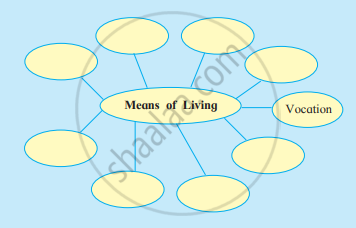
Pick out words that refer to ‘means of living’ and fill them in the Web.
(profession/recreation/occupation/job/ pastime/employment/hobby/career/entertainment/mission/trade/buisness/sports/retirement/placement)
Make a list of the preparations made for an assault on Tiger Hill.
They also explored to ______________.
Using a dictionary/internet note down the main difference between a developing nation and a developed nation.
Find evidence from the lesson and write in your own words.
Indians respect the freedom of others.
‘Never mind faded forests, Austin’. The word ‘faded’ means to become dim or faint. The word describes the forests that have become faint or dim in appearance. Now go through the poem again and complete the table.
| Describing word | Object | Explanation |
| 1. faded | forests | The forests have become faint or dim in appearance. |
| 2. silent | ||
| 3. unfading | ||
| 4. bright |
Sue and Johnsy were very close friends.
Pick out the statements which aptly depict the theme of the poem.
- In the poem, the speaker memorises the past.
- In ‘The Planners’ the poet describes the unstoppable force of modernisation.
- The poet talks about the replacement of natural environment by the concrete jungle.
- The poet proposes to stop modernisation.
- The poet laments helplessly.
Apart from the children, no other human beings are mentioned in the poem. However, many natural elements are shown to act like persons. Name them and also write what they do.
Discuss in groups and think about it.
List a few occasions on which you had become angry. What do you do when you are angry?
Show the stages in the process in which Krakatoa collapsed and then Anak Krakatoa formed in the course of volcanic eruptions. Use the flowchart given below.
Enact the advertisement:
Seven children wait in different places, striking a suitable pose as shown in the ad. The character ‘Krispy Krunchy’ comes in dancing. He goes near every child, singing the words shown in the ad. He offers a Krispy Krunchy piece to every child.
The child eats it and begins to smile and clap. At the end, the character faces the class, shows a big pack of Krispy Krunchy, and presents the last few lines.
Form a pair. Write at least one short dialogue for the following expression.
I agree.
Read the following words. Write the words that are combined to make these words.
- faraway
- nobleman
- whoever
- moneylender
- sometimes
Add ten more words to the list on your own. Each of the component words must be meaningful.
Write all the instances of the mischief done by Mr. Nobody.
Talk about your strengths.
Present these points in the form of a review, and give it a suitable title.
From the poem, find the old word used for each of the following :
- towards
- here
- does
Make adjectives from the following.
- harm
- continue
- believe
- fear
- thought
- wish
- question
- courage
Now try to add a contradictory word to the following:
- What a ______ mess you’ve got us into!
- It’s a ______ imitation of a diamond necklace.
- My trip to Matheran was a ______ holiday.
- With such heavy makeup, she looks ______ ugly.
- A ______ crowd gathered to see the magic show.
Note: Contrasting words that go together are examples of the language device called Oxymoron.
Fill in the blank choosing the appropriate word/idiom from the lesson.
In the examination, I did not know the answer, so I ______.
Describe the following in one or two lines.
The first little house of the bird.
List and say whether the following statement agrees with the passage or not.
When you want to make a speech, there’s no need to think about it in advance.
What does the poet want to know from the lark?
Give an instance that shows the pathetic condition of the young bird.
Complete the given tabular column with the suitable plural forms.
| chair | - | |
| box | - | |
| Eskimo | - | |
| lady | - | |
| radius | - | |
| formula | - | |
| child | - | |
| deer | - | |
| loaf | - | |
| hero | - |
Based on your reading, rearrange the following sentences in the correct sequence.
- Since all her methods failed, finally she gave him a pain-killer.
- He told his aunt that Peter had no aunt, so he gave him the medicine.
- The pain-killer triggered adverse reactions on Peter.
- It jumped out of the open window.
- Tom was dull and depressed.
- This incident upset Aunt Polly and she questioned him.
- But, Tom gave that painkiller to the cat Peter.
- So, Aunt Polly tried different types of remedies on him.
What game did Anne choose to play?
Rearrange the jumbled sentences and write them in the correct order.
- But Hamid bought a pair of tongs.
- Granny Ameena felt proud of her grandson.
- Hamid’s friends bought different toys of their choice.
- Hamid proudly compared his tongs with a brave tiger.
- Hamid had less money than his friends.
- Granny Ameena was worried as he had to go to the Eidgah alone.
Work in pairs and answer the following.
Write the rhyme scheme of the poem.
Vasantha could not see the rescue operation because ______
Grandmother had wanted the peepul tree cut down because______.
Identify the speaker/character.
"Don't let us down now, Gulliver; we need your help."
The boar slept until the fading sun told him it was time to get up. What does the phrase until the fading sun mean?
Our planet is called the _____.
Where did the space shuttle land?
What is our core?
What did the five friends call themselves?
Match the rhyming words.
| 1. | flow | know |
| 2. | grow | week |
| 3. | seek | blow |
Divide the following word.
circle
Read the advertisement and answer the question given below.

What is the advertisement about?
What happened to Jayan?
Does the child in the poem like her nose? Why do you think so?
Mention any three details that should not be revealed in public domain.
Pick out word which mean the same as
not protected (para 2)
Match the following items from column-A with those column-B:
| Column 'A' | Column 'Non-Textual' |
| (a) Geoffrey Chaucer | (i) Trinidad |
| (b) Daniel Defoe | (ii) Wuthering Heights |
| (c) V.S. Naipaul | (iii) Robinson Crusoe |
| (d) Emile Bronte | (iv) The Canterbury Tales |
