Advertisements
Advertisements
प्रश्न
Pick out word which mean the same as
not protected (para 2)
Advertisements
उत्तर
not protected (para 2)- insecure
APPEARS IN
संबंधित प्रश्न
Answer any four of the following in 30 − 40 words each:
(a) "It is his karam, his destiny." What is Mukesh's family's attitude towards their situation?
(b) What were the terms of the indigo contract between the British landlords and the Indian peasants?
(c) How will 'keeping quiet' protect our environment?
(d) Which objects of nature does Keats mention as sources of joy in his poem, 'A Thing of Beauty'?
(e) Why did the Tiger King decide to get married?
(f) What was Sadao's father's dream for him? How did Sadao realise it?
Read the passage and complete the activities given below :
B1 Pick out
The correct answers from the statements given below:
B2 Fill in the gaps with the information given in the passage :
Notice the following uses of the word ‘tell’ in the text.
1. Her fingers were busy telling the beads of her rosary.
2. I would tell her English words and little things about Western science and learning.
3. At her age, one could never tell.
4. She told us that her end was near.
Given below are four different senses of the word ‘tell’. Match the meanings to the uses listed above.
1. make something known to someone in spoken or written words
2. count while reciting
3. be sure
4. give information to somebody
Guess the meaning of the following word:
Kyang
In which language are these word found?
Look up the dictionary for the meaning of the word ‘diaspora’. What do you understand of the Indian diaspora from this piece?
Rearrange the following events as they occur in the story. Put the correct number in the boxes.
| (a) | Mr Fitzwarren provided shelter to Dick. | |
| (b) | A carter gave Dick a lift to London. | |
| (c) | A cat sailed to the African coast. | |
| (d) | The captain sold the cat for a very high amount of money. | |
| (e) | Dick left his village on foot, to go to London. | |
| (f) | Dick became rich, and later, the Mayor of London. | |
| (g) | Dick was homeless, helpless, cold and hungry. | |
| (h) | Dick bought a cat to get rid of the mice. | |
| (i) | The rats and mice ate up all the dinner, laid for the king and queen. |
Read the following sentence carefully and choose the correct meaning.
The Peacock had a gorgeous tail like no other bird.
Correct the given sentence with justification.
Since there is a reference to the Indian boy, there are some scenes from India too.
Draw word webs for the following.
Begin with the given word and go on writing as many other words associated with it, as you can.
Use these words to write other related words to form a word web.

Gather information about your favourite great historical personality. You may use the internet. You may also gather photographs, pictures, etc. Prepare a collage using the pictures, inspirational quotes, and a brief description of the person’s importance. Hold an exhibition of your collages in the classroom.
What is the difference between a 'dream' and a 'daydream'?
What is a website?
What is meant by being ‘offline’?
What different names is ‘Rangoli’ known by in different regions?
Guess the meaning of the following word.
coarse grained
Prospero ordered Ariel to bring ____________ to his place.
Answer the question in a paragraph of about 100 – 150 word.
Write a detailed character sketch of Prospero.
‘My tongs are like a tiger among toys.’ It means ______
They may have______ in______.
- soft
- vain
- fear
- joy
- love
- heard
- toiled
- mild
- good
- sand
- life
- harsh
It is a problem for sea turtles to come ashore because ______.
Read the poem aloud in pairs.
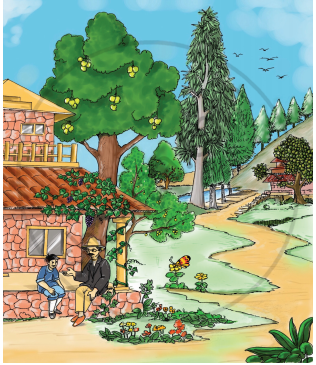
Listen to your teacher read the first part of the story. Many things described in the story can be seen in the picture. Find and name them.
How is water produced in Mars?
What was the epidemic that broke out in the story?
Pablo was the dog of ______.
Humans give importance to save______.
We ______ yarn to make sarees.
What did the boy wonder about?
What did Pinocchio say in the end?
Read the passage below:
| 1. | Our history makes it evident that the Indian Plastics Industry made a vigorous beginning in 1957 but it took more than 30 years for it to pervade Indian lifestyles. In 1979, "the market for plastics' was just being seeded by the state-owned Indian Petro-Chemicals and it was only in 1994 that plastic soft drink bottles became a visible source of annoyance. |
| 2. | In the same year, people in other cities were concerned about the state of public sanitation and also urged regulatory bodies to ban the production, distribution and use of plastic bags. However, the challenge was greater than it appeared at first. |
| 3. |
The massive generation of plastic waste in India is due to rapid urbanisation, spread of retail chains, plastic packaging from grocery to food and vegetable products, to consumer items and cosmetics. The projected high growth rates of GDP and continuing rapid urbanisation suggest that India's trajectory of plastic consumption and plastic waste is likely to increase.
|
| 4. | According to the United Nations Environment Programme (UNEP) report of 2018, India stands among few other countries like France, Mongolia and several African countries that have initiated total or partial nationallevel bans on plastics in their jurisdictions. On World Environment Day in 2018, India vowed to phase out single-use plastics by 2022, which gave a much needed impetus to bring this change |
| 5. | In this context, thereafter ten states (Andhra Pradesh, Chhattisgarh, Gujarat, Himachal Pradesh, Karnataka, Madhya Pradesh, Meghalaya, Odisha, Rajasthan and Tamil Nadu) are currently sending their collected waste to cement plants for co-processing, twelve other states/UTs are using plastic waste for polymer bitumen road construction and still four other states are using the plastic waste for waste-to-energy plants and oil production. A world of greater possibilities has now opened up to initiate appropriate and concrete actions to build up the necessary institutions and systems before oceans turn, irreversibly into a thin soup of plastic. |
| 6. | However there is no one single masterstroke to counter the challenges witnessed by the staggering plastic waste management in the country. The time is now to formulate robust and inclusive National Action Plans and while doing so, the country will establish greater transparency to combat the plastic jeopardy in a more sustainable and holistic way. |

Based on your understanding of the passage answer any six out of the seven questions given below:
- What does the writer mean by 'visible source of annoyance'?
- Why did people demand a ban on plastics?
- What created a demand for plastics in India?
- With reference to the graph write one conclusion that can be drawn about the production of plastics in 2019 (approximately).
- What does the upward trend of the graph indicate?
- What does the line, oceans turning 'irreversibly into a thin soup of plastic', suggest?
- What step must be taken to combat the challenges of plastic waste management? What will be its impact?
