Advertisements
Advertisements
प्रश्न
The significance of reading an autobiography lies in drawing lessons from another life. What is the significance of Kumudini's account for us as readers?
Advertisements
उत्तर
We as readers can understand many core issues of life by going through the account of Kumudini. Her training in dance in her initial years teach us the lesson that learning any art form requires dedication and hard work. It needs rigour to acquire the skills. Her account of going to the dance teacher's house show her sheer dedication to the art.
We can know about the value of discipline when Kumudini talks of her teachers in Queen Mary's college, Lahore. According to Kumudini, discipline in one's daily routine does bring discipline in thinking. This is really inspiring for the readers.
Kumudini's account of her days with guru Ram Gopal is inspiring. We can learn the lesson that one needs to perfect the technique with which one begins to experiment.
Her account teaches us that one should learn to adjust with a group of different personalities as in a family and a performance on the stage.
APPEARS IN
संबंधित प्रश्न
(a) crushing/destructive (pars 1)
(b) used to (pare 2)
(c) searching (pare 4)
Read the following passage and complete the activities given below :
A1 Find out :
Find from the passage the related words to the sea and write them.

ON FIERCE monsoon nights, about one and a quarter-mile off the Mumbai harbor, there have been occasions when 52-year-old Bikaji Ramchandra Dhuri is the only man on the sea. From the watchtower of the Prongs Reef Lighthouse, which is surrounded on all sides by the Arabian Sea, he has heard the sea rage like a possessed spirit – the darkness dispelled only by the beam of light flung across the waters from the tower he mans.
Dhuri is one of the last breeds of lighthouse keepers on the Indian coast, as a majority of the 182 lighthouses in the country are now unmanned. Built-in 1871, the Prongs Reef lighthouse was modeled on Scotland’s Skerryvore Rocks Lighthouse and is located at a strategic spot on the western coast, marking the entrance to the busy Mumbai Harbour. It was meant to stem the number of shipwrecks off the harbor, which the lone Colaba lighthouse could not illumine on its own. “Even now, during nights, for fishing vessels without any gadgets, it’s the soft light from this tower which directs us to Mumbai,” says Vinayak Koli, a boatsman who helps ferry people and also goes on fishing expeditions.
Throughout the year, Dhuri lives in the lighthouse for 15 days at a stretch, when he is relieved by another keeper. In the monsoon, it becomes his home for three months. “We call it the Kalapana as we are alone in the middle of the sea for days, with basic supplies – and the revolving light that keeps the sea awake,” he says.
A2 Fill in the following information using words from the passage :
(i) The Prongs Reef lighthouse was modeled on _______.
(ii) Dhuri lives in the lighthouse for _______ at a stretch.
(iii) _______ is one of the last breeds of lighthouse keepers on the Indian coast.
(iv) The majority of the _______ lighthouses in the country are now unmanned.
| Violent | Scattered | Place of shelter for ships | Shine light |
A4
A5 Personal Response
Imagine you have to spend a night in a lighthouse. Narrate your experience.
Read the following passage and do the activities:
A1 True or False:
Rewrite the following statements and state whether they are ‘true’ or ‘false’.
(i) Mashelkar’s mother did menial work to bring him up.
(ii) Mashelkar’s father died when he was twelve.
(iii) Mashelkar was born in a very rich family.
(iv) Tatas added much value to Mashelkar’s life.
I start with my greatest guru-my mother. I was born in a very poor family and my father died when I was six. We moved to Mumbai and my mother did menial work to bring me up. Two meals a day was a tough challenge. I studied under street lights and I walked barefoot until, I think, I was twelve. I remember when I passed the seventh standard and I wanted to go into the eighth standard, our poverty was such that even to secure 21 rupees for secondary school admission became a big challenge. We had to borrow from a lady, who was a housemaid in Chaupati in Mumbai. That was the tough life I had.
In fact, I remember, my passing the SSC Examination-i.e. 11th standard. Those days it used to be not 10th standard or 12th standard but 11th standard. I stood 11th among 1,35,000 but I was about to leave higher education and find a job. What helped me was the scholarship by Sir Dorab Tata Trust. It was just 60 rupees per month and would you believe that 60 rupees per month from Tatas added so much value to my life that I have been able to stand here today before you to speak to you.
I am on the Board of Tatas now and it is very interesting that the same Bombay House where I used to go to collect that 60 rupees per month now one goes and sits there like a Director on the Board of Tata Motors. The turn that these 40 years have taken is very interesting. It has all been possible because of the chance I got to do higher studies at the insistence of my mother. She gave me the values of my life. She was one of the noblest parents I have met in my life.
So, my greatest guru was my mother. My second guru was Principal Bhave, about whom I made a mention earlier. He taught us Physics. Because it was a poor school, I remember, it had to innovate to convey to the young students the message of Science.
A2 Complete:
Complete the following sentences and write:
(i) Mashelkar was inspired by his greatest guru _______
(ii) Mashelkar studied under _______
(iii) Principal Bhave taught _______
(iv) The scholarship by _______ Trust helped him in higher education.
A3 Find the meaning:
Choose the appropriate meaning of the underlined words from the given alternatives:
(i) We moved to Mumbai and my mother did menial work.
(a) skilled
(b) hard
(c) unskilled
(d) of low status
(ii) Because it was a poor school, it had to innovate to convey to the young students the message of science.
(a) do a cheap experiment
(b) introduce new things
(c) avoid
(d) try hard
(iii) I got to do higher studies at the insistence of my mother.
(a) firm saying
(b) being inspired
(c) being inspected
(d) being instigated
(iv) That was the tough life I had.
(a) difficult
(b) soft
(c) cheap
(d) simple
A4 Match:
Match the following sentences with their tags:
| 'A' | 'B' | ||
| (i) | I stood 11th among 1,35,000 |
(a) | aren’t I? |
| (ii) | I am on the Board of Tatas | (b) | didn’t we? |
| (iii) | It was a poor school | (c) | didn’t I? |
| (iv) | We moved to Mumbai | (d) | wasn’t it? |
A5 Personal Response:
“Mother is the greatest Guru.” Discuss.
Talk to your partner about the following.
Would you agree that the author’s grandmother was a person strong in character? If yes, give instances that show this.
The narrative has many phrases to describe the scenic beauty of the mountainside like:
A flawless half-moon flated in a perfect blue sky.
Scan the text to locate other such picturesque phrases.
We 'draw up a deed'. Complete the following phrase with an appropriate word.
________a deaf ear to
What distinguishes the tribal imagination from the secular imagination?
How does Forster use the analogy of Scheherazade to establish his point ?
Answer in your own words.
What are the provisions in the Declaration of the United Nations, to ensure the equality of men and women?
State whether the following statement is True or False. Correct the false statement by finding evidence from the poem to support your remark.
The poet was exalted at the sight of the cherry tree.
Read the story and choose the appropriate meaning.
Skeleton branches ____________.
Read the story and choose the appropriate meaning.
Wielded the brush ____________.
Say where the image from nature given in the poem exists.
AIR / LAND / WATER
beneath the boughs
Discuss in your class.
How can we take help of robots in our daily life?
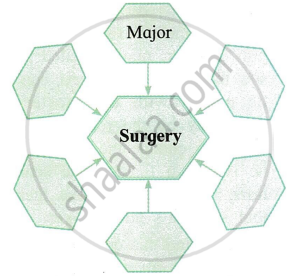
Fill in the web with words related to 'Surgery'.
Say WHY. . . . . .
Hardy invited Littlewood for a discussion.
Suggest what you would do in the following situation:
One particular friend of yours is always late for college, social functions, movies, etc. and delays everyone.
The description of the character is given below. Identify the character from the play. Find some sentences which support your choice.
He is smart as well as brave.
Read the story and write about the following in short.
Yonamine Chiru of Okinawa
Form groups and hold debates on the following topics. Make bulleted lists of points in favour of the topic (pros) and those against it (cons). (3-6 points each)
You should never lose a match.
Write a short speech for the State of Maharashtra.
Form a pair. Write at least one short dialogue for the following expression.
I agree.
What were the three things that Sushruta discovered?
Bassanio borrowed money from Shylock in Antonio’s name.
What themes would you like to add to the themes given in this passage?
Put the following events in chronological order.
- The sword in the stone appeared in the churchyard.
- Lord Uther died.
- Lord Uther drove the barbarians away.
- The Lords and knights began to fight for the kingdom.
- Sir Kay left his sword behind at home.
- Merlin announced that Arthur was the son of Lord Uther.
- Arthur brought the sword from the churchyard.
- Ancient Britain was invaded by wild barbarians.
- Many knights tried to pull the sword out of the stone.
- Arthur grew up in Sir Ector’s house.
- Merlin entrusted a baby to Sir Ector.
Write about the sights you may see from a bus or an airplane. You may write it in the form of a short poem.
Answer in your own words.
What did Neel realise from his encounter with his ancestors?
Read: ‘The Listeners’ and ‘Someone’ - poems by Walter de la Mare.
Choose the appropriate phrase to insert in the gap, to make the sentence meaningful. Use the appropriate form of the verb.
I ______ just as I was to receive my Report Card.
Often the brook speaks of itself as if it is human.
For example, 'I bicker down a valley.'
Find two other examples of the human activities of the brook.
Make a list of your favourite fruits and vegetables and note down the time of the year when they are available in plenty.
Guess the meaning of the following word.
water-logged
Read the highlighted words. They are adverbs.
- I was pulling hard.
- They ran away.
- Later, I was taken to the city.
- I went very carefully.
- They were greatly pleased.
Guess the meaning of the following word.
fragrant
What conclusions did grandfather jump to when he saw the cops?
The author was going to New York.
How did Hamid’s friends show that they enjoyed eating the sweets?
What is inclusion? Why is it important?
What makes us happy and free, according to the poet?
Grandfather felt planting trees would help the forest because______.
Mithali’s mother tongue is Telugu.
_____ is called the red planet.
Imagine you are the girl and give a different ending to the story.
Choose the odd one out.
Where was the old man sleeping?
Write the rhyming word.
Bird - ______.
Choose what the elephant did.
Identify the character/speaker.
He bought a new fish tank.
Choose and write the adverbs to complete the sentence.

She coloured the picture ____.
Which disaster had hit the village?
The king looked for a______.
Why did the king want a leader who knows to grow a plant?
What will help us grow?
Nithin had many ______toys.
If the fisher draws his net soon, he won’t get ______ in the net.
What do you think birds say to each other in the morning?
Who said – “Oh, my ears and whiskers? How late it’s getting!”
Where did the naughty boy go?
Read the passage given below:
| 1. | Very often, we do not take the first step towards a good cause because we say to ourselves, "The task is so big. What can I do alone?" So nothing gets done. There is much talk about environmental protection, air pollution and saving our forests. Do we really care? If we do, here are a few things we can do to make our surroundings more pleasant. |
| 2. | It is good to adopt a two-uses-attitude! By putting an article to a second use, we are giving it a longer lease of life and using up less raw material from nature. One of the worst things we do is abuse of paper. The clean sides of envelopes can be used to write small notes, lists and reminders around the house. The more paper we use, the more trees will have to be cut down. For the same reason, we should avoid the use of paper napkins or paper plates. Cloth napkins are just as good, for they can be washed and used over and over again. |
| 3. | Another area which needs the most urgent attention is effective garbage disposal. People who are conscious about it follow rules and laws strictly. As a result, their neighbourhoods are clean and beautiful Similarly, each one of us can contribute to a cleaner environment. All kitchen waste should be collected separately. Those of you who have green fingers can turn this into valuable manure. Dig a pit and put the kitchen waste into it. When the pit is a little over half full, cover it up with mud. Let nature do the rest. Within three or six months, we will have a good garden manure. It can also be done as a community project by digging a large pit in the colony. Do take help of all the members, for nothing succeeds like co-operation |
| 4. | A lot of people don't care about the environment because they don't understand the adverse effect that society has on it. It is important to convince people to care about the environment. The first step would be to convince people to change by providing simple alternative solutions and ways of doing things. Theintemet is a powerful tool and a group on social media of like-minded people can be formed. People can share environmental stories and issues, as well as pool in solutions and alternatives to educate one another. With the current state that our planet is in, it is imperative that people actively care about the environment and most importantly to act now. |
Based on your understanding of the passage, answer any Eight questions from the nine given below:
- Why don't we take the first step towards a good cause?
- What is a two-uses-attitude?
- What can we do to avoid the abuse of paper? (any two points)
- What is the result of an effective way of a garbage disposal?
- What procedure can one adopt for kitchen waste?
- How can making of garden manure be done as community project?
- How long does it take to make good garden manure?
- Select a suitable word from the passage which means - being concerned or interested. (Paragraph 3)
- Pick out the word from the passage which means - completely necessary? (Paragraph 4)
