Advertisements
Advertisements
प्रश्न
Personification is a figure of speech that attributes human qualities to inanimate things and abstract ideas. How has it been used in the poem?
Advertisements
उत्तर
Padma Sachdev is a Dogri poet that is close to her indigenous language. In her poem Mother Tongue, she is in a melancholic mood for her language is depreciating and that its script has died away. She is admiring her mother tongue Dogri and its native script Sharade and praises it in leaps and bounds. She calls it a “very kind Shahni”, a benevolent mistress, who is always ready to help any author or poet, “ever ready to do her bidding”. Padma transcends the furthest boundary and praises Dogri as if it were the queen of all languages, an empress who is served by all the literature folk and scripts calling them all “her servants”. However, Dogri is just one of many languages spoken in the whole of India. It is one of the 22 scheduled languages in India and is spoken in the Jammu province of J and K and in Northern Himachal and in Azad Kashmir (Neelum Valey). Even the scripts join in and admit that they all are servants of Dogri and helps the poet by giving her a new quill.
APPEARS IN
संबंधित प्रश्न
It was her determination that helped Helen Keller get admission to Radcliffe College. Comment.
Answer the following in 30-40 words each:
(a) Why do you think the booking clerk refused to accept the money? Why did the narrator get out so fast?
(b) Why could the Russian research vessel, ‘The Akademik Shokaskiy’ not move any further? What did the captain decide then?
(c) What sort of hunts did the Maharaja offer to organize for the high-ranking British officer? What trait of the officer does it reveal?
(d) What did Jo want the wizard to do when Mommy Skunk approached him?
Read the extract and do the following activities :
B1 Likes and dislikes :
(i) The child likes eating _______
(ii) The child dislikes eating _______
They won’t eat peas, don’t like your bread -
For something in it crunches;
They gag on fat, the gravy’s gross,
They won’t eat grapes in bunches.
Tomatoes, onions, peppers, fish
Garlic nor cottage cheese;
Oh, it’s a dish uncommon rare
That truly seems to please.
No red sauce may the ice cream have,
“It’s bleeding,” they will say;
And gravely hand it to their mum
To take it to clean away
But let us speak of chocolate cake,
It must be frosted o’er;
They’ll devour three full slabs,
And calmly ask for more.
Oh, I do so always love to eat
With picky little pests,
Whose parents joy to make them
The most undesirable guests!
B2 What message does the poem convey for children?
B3 Pick out two pairs of rhyming words from the poem.
Answer the following question in 200-250 words:
What is the main theme of 'The Diary of a Young Girl'?
Mention the odd way in which the author’s grandmother behaved just before she died.
Which language do you think the author and his grandmother used while talking to each other?
What does the word ‘cardboard’ denote in the poem? Why has this word been used?
'The author's treatment of the subject matter makes the readers identify themselves with the experience.' Comment on the statement.
Why do you think that the poet has chosen the title ‘Telephone Conversation’? If you were to suggest another title for the poem, what would it be?
Discuss in pairs or in small groups
'Our daily life reflects a double allegiance to 'the life in time' and 'the life by values'.
Read the extract 'Being Neighborly' and complete the following statement:
In order to tidy the room, Jo __________________.
Give a brief account of the interaction between Grandpa and Jo.
Pick out a word from the poem to complete the sentence meaningfully.
The Government made a ______ (announcement) about their new taxation policy.
In Gujarat, the kite - festival is celebrated to welcome the Spring.
You might have visited a bridge. Complete the web describing the sights you could see from the bridge.

‘The city now, doth, like garment wear’. The poet imagines that the city is wearing a beautiful garment. Hence, the figure of speech is personification. Find out more examples of personification from the poem.
Expand the idea inherent in the following proverb :
Fools rush in where angels fear to tread - Alexander Pope.
The word 'Review' is different from summarizing and appeal writing. Choose the correct statements of the following.
Form groups and discuss the following question:
The events described in the poem take place at a certain place, at a certain period of the year, under specific weather conditions. Describe the place, the time, and the weather conditions.
Enlist a few reasons for watching a drama live on the stage.
State whether the following statement is True or False:
Both Demetrius and Lysander fight for Hermia.
Answer the following question in one sentence.
Why does he ‘miss all the fun’?
How do the following avoid giving anything to the traveller?
Motiram
(Answer in one or two lines.)
Portia saved Antonio in the court of law.
Prepare similar word chains using the following ideas.
size - small _______________.
Read the passage and name the following.
He led the defense of Troy for nine years.
Write the following:
The sights seen through a railway carriage mentioned in the first stanza.
Gather more information about the following from your Science textbook, the internet, and other sources.
Gravitational force
Write the rhyme scheme of the poem (Autumn).
Present these points in the form of a review, and give it a suitable title.
Using your imagination, write about a beautiful region - its landforms, water bodies, flora and fauna, night sky, people, etc.
Find from the Internet and write down.
Which character from the play sings this song?
Discuss how you will measure the worth of a friend.
Find a word that has a similar meaning.
remove
What were the children doing beside the stone wall?
At dawn, the______ began to sing.
Pick out the words which rhyme with the given words and write similar rhyming words on your own.
| 1. | far | ||
| 2. | fear | ||
| 3. | low | ||
| 4. | kind | ||
| 5. | remain | ||
| 6. | they |
Identify the character/speaker.
Go to my cottage and fetch my gloves and fan.
Identify the speaker/character.
Stop ship. Drop anchor. Quick!
What is the poem about?
How did Grandfather’s dream come true?
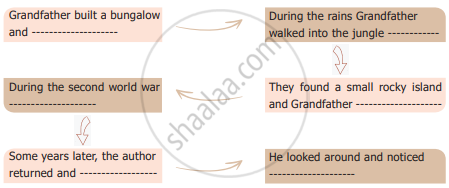
Read the story on your own. Discuss in a group and complete the story map below.
| A story map is the main events of the story given in a flow chart. |
Amma bought the vegetables from the______.
Read the lines and answer the questions given below.
Autumn is English
in red, yellow and brown
Autumn is Indian
Whenever leaves fell down
- How is autumn in India?
- Compare the English autumn with the Indian autumn.
In this story, what happened to the Earth?
Why did the girl reply haughtily?
A ________ dies for the nation.
Find the rhyming word from the poem.
Country - ______.
Jaswant was helped by __________ tribal girls.
How did he win the match?
Robinson named the boy______.
Number the pictures in the correct order of the story.

A Shepherd had a _______.
In real, the test is for______.
Do you think Ani will be a good leader? Why?
Do you tell the truth always? Why?
Does the brush bend to her will?
Finally, ______, he got permission to study Science.
Read the following passage and answer the questions that follow:
The Stationmaster’s Supreme Sacrifice by Sanchari Pal (Adapted)
- Thirty-three years ago, on the night of December 2, 1984, Bhopal was hit by a catastrophe that had no parallel in the world’s industrial history. An accident at the Union Carbide pesticide plant in Bhopal had released almost 30 tons of a highly toxic gas called methyl isocyanate, turning the city into a vast gas chamber. The result was a nightmare; more than 600,000 people were exposed to the deadly gas cloud that left thousands dead and many more breathless, blind and in agonizing pain. Few people know that during the Bhopal gas tragedy a heroic stationmaster risked his own life to save others.
- On the evening of December 3, 1984, Ghulam Dastagir was settling down in his office to complete some pending paperwork. This work kept him in his office till 1am in the night, when he emerged to check the arrival of the Gorakhpur Mumbai Express. As he stepped on to the platform, the deputy stationmaster felt his eyes burn and a queer itching sensation in his throat. He did not know that poisonous fumes leaking from Union Carbide’s pesticide factory were stealthily enveloping the railway station.
- Beginning to choke, Dastagir did not know then that twenty-three of his railway colleagues, including his boss, station superintendent Harish Dhurve, had already died. It was later reported that Dhurve had heard about the deadly gas and had immediately tried stopping the movement of trains passing through Bhopal before collapsing in his office chamber. His suddenly worsening health and years of experience told Dastagir that something was very wrong. Though he did not fully comprehend what was happening, he decided to act immediately when he did not get any response from the station master. He alerted the senior staff at nearby stations, like Vidisha and Itarsi, to suspend all train traffic to Bhopal.
- However, the jam-packed GorakhpurKanpur Express was already standing at the platform and its departure time was 20 minutes away. Listening to his gut instinct, Dastagir summoned his staff and told them to immediately clear the train for departure. When they asked if they should wait until the order to do so came from the head office, Dastagir replied that he would take complete responsibility for the train’s early departure. He wanted to ensure that the train left immediately, without any delay. His colleagues later recalled that Dastagir could barely stand and breathe as he spoke to them. Breaking all rules and without taking permission from anyone, he and his brave staff personally flagged off the train.
- But Dastagir’s work was not done. The railway station was filling up with people, desperate to flee the fumes. Some were gasping, others were vomiting, and most were weeping. Dastagir chose to remain on duty, running from one platform to another, attending, helping and consoling victims. He also sent an SOS to all the nearby railway offices, asking for immediate medical help. As a result, four ambulances with paramedics and railway doctors arrived at the station. It was winter and the gas was staying low to the ground, a thick haze poisoning everything in its path. Besieged by hordes of suffering people, the station soon resembled the emergency room of a large hospital. Dastagir stayed at the station, steadfastly doing his duty, knowing that his family was out there in the ill-fated city. That day all he had for his protection was a wet handkerchief on his mouth.
- Ghulam Dastagir’s devotion to duty saved the lives of hundreds of people. However, the catastrophe didn’t leave him unscathed. One of his sons died on the night of the tragedy and another developed a lifelong skin infection. Dastagir himself spent his last 19 years shuttling in and out of hospitals; he developed a painful growth in the throat due to prolonged exposure to toxic fumes. When he passed away in 2003, his death certificate mentioned that he was suffering from diseases caused as a direct result of exposure to MIC (Methyl Isocyanate) gas. A memorial has been built at platform No.1 to pay tribute to those who sacrificed their lives in the line of duty on the fateful night of December 3, 1984. However, Ghulam Dastagir, who died later, is not one of them. A forgotten hero whose sense of duty and commitment saved countless lives, Dastagir’s story deserves to be recognized and remembered by our fellow countrymen.
- Why was the accident at Union Carbide unparalleled in the world’s industrial history?
- How was Dastagir affected by the poisonous gas?
- What was the action taken by the station superintendent?
- How did Dastagir and his staff break rules?
- What was the cause of Dastagir’s death?
- Find words from the passage which mean the opposite of the following.
- safeguard (para 1)
- common or familiar (para 2)
- prompt (para 4)
- cause (para 6)
Match the following items from column-A with those column-B:
| Column 'A' | Column 'Non-Textual' |
| (a) Geoffrey Chaucer | (i) Trinidad |
| (b) Daniel Defoe | (ii) Wuthering Heights |
| (c) V.S. Naipaul | (iii) Robinson Crusoe |
| (d) Emile Bronte | (iv) The Canterbury Tales |
