Advertisements
Advertisements
प्रश्न
What were the attempts made by the author to get his watch repaired?
Advertisements
उत्तर
After a possession of 18 months, the author let his watch run down. Devastated, the author went to all possible watch makers starting from the chief jeweller, the very next day. The head of the establishment pushed the regulator of the watch a little too much, which did no good, rather worsened its condition. Then the author went to another watch maker who kept it for a week and slowed it down, however, too much. Then he went to another one who kept it for three days; and then couple of more. Even after having spent thousands dollars, none of the watch makers could fix the watch. Hopeless, the author gave it a last shot and went to a watch maker who turned out to be an erstwhile, not a good, steam-boat engineer. It was now that the author realised that “a good horse was a good horse until it had run away once, and that a good watch was a good watch until the repairers got a chance at it. ”
APPEARS IN
संबंधित प्रश्न
Answer any four of the following in 30–40 words each :
(a) Describe the irony in Saheb's name.
(b) Why was Gandhiji opposed to C.F. Andrews helping him in Champaran?
(c) Aunt Jennifer's efforts to get rid of her fear proved to be futile. Comment.
(d) What does Stephen Spender want to be done for the children of the school in a slum?
(e) When he was only ten days old, a prediction was made about the future of the Tiger King. What was ironic about it?
(f) What was his father's chief concern about Dr. Sadao?
What inference can you draw from the action of the female gorilla described in para 2 ?
How would you say ‘a dilapidated drum’ in your language?
Notice the italicized sentence placed at the top of the article which tells us at a glance what the article is about.
Tick the item that is closest in meaning to the following phrase.
to be wound up
The episode has been narrated in a light vein. What social mores does the author seem to ridicule?
Comment on the subtlety with which the poet captures the general pattern of communication within a family.
What makes the urgency of the child's demand seem logical?
The title, 'Refugee Blues' encapsulates the theme of the poem. Comment.
Identify the words that help you understand the nature of the poet's father.
Read the following statement and mark those that apply to you.
I make friends easily.
Rearrange the letters to make meaningful words, occurring in the poem.
- clearmis ____________
- sowmid ____________
- gearuoc ____________
- rissupser ____________
- tabyue ____________
- madres ____________
- laveu ____________
- downre ____________
What message does this story bring out for youngsters?
Think and answer in your own words.
Does the poet really wish to become a hawker/gardener/watchman? Justify your response.
The writer of the story is William Blake.
The special thread for kite - flying is sharpened by adding sugar and glass pieces.
Correct the following statement.
Sue and Johnsy were good neighbours.
Proverbs associated with the word season: for eg: Make hay while the sun shines.
- _________________________
- _________________________
Find a suitable object for each comparison.
The description of the character is given below. Identify the character from the play. Find some sentences which support your choice.
He is a major character. He dominates in the story.
Discuss the following question after you have seen a presentation of the ‘ad’.
Think of the people you like. Do you like them because they have a fair (white) skin or because of some other qualities? List those qualities.
Divide the story into different sections to show the different events and time periods in it. Give a suitable title to each section.
Think carefully for a minute.
Jog your memory and recall all the things/objects on which you have seen wheels. Write them down
Imagine you are visiting the Science Fair. What other stalls (apart from the ones mentioned here) are you likely to find there? Try to list at least five more stalls.
To whom is the poem addressed?
Use the following expressions in your own sentences:
- We all agree that
- It is he/she who
- Don’t you see
- None of us
Read the following sentence aloud. Write who said it and to whom.
“You have nothing else?”
Visit a library:
Read the stories of King Arthur and his Knights of the Round Table.
Sayali made a hasty purchase.
Write in your own words.
How does the poet describe his home in the second stanza?
What did Gopal Bhand want to tell the husband and wife?
Make groups. One person in the group chooses an announcement. Everyone in the group reads that announcement silently but carefully and closes their books. Then that person presents the announcement, changing one of the details in the announcement. Others spot the change. For example, you might say ‘red’ key chain instead of ‘blue’ in the last announcement.
Name the following.
Captain of the Indian Team.
Discuss what you can do to help other animals in your surroundings. Write down any three ideas you like from the discussion.
What did he try to take the milk from?
Draw a diagram to explain the idea of Internet.
He decided to find his cousins’ home without their help. He asked the policeman for information in Italian because he.
What did Suresh ask Usha? Why?
When are we in a state of trance?
Can a courageous man be defeated? Why?
Read the following lines and answer the questions.
It’s part of his hours, his days and his years,
Back of his smiles and behind his tears.
What does ‘tears’ mean?
There are seven kinds of sea turtles in the world.
What made Grandfather plant saplings on the rocky island?
According to the author the tendril was moving towards grandfather because it______.
Who came to India from Portugal in search of pepper?
Fruits, vegetables, and water in the Mars are not ______.
How does Patna differ from Delhi?
The robot did not obey his master.
How did Vicky change at the end?
Write the correct form for the present perfect tense.
They ______ (start) playing.
Recite the poem 'Treasure Trove' with the correct intonation.
Choose the champion of the year.
Choose and write the adverbs to complete the sentence.

The lion fought _____.
Guess how would the sparrow pull the elephant and the crocodile.
Fill in the blank with rhyming word.
tree- ______
Read the passage three times and colour a dustbin each time.
|
I am Mani. I had to take a bus to nearby city. I crossed the road to reach the bus stand. I got the bus, sat down, and read a book. Before I started to read, I just looked at the people around me. The two men sitting next to me were talking loudly. Some were listening to music on their phone. I was unable to focus on reading. The men were talking about cleaning the city. As they were talking, they opened a pack of biscuits to eat. After some time I dozed off. When I opened my eyes, the bus had reached the city. The two men were not there but pieces of the biscuits and wrappers were there. I cleaned the wrappers and put them in the dustbin.
|

- What did Mani take out?
- What did Mani find on the seat when he woke up?
- If you were Mani, what would you do?
Match the rhyming words.
| strokes | floor |
| shore | rush |
| brush | chokes |
The Delhi government did not allow blind children to study Science after ____________.
Are these sentence TRUE or FALSE
The poet tells the child to think of friends after it is dark.
The passage given below is on Kabbadi. Read the passage and complete the activities that follow.
Kabbadi (கபடி - in Tamil) is a contact team sport that originated in Tamil Nadu, India. It is the national sport of Bangladesh. It is also popular in South Asia and is the state game of the Indian states of Tamil Nadu, Kerala, Andhra Pradesh, Bihar, Haryana, Karnataka, Maharashtra, Punjab, and Telangana.
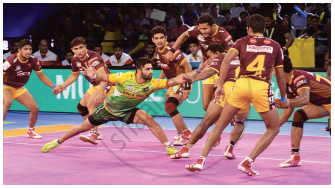
Kabbadi is played between two teams of seven players: the objective of the game is for a single player on offence referred to as a 'raider', to run in to the opposing teams half of a court, tag out as many of their defenders as possible, and return to their own half of the court–all without being tackled by the defenders. Points are scored for each player tagged by the raider, while the opposing team earns a point for stopping the raider. Players are taken out of the game if they are tagged or tackled, but can be 'revived' for each point scored by their team from a tag or tackle. The raider should hold his breath and utter the words like 'kabbadi kabbadi, hututu hututu, chadu kudu' etc. while the opponents try to catch him. If he stops uttering these words, he is considered out.
The game is known by its regional names in different parts of the subcontinent, such as Kabbadi or Chedugudu in Andhra Pradesh, Kabbadi in Kerala and Telangana, Hadudu in Bangladesh, Bhavatik in Maldives, Kauddi or Kabbadi in the Punjab Region, Hu-Tu-Tu in Western India and Hu-Do-Do in Eastern India and Chadakudu in South India. The highest governing body of Kabbadi is the International Kabbadi Federation.
Given below is the visual presentation of the first paragraph.
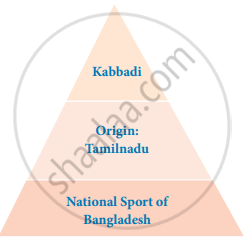
i) Represent the other paragraphs in a visual form of your choice(flow chart, mind-map, pie-chart, etc.).
ii) Choose the correct option.
1. A contact sport usually involves a ______contact between players.
- violent
- gentle
- physical
2. Kabbadi is a game played between ______.
- seven teams of two players
- two teams of seven players
- four teams of seven players
3. A single ______.
- player on offence is referred to as a raider
- offence is referred to as a raider
- raider is an offence by the player
iii) Answer the following.
- How does a raider score points for his team?
- When does a raider concede a point to the opponent team?
- Can a player be revived when he/she is out of the game? Explain your answer.
- Kabbadi is called by different names in different parts of India. Do you know how Pallankuzhi is called in Karnataka, Andhra Pradesh and Kerala?
