Advertisements
Advertisements
Question
What were the attempts made by the author to get his watch repaired?
Advertisements
Solution
After a possession of 18 months, the author let his watch run down. Devastated, the author went to all possible watch makers starting from the chief jeweller, the very next day. The head of the establishment pushed the regulator of the watch a little too much, which did no good, rather worsened its condition. Then the author went to another watch maker who kept it for a week and slowed it down, however, too much. Then he went to another one who kept it for three days; and then couple of more. Even after having spent thousands dollars, none of the watch makers could fix the watch. Hopeless, the author gave it a last shot and went to a watch maker who turned out to be an erstwhile, not a good, steam-boat engineer. It was now that the author realised that “a good horse was a good horse until it had run away once, and that a good watch was a good watch until the repairers got a chance at it. ”
APPEARS IN
RELATED QUESTIONS
A1. True or False
State whether the following statements are true or false:
(i) A new research suggests that eating healthy food and getting proper sleep helps children to succeed in school.
(ii) Kids in the age group of 6-12 years should get an average sleep of little less than 7 hours.
(iii) Kids should start their day with yogurt, fruits and veggies.
(iv) Children should have consistent sleeping habit.
A new research suggests that eating healthy food and getting proper sleep can help children succeed in school. According to research, when kids go to school without eating breakfast, their cognitive function can be affected.
According to study, kids should start the day with fruits, proteins and whole grains and they should avoid sugary cereals because they cause a sugar high. If the kids do need to eat something prior to dinner, parents should offer healthy choices like yogurt, fruits and veggies or baked chips. Children have also been advised to drink water instead of soda as-it lacks nutritional value. Moreover, research suggests that children need a good night's sleep for theiroverall school performance. It is said that. lack of sleep can lead to problems with attention and memory in the classroom, affect impulse control and mood regulation lead to.
anxiety and even depression.
While kids aged 6-12 years should get nine hours sleep nightly, adolescents from the age of 13 to 18 years should get an average sleep of little more than seven hours per night. However, the research suggests that catching up on lost sleep on the weekend can make matters worse and recommended a consistent bedtime seven days a week.
A2. Find
Fill in the blocks with the following given in the passage:
(i) Two things to be avoided by children:
(ii) Lack of sleep due to mood regulation leads to:
A3. Select
Select the correct word from the brackets and complete the statements given below:
(anxiety, consistent, impulse, attention)
(i) Last minutes study causes......... to the students.
(ii) Stress affects the.............. for a quick action.
(iii) Saina has shown ........... improvement in her performance.
(iv) Students should pay ..............in class.
A4. Language study
(i) Pick out anyone sentence from the passage where a modal auxiliary indicating advice is used.
(ii) Pick out the correct conjunctions from the given sentences:
(a) Kids should avoid sugary cereals because they cause a sugar high.
(b) It is said that lack of sleep can lead to problems.
A5. Personal response
We should eat healthy food. Explain..
Answer any four of the following questions in 30-40 words each :
(a) Why was Franz not scolded for reaching the school late that day?
(b) Sophie was dreaming of so many things in her life. What were they?
(c) Why are the youngsters described as springing? (My Mother at Sixty-six)
(d) In the hot season, how do man and beast get comfort? (A Thing of Beauty)
(e) How did the Maharaja deal with a high ranking British officer who wanted to shoot a tiger?
(f) Having got rid of his stink, what problem did Roger Skunk face?
Read the passage and complete the activities given below :
B1 Pick out
The correct answers from the statements given below:
B2 Fill in the gaps with the information given in the passage :
Read the following passage and do the given activities:
A.1) True or False
State whether the following statements are true or false:
(i) The patient stirred and looked about in cheerful anticipation
(ii) The patient’s wife wanted to know the truth …………
The lady went away to the kitchen. She felt restless. She felt she must know the truth whatever it was. Why was the great man so evasive? The suspense was unbearable. Perhaps he could not speak so near the patient’s bed. She beckoned to him from the kitchen doorway.
The doctor rose and went over. She asked, “What about him now? How is he?” The doctor bit his lips and replied, looking at the floor, “Don’t get excited. Unless you must know about it, don’t ask now.” Her eyes opened wide in terror. She clasped her hands together and implored, “Tell me the truth.” The doctor replied, “I would rather not talk to you now.” He turned around and went back to his chair. terrible wailing shot through the still house; the patient stirred and looked about in bewilderment. The doctor got up again, went over to the kitchen door, drew it in securely and shut off the wail.
A.2) Give reasons for the following:
(i) Her eyes opened wide in terror.
(ii) The lady went away to the kitchen.
A.3) How, according to you, should the nature of the doctor be?
Give reasons for the following statement.
The article has been titled ‘Silk Road.’
'Have you come back?' said the woman.'I thought that no one had come back.'
Does this statement give some clue about the story? If yes, what is it?
Explain the metaphor in the line: ‘Poets are the mirrors of gigantic shadows that futurity casts on the present’.
The following common word is used in a different sense in the poem. Guess what it means.
What, according to Ruskin, are the limitations of the good book of the hour?
Comment on the subtlety with which the poet captures the general pattern of communication within a family.
Give a brief account of the interaction between Grandpa and Jo.
Arrange the following set of words in the alphabetical order in your notebook.
ship, small, successful, scoldings, stone, saving, someone, stood, streets, still, screamed, sat, seemed, saint, share.
State whether the following statement is true or false. Correct the false statement.
The Ear was appointed as a judge.
Discuss in your group and write down the most important reason, why Pediatrician and Veterinarians have, a tougher job to diagnose their patients' illnesses.
Choose the proper alternatives from the statements given below which would explain why town planning is essential - _______________.
- To develop the city according to the guidelines.
- To get the ‘Best City Award’.
- To attract tourists.
- To use and develop the land available in the city for the interest of the citizens.
Discuss orally in your class.
In what subjects is knowledge of mathematics used, at school level, and college/university level? Name them.
Did you know maths is used in music and poetry also? Can you tell how?
Answer the following question in short.
What was Pundit Shahane’s claim as a scholar?
Answer the following question in short.
Why was Tenali Raman summoned to the court?
Fill in the gap, choosing a word from the bracket to make an appropriate comparison.
(tall / quiet / humble / merry / busy / slippery / fast / sly / slow / big)
as ______ as a bee
Fill in the gap, choosing a word from the bracket to make an appropriate comparison.
(tall / quiet / humble / merry / busy / slippery / fast / sly / slow / big)
as ______ as an elephant
Complete the following web diagram.

State whether the following statement is True or False:
Oberon transforms Bottom's head into that of an ass.
Draw a diagram to show how life returned to the island. Label the diagram.
(Use the technique of drawing diagrams when you study science, geography, etc.)
Shakespeare is acknowledged as the greatest writer because he understood human nature better than anyone else. Explain the statement in the context of the play.
Present the information in the box ‘My Teacher says’. Translate the box ‘My Teacher says’ into your mother tongue.
Talk about your favourite season. (A one-minute activity.)
Sayali was travelling in space for the first time.
Read the poem and answer the following.
Which are the two different places where strawberries grow?
Read the word. Write the words that combine to make it.
stepmother
List and say whether the following statement agrees with the passage or not.
If you don’t understand something, don’t let the others know about it.
Write what the goldfish does.
Look at the following situations the writer was in. He could have avoided the situation and saved himself. Glance through the write up again and comment on what the writer should have done in the following situations.
- Gilson asked the writer to bring a tie.
- On the day of arrival, the writer had no time to think about the tie.
- The writer remembered about the tie when the bus was leaving for the airport.
- The writer walked down in search of the shop.
- The writer rushed out with the tie in a paper bag.
Read the data below and answer the following question.
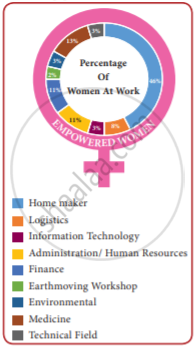
Choose the correct answer.
Percentage of women working in finance is the same as ______.
Hamid thought that his grandma would be pleased if he bought______
How does the ability to question help us?
Look at the number pattern. Fill the blank in the middle of the series or end of the series.
QPO, NML, KJI, ______, EDC
Why did the train stop in the middle of the forest?
Who inhabited the jungles that the train passed through?
Vasantha made a lot of noise because ______
Identify the speaker/character.
He'll have to be given artificial respiration and kept warm.
The poor farmer’s crop was______.
Karmugilan went to __________ for higher studies.
Put the given time expressions in the correct columns.
| winter | morning | 2’ o clock | evening | 1947 |
| March | Sunday | 15th August | 4.30 PM | wedding day |
| in | at | on |
How does it welcome all?
What is the use of mechanical parts?
Why did the audience cheer?
They use ______ as bait.
Answer using Yes or No and pick sentence from the story to support your answer.
Did Robinson kill Friday?
Match the rhyming words.
| 1. share | dare |
| 2. bread | rest |
| 3. care | needs |
| 4. deeds | ahead |
| 5. zest | bear |
Who were the friends referred in the story?
Read the advertisement and answer the question given below.

What is the size of the screen?
Imagine your world and write its qualities in the cloud.

The goose is swimming with its ______.
The grandmother had kept the plate in memory of her ______.
Finally, ______, he got permission to study Science.
Why was Chris worried?
Describe in your own words the garden that Alice saw.
What happens when the day is over?
Are these sentence TRUE or FALSE
The poet tells the child to be afraid when it is dark.
What should parents do to ensure cyber safety for their wards? (Any three points)
