Advertisements
Advertisements
Question
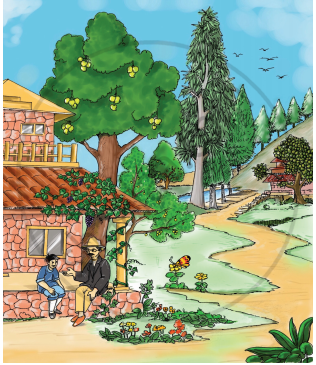
'Trees are sacred my grandmother used to say'– what does the poet imply by this line?
Advertisements
Solution
There are many legends surrounding the sheoga, the oudumber, the neem, and most of all the banyan tree. These are considered mythologically relevant and holy in Hinduism. Old folk who are deeply religious consider it sin to cut down these trees as they are to be worshipped according to the holy scriptures. They even say that if one brings neem or peepal down by felling them they are cursed with ill fate. There are plenty of stories in our mythology that fear and plague our society with as many superstitions as possible. Thus, the poet is merely trying to convey the fears and religious beliefs of old folk like his granny.
APPEARS IN
RELATED QUESTIONS
Describe the progress made by Helen Keller during the two years she spent at Wright-Humason School for the Deaf in New York City.
What were Watson's observations on the stick left behind by Dr. Mortimer? How far did Sherlock Holmes prove him wrong? (in about 125 words)
Answer the following question in 120 – 150 words:
How do you perceive Dr. Kemp based on his interaction with Griffin ? (The Invisible Man)
Read the following passage and do the given activities:
A.1) True or False
State whether the following statements are true or false:
(i) The patient stirred and looked about in cheerful anticipation
(ii) The patient’s wife wanted to know the truth …………
The lady went away to the kitchen. She felt restless. She felt she must know the truth whatever it was. Why was the great man so evasive? The suspense was unbearable. Perhaps he could not speak so near the patient’s bed. She beckoned to him from the kitchen doorway.
The doctor rose and went over. She asked, “What about him now? How is he?” The doctor bit his lips and replied, looking at the floor, “Don’t get excited. Unless you must know about it, don’t ask now.” Her eyes opened wide in terror. She clasped her hands together and implored, “Tell me the truth.” The doctor replied, “I would rather not talk to you now.” He turned around and went back to his chair. terrible wailing shot through the still house; the patient stirred and looked about in bewilderment. The doctor got up again, went over to the kitchen door, drew it in securely and shut off the wail.
A.2) Give reasons for the following:
(i) Her eyes opened wide in terror.
(ii) The lady went away to the kitchen.
A.3) How, according to you, should the nature of the doctor be?
Answer the following in 200-250 words :
Describe Ms. Sullivan's teaching methods?
Answer the following question in 150-200 words:
Why did Anne like her father more than she liked her mother?
Mention the three phases of the author’s relationship with his grandmother before he left the country to study abroad.
Discuss the following statement in groups of two pairs, each pair in a group taking opposite points of view.
Reality is what is directly experienced through the senses.
What do you think is the message that the author seems to convey through the story?
What do you understand of the three voices in response to the question 'What does a novel do' ?
Why is the poem entitled 'Hawk Roosting'?
The significance of reading an autobiography lies in drawing lessons from another life. What is the significance of Kumudini's account for us as readers?
Read the extract 'Being Neighborly' and complete the following statement:
To Jo, the fine house seemed like ______.
Answer in your own words.
What message does the poem convey to all of us?
The best punishment is ‘forgiveness’. Discuss the sentence in light of the text you have read. You can make use of the following points.
(a) Forgiveness provides an opportunity to change the behaviour.
(b) Forgiveness leads to repentance.
(c) A person may commit a mistake/crime impulsively or under the force of strong emotions.
(d) ________________________
(e) ________________________
Find evidence from the lesson and write in your own words.
Indians respect the freedom of others.
Find evidence from the lesson and write in your own words.
In Israel, the media have a positive outlook and self-respect.
Discuss in groups, reasons/ consequences/ effects:
The cherry blossomed.
Answer the given question in your own words.
What message do you get from this story?
Write four reasons why animals in a zoo suffer more than those who live free in the wild.
Expand the idea inherent in the following proverb :
If winter comes, can spring be far behind? - Shelley
Write a short note on Emperor Akbar.
Suggest what you would do in the following situation:
Your very close friend has been using a fake social media account to play pranks on others and is not ready to stop in spite of several attempts by you.
Read aloud with the leader: Form groups of five. Read the passage aloud in groups. The leader begins every sentence and stops after a few words. The other members complete the sentence, reading it aloud in the chorus.
Shakespeare’s poetry has come to be valued for its own sake on the stage. Comment with reference to the play ‘A Midsummer Night’s Dream.’
Explain the following statement with reference to the context.
You ought to be ashamed of yourself.
Imagine you are visiting the Science Fair. What other stalls (apart from the ones mentioned here) are you likely to find there? Try to list at least five more stalls.
Complete the following sentence with reference to the passage:
The king was determined to prevent his beloved son from ____________.
Try to write interesting time tables for imaginary people or creatures.
Start a collection of new and interesting words. Write the words in colored ink on cards of equal size and arrange them in alphabetical order. Try to use the words in your writing or conversation from time to time.
Complete the following diagram.

Find the words that mean the following from the first stanza.
- Gold hammered into a flat, thin shape: ______
- show off proudly: ______
- tilt, move at an angle: ______
- across, especially in a slanting direction: ______
Using the information given in the passage, write a short note on the following in your mother tongue.
Gond art
Who said the following, to whom, and when?
“Mighty thy Teacher must be and divine.”
Enact the play.
Who is a ‘netizen’?
Guess the meaning of the following word.
coarse grained
What prompted the young seagull to fly finally?
What happened to the young seagull when it landed on the green sea?
Why were the policeman prevented from entering grandfather's room?
Find a sentence/word from the text which express the following.
The parent’s earlier view of the child
How should you speak with old people?
Read the lines and answer the questions.
Deep inside the mountain
the adventures hide themselves.
Where do adventures hide?
Read the lines and answer the questions.
They are of all forms and shapes
They all have an excellent ending
What do have an excellent ending?
Have you ever had a strange dream? Share your dream in the class.
He woke up very late in the morning.
The captain presented a gift to Vasantha because ______
Read the incidents. Work in small groups to role play the situations in which they showed their presence of mind. Each group should perform the skit for the rest of the class. Share similar situations in the class.
Listen to your teacher read the first part of the story. Many things described in the story can be seen in the picture. Find and name them.
Flag day is observed on the _________.
What happened to Dr. Karmugilan in the story?
Find the rhyming word from the poem.
Language - ______.
Who is the guest?
Name the character or speaker.
"Do you have a fever?"
Do you think you treat everyone equally? Justify with an example.
______will often say to be honest.
Match the following rhyming words.
| 1. | earn | glow |
| 2. | fend | day |
| 3. | slow | learn |
| 4. | play | end |
Pencil asked him to draw ______.
What did Helen learn when the teacher put her hand into running water?
