Advertisements
Advertisements
Question
Discuss the following statement in groups of two pairs, each pair in a group taking opposite points of view.
The methods of inquiry of history, science, and philosophy are similar.
Advertisements
Solution
|
In favour of the motion |
Against the motion |
|
The methods of inquiry of History, Science, and Philosophy are similar. In the story The Adventure one can find the perspectives of History, Philosophy, and Science converging towards a focal point. History employs the methods of observation, analysis, and rationalism in understanding the course of past events. Science is based on observation, experimentation, and analysis. Rationalism is the most fundamental principle that Science follows. Philosophy is thoroughly critical in methodology. Philosophy examines everything including the assumptions and methodology of science and other disciplines like History. In the story, The Adventure History, Science, and Philosophy converge. Prof. Gaitonde experienced an altogether different version of the outcome of the Battle of Panipat. Contrary to the version as provided in History textbooks, the Marathas emerged as victorious in this battle. Prof. Gaitonde tried to understand this rationally but he failed to get any clue. In this context, Rajendra intervened to explain this phenomenon in the light of the Catastrophic theory which is being employed by Physicists in understanding the behaviour of atoms. Here we find Science and History converging. A similar perspective is seen in Philosophy that truth is relative and not absolute. In fact, the philosophical movement of post Modernism is based on this. In other words, the methods of inquiry of History, Science, and Philosophy are similar. |
It is a misnomer that the methods of inquiry of History, Science, and Philosophy are similar. The similarity is at a superficial level and not at the core. In the story, The Adventure Rajendra tried to rationalise the experience of Prof Gaitonde by applying the Catastrophic theory. But this explanation is not convincing though it convinced the professor. Catastrophic theory can best explain the phenomenon of the physical world but History deals with the behavioural world. It is concerned with the behaviour of society and individuals. The methods of inquiry will also vary accordingly. The method of inquiry of Philosophy is speculative. Philosophy even questions rationalism. Philosophy is highly critical of the methods of Science and History. In other words, the methods of History, Science, and Philosophy are not similar. The story The Adventure by Jayant Vishnu Narlikar is, in fact, a science fiction that is trying to show the convergence of Science History and Philosophy. In reality, the three disciplines, namely, Science, History, and Philosophy have to employ different methodologies of inquiry vis-a-vis the subject matter. |
APPEARS IN
RELATED QUESTIONS
Which language do you think the author and his grandmother used while talking to each other?
Briefly comment on:
“As a Buddhist, he told me, he knew that it didn’t really matter if I passed away, but he thought it would be bad for business.”
|
The energy stored in coal and petroleum originally came to the earth from the sun. The bulk of the present-day supplies was laid down some 200 to 600 million years ago, when tropical conditions were widespread. Lush, swampy forests produced huge trees; warm coastal seas swarmed with microscopic forms of life. When these organisms died, much of their tissue was recycled as it is today — through scavenging and decay. But a significant amount of dead plant and animal material was covered with mud, which prevented complete decomposition. With the passage of time, layer upon layer of the fine sediment was deposited over the once-living material; the sheer weight turned the sediments to rock. Sandwiched between the layers, both coal and petroleum were produced and preserved under pressure. Coal was formed mostly of giant fern-like plants that have only small counterparts today. Coal may still be forming here and there on earth, but conditions are not right for the production of significant quantities. |
Group related points.
Nouveau riche and bourgeoise are French words. Collect from newspapers, magazines, and other sources some more French words or expressions that are commonly used in English.
Locate expressions in the text reflect the Indian idiom, for example, the pride of the generations of his ancestors.
What were the attempts made by the author to get his watch repaired?
Why does Ruskin feel that reading the work of a good author is a painstaking task?
How is the essence of the poem captured in the lines 'two tickets to Happiness'?
How does Kumudini Lakhia describe her guru Ramgopal's influence on her?
Make groups and discuss the following:
Name a few scientists/explorers/social reformers/inventors/discoverers, who spent most of their lives to find solutions to some major problems/setbacks, that mankind faced.
Read the story and complete the following.
Revathi was confident of proving her ownership of her pot of plants because, ____________.
Think and answer in your own words.
Which line proves that in our busy lives we do not even have a fraction of a second to enjoy nature’s beauty?
Answer the following question in short.
Explain the significance of the title.
Correct the given sentence with justification.
The play is restricted to only a part of the woods.
Read the given extract (Act III)
Complete the following table.
| Sr. No. | Character | Supportive Character | Incident |
| 1. | Dr. Stockmann | (a) ................................. (b) ................................ |
(a) ................................. (b) ................................ |
| 2. | Peter Stockmann | (a) ................................. (b) ................................ (c) ................................. |
(a) ................................. (b) ................................ (c) ................................. |
| 3. | Aslaksen | (a) ................................. (b) ................................ |
(a) ................................. (b) ................................ |
Explain the following statement with reference to the context.
From now on The Herald shall be my artillery.
Explain the following statement with reference to the context.
And it's by no means the small sacrifice the town will have to make.
Discuss the following question after you have seen a presentation of the ‘ad’.
Why does Didi say ‘No party for me!’?
What themes did the committee identify?
Form groups of five and discuss:
There are many things that seem small, minor, or insignificant to some people but the same may be the cause of great pain, suffering for others. Can you list such things? What can you do to provide help on those occasions?
This story takes an unexpected turn when the lion decides to spare the camel’s life. Choose any fable, a story that you like, and rewrite it giving it an unexpected turn.
Read the following:
- Charging along like troops in a battle.
- Fly as thick as driving rain.
Using your imagination, write one or two comparisons each with -
- like ______
- as ______ as
The Emperor says he had realised earlier that Abdul has great talent. Does this tally with his actions? Give your opinion.
Write out a few things that you would really miss about your home if you were to stay away from it for long.
Imagine the following and write about it in your own words:
What the world looks like to a baby.
Describe Gulliver’s walk around the city.
Write a short note/story based on the ill effects of pollution.
Why did he spill the milk?
Based on your understanding of the poem, complete the following passage by the using the phrases given in the box.
| youth to old age | up or down the hill | to hurry nor move away | |
| high adventure | joyful | mourn | looking ahead |
The poet wants to live his life __________, willing to do something. He neither wants __________from his goal. He does not want to _______ the things he has lost, not hold back for fear of the future. He instead prefers to live his life with a whole and happy heart which cheerfully travels from __________. Therefore, it does not matter to him whether the path goes __________, rough or smooth, the journey will be __________. He will continue to seek what he wanted as a boy - new friendship, __________ and a crown (prize). His heart will remain courageous and pursue his desires. He hopes that every turn in his life's journey will be the best.
Identify the character or speaker.
I will soon move you.
What did the bird suggest Chulong, in exchange for its freedom?
Why did Dr. Ashok’s cousin call him?
Read the data below and answer the following question.
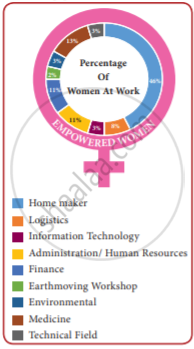
Choose the correct answer.
In which field of work is women’s involvement the second highest?
What did the coach teach the child?
Identify the character/speaker.
I must find out why he's in such a hurry!
Did he hire Kiouni? Why?
The pit was comfortable for the wild boar to sleep in.
Why did the farmer have to travel far?
Which line tells you that the girl was faster than the boy?
Work in groups. Discuss and have a debate on life in bustling cities and life in calm towns.
________ was a young talented doctor.
When did the battle of Nauranang start? How long did it continue?
Name the character or speaker.
"Why don't you do that yourself?"
What robot will you make? Why?
What day is it?
Why was the fish floating on top?
The message was to gather on ______.
What did the five friends call themselves?
Match the rhyming words.
| 1. | flow | know |
| 2. | grow | week |
| 3. | seek | blow |
Muthu collected ______ from every house.
Leafcutter ants drink______.
What are things that we can save? Why should we save them?
In which season is ice cream popular?
Does the brush bend to her will?
Match the rhyming words.
| 1. | earn | day |
| 2. | fend | learn |
| 3. | glow | end |
| 4. | play | slow |
What did Helen learn when the teacher put her hand into running water?
How did the tree help the boy earn money?
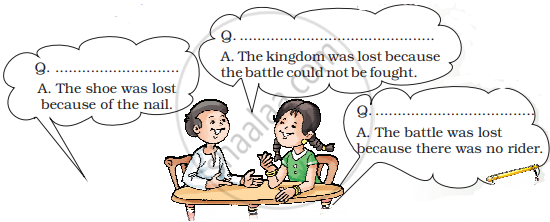
Read the poem.
For Want of a Nail
For want of a nail, the shoe was lost,
For want of a shoe the horse was lost,
For want of a horse, the rider was lost,
For want of a rider, the battle was lost,
For want of a battle, the kingdom was lost,
And all for the want of a horseshoe nail!
[traditional rhyme]
Now form questions for the answers given in the speech bubbles.
Here is an amazing news item on how the qualities of duty and devotion is not restricted to humans alone but shared by animals. Read the passage and answer the questions that follow.
Caesar, the Hero of Mumbai on 26/11
- Mumbai: Caesar, the last surviving hero of his kind, died of a heart attack on Thursday. Caesar, a Labrador Retriever, was covered with tri-color and given an emotional farewell from the city Police Force. The Mumbai Police Commissioner too marked the passing of the hero with a tweet.
- Caesar, who was 11 years old was the sole survivor among the dogs of Mumbai Police who took part in bomb detection operations during the terrorist attack on Mumbai that began on November 26, 2008. He died of a heart attack at a farm in Virar where he and his three canine buddies had been sent after retirement. During the terror attack in Mumbai, Caesar saved several lives when he sniffed out the hand grenades left by the terrorists at the busy CST railway station.
- Caesar was also a part of the search team at Nariman House, where terrorists were holed up for three days. Earlier he was also pressed into service for bomb search operation after the 2006 serial train blasts and July 2017 blast in Mumbai. The Mumbai police officials also tweeted their grief saying, “Services of retired members of Dog Squad during 26/11 will be unforgettable. We will remember our heroes forever.”
Answer the following questions.
- The Labrador Retriever was covered with tri-color. What does this signify?
- How did Caesar save several lives at the CST railway station?
- Which word in the third paragraph of the passage means the same as ‘forced’?
- “Services of retired members of Dog Squad during 26/11 will be unforgettable”. Mention three services rendered by Caesar.
- Caesar is a Labrador breed of dogs. Name a few other native breeds that are used by the Police Force.
- Try to rewrite the news item in your mother tongue without losing the spirit and flavour of the text. Give a suitable title to the translated version.
Activity: Live English: Packs, packets, pouches, wrappers

Given above is the picture of an imaginary food item’s packet. Let us see how to ‘read’ the matter on the packet as a vigilant consumer.
- Look at the wrapper and complete the sentences.
- The name of the food item is ______.
- It is made by ______.
- It is a ______ food item. (Veg/Non-veg)
- The ______ sign indicates whether it is a Veg or Non-veg food item.
- The ingredients are ______, ______, ______, ______.
- The date of packing is ______ and the expiry date is ______.
- It should be consumed before ______ from the date of manufacturing.
- Try and obtain more information about the various symbols printed on the packet.
- Discuss the following -
- Why the ‘recipe’ is given on the packet.
- Why the packet tells us to visit the website of the company.
- What ideas are used to make the packet attractive?
- How you will verify whether something is good for you to eat.
