Advertisements
Advertisements
Question
Read the poem.
For Want of a Nail
For want of a nail, the shoe was lost,
For want of a shoe the horse was lost,
For want of a horse, the rider was lost,
For want of a rider, the battle was lost,
For want of a battle, the kingdom was lost,
And all for the want of a horseshoe nail!
[traditional rhyme]
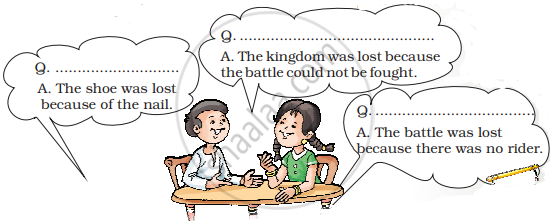
Now form questions for the answers given in the speech bubbles.
Advertisements
Solution
- The shoe was lost because of the nail.
- The kingdom was lost because the battle could not be fought.
- The battle was lost because there was no rider.
APPEARS IN
RELATED QUESTIONS
'The Address' is a story of human predicament that follows war. Comment
List the distinctive features of the tribal arts.
The poet encourages her brother in the second part of the poem by telling him about the brighter side of life. Discuss with your partner and make a list of the expressions in the poem that mean encouragement.
- Brighter garden
- ________________
- ________________
Using points from the lesson, give the details of the following in a short paragraph.
The kite Bazar of Ahmedabad.
Human beings can learn from honey bees ______.
Write in short about what your parents/guardians feel when they send you to school.
State a type of drama each from any four periods of history.
The characters are a part of the stage setting. How does this reflect when the characters of the play range from the Duke and the Indian boy to the faeries?
What story did grandfather tell them about the haunted hill?
The turtles use their flippers and make a hollow for their nests.
What does the teak tree give us?
Flag day is observed on the _________.
Anbu was talented in catching______.
The official visited the rehabilitation centre daily.
Parents never let us get ______.
What did Kani realize in the story?
Why did Jana chase the squirrel?
If the fisher draws his net soon, he won’t get ______ in the net.
The pretty little fir tree was happy with gold leaves but______.
Now, read the following passage on “Laughter Therapy” and answer the questions that follow.

- Laughing is an excellent way to reduce stress in our lives; it can help you to cope with and survive a stressful life. Laughter provides full-scale support for your muscles and unleashes a rush of stress-busting endorphins. Since our bodies cannot distinguish between real and fake laughter, anything that makes you giggle will have a positive impact.
- Laughter Therapy aims to get people laughing, in groups and individual sessions and can help reduce stress, make people and employees happier and more committed, as well as improve their interpersonal skills. This laughter comes from the body and not the mind.
- Laughter Yoga (Hasya yoga) is a practice involving prolonged voluntary laughter. It aims to get people laughing in groups. It is practiced in the early mornings in open-parks. It has been made popular as an exercise routine developed by Indian physician Madan Kataria, who writes about the practice in his 2002 book ‘Laugh for no reason'. Laughter Yoga is based on the belief that voluntary laughter provides the same physiological as well as psychological benefits as spontaneous laughter.
- Laughter yoga session may start with gentle warm-up techniques which include stretching, chanting, clapping, eye contact and body movements to help break down inhibitions and encourage a sense of playfulness. Moreover, laughter is the best medicine. Breathing exercises are used to prepare the lungs for laughter followed by a series of laughter exercises that combine a method of acting and visualization techniques. Twenty minutes of laughter is sufficient to augment physiological development.
- A handful of small-scale scientific studies have indicated that laughter yoga has some medically beneficial effects, including cardiovascular health and mood. This therapy has proved to be good for depressed patients. This laughter therapy also plays a crucial role in social bonding.
Answer the following.
a. How does laughter help one to cope with stress?
b. Which word in the text (para 2) means the same as ‘dedicated'?
c. Why do you think voluntary laughter provides the same physiological as well as psychological benefits as spontaneous laughter?
d. ‘Laughter is the best medicine’. Explain.
e. Given below is a set of activities. Which of these are followed in the ‘Laughter Yoga’ technique?
- sitting on the ground with legs crossed
- body movements
- clapping
- closed eyes
- breathing exercises
- chanting
- stretching of arms and legs
- bending backwards
- running/jogging
- eye contact
f. ‘Laughter therapy also plays a crucial role in social bonding’. How?
