Advertisements
Advertisements
Question
Discuss the following statement in groups of two pairs, each pair in a group taking opposite points of view.
Reality is what is directly experienced through the senses.
Advertisements
Solution
|
In favour of the motion |
Against the motion |
| Our senses, that is the senses of touch, sight, taste, and hearing and smell provide us facts about the world we live in. Knowledge from experience comes through these senses. The reality is what we directly experience through these senses. No other reality exists which is not revealed to the senses. | Reality is not what is directly revealed to the senses. We cannot experience so many entities like atoms and molecules but these are real. We cannot even predict the behaviour of these entities accurately. This point is mooted by Rajendra in the story Adventure when he points to the discoveries made by the physicists regarding the behaviour of the atoms. We can predict the position of a bullet fired in a particular direction from a gun but we cannot predict the position of an electron fired from a source. This proves that reality is not what is directly revealed to the senses, there can be alternative realities existing side by side. |
APPEARS IN
RELATED QUESTIONS
How did Helen display her passion for Radcliffe College?
Read the following extract and then do all the activities that follow :
I rain into a stranger as he passed by
“Oh, excuse me please” was my reply.
He said, “please excuse me too; wasn't even watching for you.”
We were very polite, this stranger and I.
We went on out way and we said good-bye.
But at home a different story is told.
How we treat out loved ones, young and old.
Later that day, cooking the evening meal,
My daughter stood beside me very still.
When I turned, I nearly knoked her down.
“Move out of the way,” I said with a frown.
She walked away, her little heart broken.
I didn't realize how harshly I'd spoken.
While I lay awake in bed,
God's still small voice came to me and said,
“While Dealing with a stranger, common courtesy you use,
But children you love, you seem to abuse.”
A1. Order-
The incidents narrated in the extract are arranged in a jumbled manner here, Rearrange them in a proper order as they occur in the extract:
(i) The poet and the stranger went on their way saying good-bye.
(ii) Seeking excuse politely from the stranger, she went her way.
(iii) The poet ran into a stranger on the road.
(iv) The poet yelled at her daughter.
A2. Poetic device:
Make a list of rhyming pairs from the second stanza and note down the rhyme scheme of the same stanza.
A3. Personal Response:
Understanding and politeness are the essentials of out everyday life. Explain your views in brief.
A4. Creativity -
Frame two poetic lines on the following situation using a rhyming pattern with the help of clues given:
“While introducing great personalities, we praise them highly and talk about their qualities, but while speaking
about our friends we may not follow the same trend.”
While introducing great personalities, — a
------------------------------------ — a
But while speaking about our friends, — b
------------------------------------ — b
Describe the role of Mr. Keith in the life of Helen in ‘The Story of My Life’.
Tick the item that is closest in meaning to the following phrase.
to meet one's match
Comment on the indifference that meets Iona's attempts to share his grief with his fellow human beings.
Look at the words given in the box below
|
snigger |
wriggle |
sneak |
squeak |
|
squawk |
titter |
pant |
chuckle |
|
giggle |
jeer |
chortle |
guffaw |
|
sigh |
sidle |
boo |
shriek |
|
scramble |
croak |
straggle |
plod |
|
gasp |
|
|
|
Now classify them according to their closeness in meaning to the words given below
|
A |
B |
C |
D |
E |
|
snigger |
wriggle |
squeak |
jeer |
sigh |
What do you understand of the natures of Ramanand and Azam Khan from the episode described?
What were the attempts made by the author to get his watch repaired?
Which are the lines in the poem that impressed you the most and why?
The poem has a literal level and a figurative level. Why has the poet chosen 'tigers' and 'sheep' to convey his message?
Make groups and discuss the following:
What fatal dangers/problems did mankind face centuries ago, but are no longer a threat today?
The best punishment is ‘forgiveness’. Discuss the sentence in light of the text you have read. You can make use of the following points.
(a) Forgiveness provides an opportunity to change the behaviour.
(b) Forgiveness leads to repentance.
(c) A person may commit a mistake/crime impulsively or under the force of strong emotions.
(d) ________________________
(e) ________________________
Think and answer in your own words in your notebook.
Why do you think God created worms? What is their ecological importance?
Using a dictionary/internet note down the main difference between farm and granary.
Using a dictionary/internet note down the main difference between a remote-sensing satellite and a natural satellite.
The tone of the poet is sarcastic. When he writes ‘All spaces are gridded filled with permutations of possibilities’ he intends to indicate the efforts made by the planner to exploit every available piece of land without any consideration of harming nature or violating attachments of people to places. Make pairs/groups and find out some more sarcastic lines having the same effect.
Select a season of your choice and give the following details:
- Time of the year -
- Characteristics- crops, festivals, etc.
- Features/changes - climate/weather/temperature etc.
- Advantages/Disadvantages -
Answer the following question in short.
How did Tenali Raman outwit Pundit Shahane?
What is described in the poem?
What is implied in the following phrases or lines?
- A silver house in the lovely sky
- It takes two weeks to build it up
- And two to pull it down.
Answer the following question in one sentence.
Who misses all the fun?
Visit a library:
Find more information/stories about scholars of the ancient world - Aryabhatta, Bhaskaracharya, Varahamihira, Charaka, Nagarjuna, Jeevaka.
Rewrite the poem in the form of a prose passage.
Read the following proverb that has a biblical reference.
‘Do unto others as you would have others do unto you.’ Now find at least 5 other proverbs/ axioms/quotations which convey the same message. Search the internet/dictionary of proverbs.
Correct the following sentence using facts from the passage.
Achilles was killed by an arrow that pierced his heart.
Find pairs of rhyming words from the poem.
Complete the following sentence with reference to the passage.
At the back rose the high peak of Mount Ida, from which _______________.
Sayali was travelling in space for the first time.
Write the symbol that is used in the poem to represent the following idea.
It was tempting and needed to be tried.
Say whether you agree or disagree.
The children showed disinterest even in the bachelor’s story-telling, throughout.
Who said the following, to whom, and when?
“He dwells within a cave of Himalaya.”
Read the poem and answer the following.
What are the two different ways of eating strawberries?
Guess the meaning of the following word.
water-logged
Discuss how you will measure the worth of a journey.
Where was the well situated?
How did the parents support and encourage the young seagull’s brothers and sister?
Read the following line from the poem and answer the question that follow.
My heart will keep the courage of the quest And hope the road's last turn will be the best.
|
My heart will keep the courage of the quest, And hope the road's last turn will be the best. |
- What kind of quest does the poet seek here?
- What is the poet’s hope?
Why was the narrator sorry to have paid attention to the footsteps?
What do Tamil Nadu folk dances and folk arts represent?
There were many toys in the stall. Three of Hamid’s friends had bought some toys.
Write the names of Hamid’s friends in column A and the toys they bought in column B
| A | B |
What did Hamid buy at the fair? And for whom?
Why does the poet tell us to speak gently to young children?
Neerja was sent to London based on______.
Grandmother had wanted the peepul tree cut down because______.
Grandfather felt planting trees would help the forest because______.
What did Amma mean when she said tomatoes, ladies' fingers and corn came from other countries?
Recall Merlin’s memories and complete the story map.
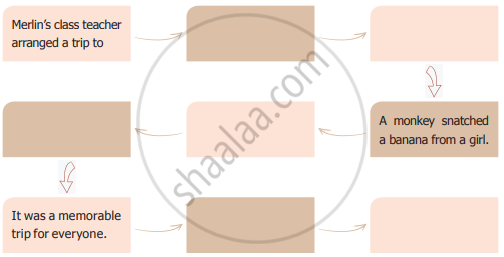
How does Patna differ from Delhi?
| Our national emblem is taken from Ashoka’s pillar at Sarnath. It is found on all government documents, coins, currency notes, postcards, and envelopes. It consists of four lions standing back to back but, we can see only three lions at a time. There is a Dharma chakra in the centre of the base plate, with the figure of a bull in the right and that of a horse in the left. The entire structure is sitting on a lotus. The words ‘Sathyameva Jayate’ is written under it in Devanagari script. These words mean, ‘Truth alone Triumphs’. |
- Where is our national emblem taken from?
- Where is our national emblem found?
- What does ‘Sathyameva Jayate’ mean?
- What are the animals found in the emblem?
Choose the odd one out.
What would we do when we are happy or sad?
Write the rhyming word.
one
Write the word under the correct group and divide it.
bullet
candle
bat
title
ball
tiffin
 |
 |
 |
The official's family visited the rehabilitation centre for ______ years.
The squirrel ran to the _________ tree.
Do you tell the truth always? Why?
In real the plate was made of ______.
What incident made Mugund make a wooden drum?
Recite the poem The Painter with correct intonation.
Where did the naughty boy go?
