Advertisements
Advertisements
Question
Discuss the following statement in groups of two pairs, each pair in a group taking opposite points of view.
A single event may change the course of the history of a nation.
Advertisements
Solution
|
In favour of the motion |
Against the motion |
| A single event may change the course of the history of a nation. The battle of Panipat for example is said to be the turning point in the history of India. In the Battle of Panipat, the Marathas gave in to the forces of Ahmed Shah Abdali. After this event, the history of India took another turn. Gradually, the country was overtaken by the foreign forces. In the story The Adventure it is mentioned how in the beginning Prof. Gaitonde was preparing a speech on what course the history would have taken if the Marathas had won the Battle of Panipat. This shows the importance of a single event in the history of a nation. | The motion that A single event may change the course of the history of a nation is a matter of perspective only. It is a relative truth. If we apply the catastrophic theory in understanding history then we will find that there may be alternative outcomes of a single event so that we cannot proclaim that any one course of the event is the reality. Since there may be alternative courses of history so debating on a single course is not fruitful. In the story, the Adventure due to catastrophic phenomenon the Battle of Panipat is revealed in a different version to Prof Gaitonde. According to this version, the Marathas emerged victorious in the Battle of Panipat. After the event, the Marathas extended influence over the entire country. India never fell to the alien forces. So, to argue that a single course of the event may change the course of history is not tenable. There may be alternative effects following an event. |
APPEARS IN
RELATED QUESTIONS
Aunt Jennifer's tigers prance across a screen,
Bright topaz denizens of a world of green.
They do not fear the men beneath the tree;
They pace in sleek chivalric certainty.
(a) Why are the tigers called Aunt Jennifer's tigers?
(b) How are they described here?
(c) How are they different from Aunt Jennifer?
(d) What does the word, 'chivalric' mean?
Answer any four of the following questions in 30 – 40 words each :
(a) After initial reluctance why did the lawyers tell Gandhiji that they were ready to follow him into jail?
(b) What is Mukesh's attitude towards the family business of making bangles?
(c) How does the poet show the futility of Aunt Jennifer's efforts?
(d) Stephen Spender in his poem, 'An Elementary School Classroom in a Slum' paints a dismal picture of poverty. Comment.
(e) Jackson went through the contents of Rev. McLeery's suitcase. Which object therein puzzled him sorely? What was his comment on that?
(f) How did the servants react when they realized that Dr. Sadao was going to save the life of an enemy?
Answer the following question in 150-200 words:
Attempt a character sketch of Mr. Gilman.
Tick the item that is closest in meaning to the following phrase.
to take issue with
We 'draw up a deed'. Complete the following phrase with an appropriate word.
________one's word
What was the reason for young Paul's restlessness at the beginning of the story? How did it find expression?
What were the attempts made by the author to get his watch repaired?
How does the poet bring out the immortality of the bird?
What facet of political life does the behaviour of Ajamil illustrate?
Correct the following statement.
Behrman was a very heartless person.
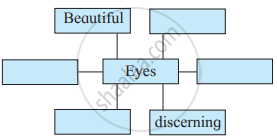
Complete the web with the help of adjectives used to describe eyes and nose in all respects. Two are done for you.

How do we help animals and birds?
Read the lesson and name the following.
The First surgeon to perform operations ______
Fill in the gap, choosing a word from the bracket to make an appropriate comparison.
(tall / quiet / humble / merry / busy / slippery / fast / sly / slow / big)
as ______ as a fox
What changes in the stage setting would you suggest.
Discuss the following question after you have seen a presentation of the ‘ad’.
What would happen if you never ate Krispy Krunchy?
Write a short speech for the State of Maharashtra.
What two basic rules were followed in the Science Fair?
What does the poet want to do?
There were no human settlements on the moon.
What changes do we see in the life of human beings when the season changes? Write with reference to their clothes.
Answer the following question and write in short, why the parody sounds funny.
Why does the crocodile work?
Rearrange the following in their proper order as in the poem. Write the serial number against each line:-
(a) The Ostad sang the Malkous Raga enchantingly.
(b) Akbar followed Tansen, dressed miserably.
(c) I request you to sing such a song that will I experience unmatched joy.
(d) Ostad was nowhere to be seen.
(e) O Divine Teacher, please gift us the joy of your song.
(f) One day, the singer sang Deepak Raga in the court.
(g) Akbar expressed his wish to meet the Teacher.
(h) He experienced heavenly delight.
(i) Tansen sings to please the earthly king but Ostad devotes his songs to God.
(j) She sang Raga Malhar, which had a cooling effect.
Sit quietly for some time. Close your eyes and listen carefully to all the sounds that you hear. Can you guess what sounds they are, who or what is making that sound? Note down what you heard.
Read the poem and answer the following.
Which are the two different places where strawberries grow?
Make groups. One person in the group chooses an announcement. Everyone in the group reads that announcement silently but carefully and closes their books. Then that person presents the announcement, changing one of the details in the announcement. Others spot the change. For example, you might say ‘red’ key chain instead of ‘blue’ in the last announcement.
How was Gulliver tied down on the seashore?
Which event in the story tells us that the scarecrow was intelligent?
Read the following line from the poem and answer the question that follow.
So let the way wind up the hill or down, O'er rough or smooth, the journey will be joy: Still seeking what I sought when but a boy, New friendship, high adventure, and a crown,
- How is the way of life?
- How should be the journey of life?
- What did the poet seek as a boy?
Who were the inhabitants of the island?
Answer the question in a paragraph of about 100 – 150 word.
Narrate how Prospero made his enemies repent to restore his dukedom.
What made the reporter gaze at the author?
Read the incident again and answer the following question.
What is the humour element in the above incident?
Identify the speaker/character.
‘ Remember the tiny penknife he gave me last year’.
Why did Mrs. Jhunjhunwalla buy the painting?
Write the name of the toy against the picture.

Find a sentence/word from the text which express the following.
Words related to prize.
Read the comic strip and answer the following question.
Do you think that all the information online can be used without any permission?
What kind of joy is unfurled during the festival of sacrifice?
Can courage be developed suddenly? Why?
The wild boar settled down scraping the hole into a ______ to have a good sleep.
A day in Mars is called ______.
They use ______ as bait.
Look at the picture and tick Choose the correct word.

Try your own.
Find and write the clues.
Clue for lame ______.
Who were the friends referred in the story?
Kani and Teddy were in the garden at _____.
Read the passage three times and colour a dustbin each time.
|
I am Mani. I had to take a bus to nearby city. I crossed the road to reach the bus stand. I got the bus, sat down, and read a book. Before I started to read, I just looked at the people around me. The two men sitting next to me were talking loudly. Some were listening to music on their phone. I was unable to focus on reading. The men were talking about cleaning the city. As they were talking, they opened a pack of biscuits to eat. After some time I dozed off. When I opened my eyes, the bus had reached the city. The two men were not there but pieces of the biscuits and wrappers were there. I cleaned the wrappers and put them in the dustbin.
|

- What did Mani take out?
- What did Mani find on the seat when he woke up?
- If you were Mani, what would you do?
Read the passage three times on your own. Colour a Piggy bank each time you read.
Piggy bank is a coin box used by children. The real use of a piggy bank is to store coins. Piggy banks look like pigs. They come in many shapes and sizes. In Tamil, they are known as Hundial. It is a red, mud pot. We can drop the coins into the pot. Once the pot is full, we must break the pot and use the coins. Start saving with your hundial today!

Choose the correct one.
Rooster

Write the word with same meaning.

chips- ______
Mugund loved wild animals.
What did his mother say in his dream?
Match the rhyming words.
| 1. | earn | day |
| 2. | fend | learn |
| 3. | glow | end |
| 4. | play | slow |
What did Nasruddin boast about?
“Something is wrong,” said Helen’s mother. What was wrong with Helen?
Read the following passage and do the activities.
A1. State whether the following sentences are True or false. [2]
- The king’s temperament also changed.
- The king was happy with prediction of the astrologer.
- The courtiers sought an audience with Tenali Raman.
- Courtiers advised the king to regulate his diet.
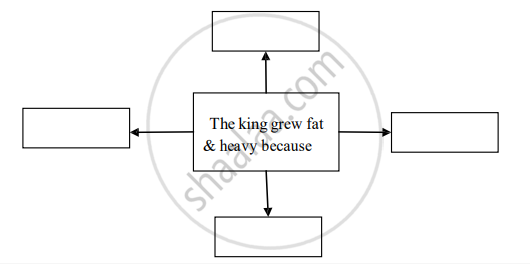
A2. Complete the web. [2]
|
King Krishnadeva Raya would perform heavy exercises every morning. He regularly applied oil on his body and thereafter worked out till all the oil came out with the sweat. This was followed by a long ride on his horse. Once the king started leading a sedentary lifestyle, and he stopped exercising. He no longer went horse-riding either. The king overate and as a result grew fat and heavy. The king‟s temperament also underwent a sea change. Noticing this, the royal physicians cautioned the king against the ill effects of overeating and explained to him the risks posed by obesity. They advised the king to regulate his diet, exercise, and take care of his health. The repeated advice he got from the physicians to eat less made him so angry that one day he announced a reward for anyone who could find him an easy cure. But there was one condition: those who failed would have their heads off. None dared to advise the king in this regard. The situation became precarious and as usual Tenali Raman was approached by the courtiers for a remedy. Tenali heard the problem and assured the courtiers of a viable solution. The next day, an astrologer predicted that the king had only a month left to live. When the king came to know of this, he was furious. The astrologer was ordered by the king to be imprisoned for a month so that his prediction could be put to test and so the hapless forecaster was sent to prison. |
A3. Find out describing words from the passage for the words given below. [2]
- exercise - ...........
- lifestyle - ...........
- ride - ...........
- physician - ...........
A4. Do as directed. [2]
- King Krishnadeva Raya would perform heavy exercises every morning.
(Use ‘used to’) - They advised the king to regulate his diet. (Pick out the infinitive)
A5. What are the benefits of daily exercise? [2]
Look up the following entries in the Language Study pages given at the end.
- stress
- intonation
- sound
- consonant
- vowel
