Advertisements
Advertisements
प्रश्न
Discuss the following statement in groups of two pairs, each pair in a group taking opposite points of view.
A single event may change the course of the history of a nation.
Advertisements
उत्तर
|
In favour of the motion |
Against the motion |
| A single event may change the course of the history of a nation. The battle of Panipat for example is said to be the turning point in the history of India. In the Battle of Panipat, the Marathas gave in to the forces of Ahmed Shah Abdali. After this event, the history of India took another turn. Gradually, the country was overtaken by the foreign forces. In the story The Adventure it is mentioned how in the beginning Prof. Gaitonde was preparing a speech on what course the history would have taken if the Marathas had won the Battle of Panipat. This shows the importance of a single event in the history of a nation. | The motion that A single event may change the course of the history of a nation is a matter of perspective only. It is a relative truth. If we apply the catastrophic theory in understanding history then we will find that there may be alternative outcomes of a single event so that we cannot proclaim that any one course of the event is the reality. Since there may be alternative courses of history so debating on a single course is not fruitful. In the story, the Adventure due to catastrophic phenomenon the Battle of Panipat is revealed in a different version to Prof Gaitonde. According to this version, the Marathas emerged victorious in the Battle of Panipat. After the event, the Marathas extended influence over the entire country. India never fell to the alien forces. So, to argue that a single course of the event may change the course of history is not tenable. There may be alternative effects following an event. |
APPEARS IN
संबंधित प्रश्न
There were many reasons for Helen Keller's embittered childhood. What were they and how were they overcome?
Attempt the following in 150-200 words.
Bring out the importance of the diary in Anne's life.
How did Helen benefit when Dr. Graham Bell accompanied her to the World Fair?
Answer the following question in 200-250 words:
What is the main theme of 'The Diary of a Young Girl'?
We 'draw up a deed'. Complete the following phrase with an appropriate word.
________a loan
Discuss the following in pairs or in groups of four:
Because India's tribal communities are basically bilingual there is a danger of dismissing their languages as dialects of India's major tongues.
While tribal communities may not seem to possess the scientific temper,there are many ideas from tribal conventions that could enrich modern societies.
The power of poetry lies in suggestion and understatement. Discuss this with reference to the poem.
Study each of the following sentences and notice the balance between its parts. Pick out other sentences in the text that reflect this kind of balance
a. It is right that a false Latin quantity should excite a smile in the House of Commons; but it is wrong that a false English meaning should not excite a frown there.
b. Let the accent of words be watched, by all means, but let the meaning be watched more closely still, and fewer will do the work.
What do you understand of the three voices in response to the question 'What does a novel do' ?
You notice a sense of urgency in the poet's request – what is the reason for this?
Study the Note to Aspects of the Novel given at the end. Discuss the features that mark the piece as a talk as distinguished from a critical essay.
What is the poetic technique used by the poet to convey the plaintive theme of the poem?
Identify the words that help you understand the nature of the poet's father.
Fill in the blank.
Moru Dada wanted to spray __________ on the moong crop.
An acrostic is a poem or a write· up in which the first letter of each line forms a word. when it is read vertically.
For example,
Faithful
Reliable
Inspiring
Encouraging
Noble
Dedicated
With your benchmate / group, complete the acrostic of BELIEVE and FAITH.
(Please note that the words / phrases should be more or less related to the topic. You can use a thesaurus.)
Be certain of
E ......................
L ......................
I ......................
E ......................
V ......................
E ......................
F ......................
A ......................
I ......................
T ......................
H ......................
Rearrange the letters to make meaningful words, occurring in the poem.
- clearmis ____________
- sowmid ____________
- gearuoc ____________
- rissupser ____________
- tabyue ____________
- madres ____________
- laveu ____________
- downre ____________
Behrman did not know anything about the last leaf on the ivy.
Go through the poem and state whether the following statement is true or false.
The newly planned city looks modern and amazingly beautiful.
Form pairs. Make a list of as many games as you can. (At least 25) Then classify the games using the following criteria:
- Indoor and outdoor games.
- Games played with and without any equipment.
- Games which have one-to-one matches and those in which teams play against each other (Single-player or team)
- Games played mostly by children and games played by adult players.
- Shape and size of the court or field.
Use the following figures to show your classification.
Go through the following web that highlights the essential qualities of a compere. Discuss with your partner the essential qualities and also the precautions that a compere should take while compering a program.

Precautions to be taken :
- __________________________
- __________________________
- __________________________
- __________________________
Give reasons :
Oberon and Titania fight for the custody of the Indian boy because - Titania wants ______________________.
Find 2/4 expressions of humour from the extract.
Have you seen non-commercial advertisements - those that are not ‘selling’ anything but are only giving people useful information?
Answer the following question in one sentence.
Why does he ‘miss all the fun’?
On any one page, note against the speech of every character what feelings it should show to bring out the meaning best. For example, joy, fear, anger, nervousness, friendliness, dislike, surprise, wonder, excitement, politeness, rudeness, cunning, curiosity.
Choose a 'question' through your own observation. Try to follow the scientific method to find the answer to that question. Take the help of your teacher/parents to set up the experiment.
Draw word webs for the following. Begin with the given word and go on writing as many other words associated with it, as you can. Use these words to write other related words to form a word web.

Read the following sentence aloud. Write who said it and to whom.
“Look, here’s something for you.”
Read the following:
- Charging along like troops in a battle.
- Fly as thick as driving rain.
Using your imagination, write one or two comparisons each with -
- like ______
- as ______ as
Note that most of the time well-known works are parodied, because people can enjoy the parody better when they know the original. Try to find more examples of parodies in English or other languages.
Think of a play/skit which you have seen enacted on the stage and which has impressed you. Write the following details about it.
| Name of the play/skit: | ______________ |
| Important characters: | ______________ |
| Any famous actors/actresses: | ______________ |
| Theme: | ______________ |
| Climax: | ______________ |
| Ending: | ______________ |
| Use of lights and special effects if any: | ______________ |
| Use of background music and sound effects if any: | ______________ |
| Use of sets: | ______________ |
| The costumes, make up, etc. of the characters: | ______________ |
| How well the actors present the play and behave on the stage: | ______________ |
| Your own opinion about the play: | ______________ |
From the passage, find all the words and phrases used to describe the ‘monster’.
Fill in the blank choosing the appropriate word/idiom from the lesson.
In the examination, I did not know the answer, so I ______.
Find out how the following game is played.
Hockey
Guess the meaning of the following word.
coarse grained
Write a paragraph on ‘The Grumble Family’ and their attitude towards other folks.
Read the data below and answer the following question.
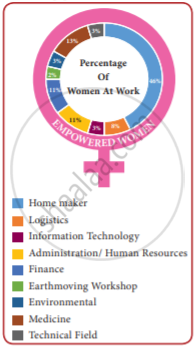
Choose the correct answer.
Percentage of women working in finance is the same as ______.
Imagine you are a marketing executive for a company in a specific industry (toothpaste, soup, hair care products, automobiles, etc) and are developing a product with a brand name that refers to a character from the story.
For example: You want to sell bandages that have little pictures of Don Quixote on them. Your company’s name is Kure-All and you decide to call them “Kure-All Quixote Bandages”.
The slogan might be: “Had a tough day with windmills? When you take a fall, use Kure-All.”
You can use exciting words, a catchy new slogan and a jingle among other things to promote sales of your item.
Turtles are different from tortoises.
Identify the sports and the sports personalities from the lesson and fill in the table.
| Sports | Name of the player & Field of sports | Awards |
 |
||
 |
||
 |
Why did Muthu and his friends step out of the train?
Vicky decided to______ the robot at the end.
Vicky was an active boy.
Whom did Vicky want to do all his work?
Name the character or speaker.
"You want me to strain my back?"
The robot that sat on her shoulder was a______.
Whose hospitality is described in the poem?
What did they use as net?
Why did Robinson name the tribe Friday?
Name the character or speaker.
"Do you have a fever?"
Read the advertisement and answer the question given below.

When does the offer end?
Fill in the blank with rhyming word.
tunnels- ______
What kind of water did Divya use to brush her teeth?
The kingdom was situated in the foothills of______.
The king shouted at Ani.
What did his mother say in his dream?
Before going to bed that night, Chris gave his new teacher a ______.
Who was Nokomis?
