मराठी
महाराष्ट्र राज्य शिक्षण मंडळएस.एस.सी (इंग्रजी माध्यम) इयत्ता ६ वी

Form pairs. Make a list of as many games as you can. (At least 25) Then classify the games using the following criteria:  Indoor and outdoor games. Games played with and without any equipment. - English

Advertisements
Advertisements

प्रश्न

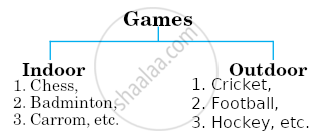
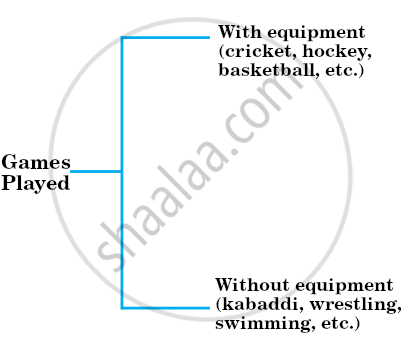
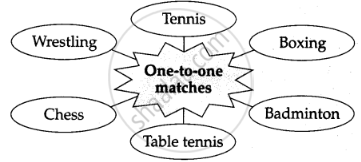
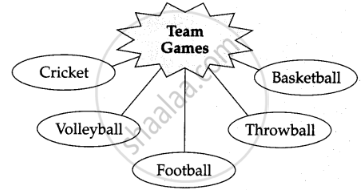
Form pairs. Make a list of as many games as you can. (At least 25) Then classify the games using the following criteria: 

  • Indoor and outdoor games.
  • Games played with and without any equipment. 
  • Games which have one-to-one matches and those in which teams play against each other (Single-player or team)
  • Games played mostly by children and games played by adult players.
  • Shape and size of the court or field.

Use the following figures to show your classification. 

तक्ता
Advertisements

उत्तर

Games played by children Games played by adults
Blind man’s buff Chess
Cops and robbers Snooker
Dodge ball Hockey
Ring a Ring o’ Roses Cricket


Name of the game Shape of the court field Size of the field
Basketball Rectangular 26 m in length, 14 m in width measured from the inside edges of the boundary lines.
Boxing Square The ring should not be less than 12 feet or more than 20 feet square. The height from the ring floor level to the top rope should not be less than four feet, nor more than five feet.
shaalaa.com
Reading Skills
  या प्रश्नात किंवा उत्तरात काही त्रुटी आहे का?
पाठ 1.5: A Kabaddi Match - Exercise [पृष्ठ १६]

APPEARS IN

बालभारती English [English] Standard 6 Maharashtra State Board
पाठ 1.5 A Kabaddi Match
Exercise | Q 1 | पृष्ठ १६
बालभारती English Integrated [English] Standard 6 Maharashtra State Board
पाठ 1.5 A Kabaddi Match
POINTERS | Q 1. | पृष्ठ १७

संबंधित प्रश्‍न

Read the passage given below and answer the questions that follow:

1. Air pollution is an issue which concerns us all alike. One can willingly choose or reject a food, a drink or a life comfort, but unfortunately there is little choice for the air we breathe. All, what is there in the air is inhaled by one and all living in those surroundings.

 2. Air pollutant is defined as a substance which is present while normally it is not there or present in an amount exceeding the normal concentrations. It could either be gaseous or a particulate matter. The important and harmful polluting gases are carbon monoxide, carbon dioxide, ozone and oxides of sulphur and nitrogen. The common particulate pollutants are the dusts of various inorganic or organic origins. Although we often talk of the outdoor air pollutions caused by industrial and vehicular exhausts, the indoor pollution may prove to be as or a more important cause of health problems.

 3. Recognition of air pollution is relatively recent. It is not uncommon to experience a feeling of 'suffocation' in a closed environment. It is often ascribed to the lack of oxygen. Fortunately, however, the composition of air is remarkably constant all over the world. There is about 79 per cent nitrogen and 21 per cent oxygen in the air − the other gases forming a very small fraction. It is true that carbon dioxide exhaled out of lungs may accumulate in a closed and over-crowded place. But such an increase is usually small and temporary unless the room is really air-tight. Exposure to poisonous gases such as carbon monoxide may occur in a closed room, heated by burning coal inside. This may also prove to be fatal.

 4. What is more common in a poorly ventilated home is a vague constellation of symptoms described as the sick-building syndrome. It is characterized by a general feeling of malaise, head-ache, dizziness and irritation of mucous membranes. It may also be accompanied by nausea, itching, aches, pains and depression. Sick building syndrome is getting commoner in big cities with the small houses, which are generally over-furnished. Some of the important pollutants whose indoor concentrations exceed those of the outdoors include gases such as carbon monoxide, carbon dioxide, oxides of nitrogen and organic substances like spores, formaldehydes, hydrocarbon aerosols and allergens. The sources are attributed to a variety of construction materials, insulations, furnishings, adhesives, cosmetics, house dusts, fungi and other indoor products.

 5. By-products of fuel combustion are important in houses with indoor kitchens. It is not only the brining of dried dung and fuelwood which is responsible, but also kerosene and liquid petroleum gas. Oxides of both nitrogen and sulphur are released from their combustion.

 6. Smoking of tobacco in the closed environment is an important source of indoor pollution. It may not be high quantitatively, but significantly hazardous for health. It is because of the fact that there are over 3000 chemical constituents in tobacco smoke, which have been identified. These are harmful for human health.

 7. Micro-organisms and allergens are of special significance in the causation and spread of diseases. Most of the infective illnesses may involve more persons of a family living in common indoor environment. These include viral and bacterial diseases like tuberculosis.

 8. Besides infections, allergic and hypersensitivity disorders are spreading fast. Although asthma is the most common form of respiratory allergic disorders, pneumonias are not uncommon, but more persistent and serious. These are attributed to exposures to allergens from various fungi, molds, hay and other organic materials. Indoor air ventilation systems, coolers, air-conditioners, dampness, decay, pet animals, production or handling of the causative items are responsible for these hypersensitivity − diseases.

 9. Obviously, the spectrum of pollution is very wide and our options are limited. Indoor pollution may be handled relatively easily by an individual. Moreover, the good work must start from one’s own house

(Extracted from the Tribune)

 (a) (i) What is an air pollutant? (1)

(ii) In what forms are the air pollutants present? (2)

(iii) Why do we feel suffocated in a closed environment? (1)

(iv) What is sick building syndrome? How is it increasing? (2)

(v) How is indoor smoking very hazardous? (1)

(vi) How can one overcome the dangers of indoor air pollution? (2)

(b) Find the words from the above passage which mean the same as the following: (3)

(i) giddiness (para 4)

(ii) constant (para 8)

(iii) humidity (para 8)


Griffin failed not only as a son and a scientist, but also as a human being. Comment. (The Invisible Man) 


Find from the poem, positive qualities to fill up the web.


Divide the story into different sections to show the different events and time periods in it. Give a suitable title to each section. 


Gather more information about cold winters in Russia. 


Who said the following, to whom, and when?

“Mighty thy Teacher must be and divine.”


Write what you can do to welcome birds in your surroundings.


Do you agree with the poet’s thoughts? Why?


What do Tamil Nadu folk dances and folk arts represent?


Describe the elephant driver in your own words.


Share
Notifications

Englishहिंदीमराठी


      Forgot password?
Use app×