Advertisements
Advertisements
प्रश्न
Write any five illnesses of the animals in the poem that you find most amusing / laughable.
Advertisements
उत्तर
- Lion centipede catches a cold.
- Centipede catches a has trouble with his feet.
- Arctic fox Suffering from heat.
- The bear's too full of buns.
- Panther's wife chews his ears.
APPEARS IN
संबंधित प्रश्न
India, my India, where the first human eyes awoke to heavenly light! All Asia’s holy place of pilgrimage, great Motherland of might! World – mother, first giver to humankind of philosophy and sacred lore, knowledge thou gav’st to an, God – love, works, art, religion’s opened door.
O even with all that grandeur dwarfed or turned and can vaunt thy mighty name?
Before us still there floats the idea of those splendid days of gold; a new world in our vision wakes, Love’s India we shall rise to mould. India, my India, who dare call thee a thing for pity’s grace today? Mother of wisdom, worship, works nurse of the spirit inward ray!
(1) The poem is a ……………………
(a) Praise
(b) Prayer
(c) Story in the form of poem
(d) Song of condolence [Choose the correct alternative]
(2) What has India given to the world?
(3) How does the poet visualize New India?
(4) Give the rhyme scheme of the first four lines.
(5) Name and explain the figure of speech that dominates the poem.
Answer any four of the following questions in 30-40 words each:
(a) What did Franz wonder about when he entered the class that day?
(b) What shocking experience did Douglas have at YMCA pool?
(c) Why does Kamala Das compare her mother to 'a pale winter's moon'?
(d) What rich bountry has the heaven given us? (A Thing of Beauty)
(e) Why did the Maharaja have to pay a bill of three lakh rupees to the British jewellers?
(f) What problem did Roger Skunk face when he went to play with his friends. How did he solve it?
Answer any four of the following in 30 – 40 words each:
(a) How did his experience at the YMCA swimming pool affect Douglas?
(b) What hospitality did the peddler receive from the crofter?
(c) Aunt Jennifer;s efforts to get rid of her fear proved to be futile. Comment.
(d) What does Stephen Spender want to be done for the children of the school in a slum?
(e) What kind of life was enjoyed by crown prince Jung Bahadur till he reached the age of twenty?
(f) Where, when and how did Dr. Sadao meet Hana?
Read the following passage and complete the activities given below :
A1 Find out :
Find from the passage the related words to the sea and write them.

ON FIERCE monsoon nights, about one and a quarter-mile off the Mumbai harbor, there have been occasions when 52-year-old Bikaji Ramchandra Dhuri is the only man on the sea. From the watchtower of the Prongs Reef Lighthouse, which is surrounded on all sides by the Arabian Sea, he has heard the sea rage like a possessed spirit – the darkness dispelled only by the beam of light flung across the waters from the tower he mans.
Dhuri is one of the last breeds of lighthouse keepers on the Indian coast, as a majority of the 182 lighthouses in the country are now unmanned. Built-in 1871, the Prongs Reef lighthouse was modeled on Scotland’s Skerryvore Rocks Lighthouse and is located at a strategic spot on the western coast, marking the entrance to the busy Mumbai Harbour. It was meant to stem the number of shipwrecks off the harbor, which the lone Colaba lighthouse could not illumine on its own. “Even now, during nights, for fishing vessels without any gadgets, it’s the soft light from this tower which directs us to Mumbai,” says Vinayak Koli, a boatsman who helps ferry people and also goes on fishing expeditions.
Throughout the year, Dhuri lives in the lighthouse for 15 days at a stretch, when he is relieved by another keeper. In the monsoon, it becomes his home for three months. “We call it the Kalapana as we are alone in the middle of the sea for days, with basic supplies – and the revolving light that keeps the sea awake,” he says.
A2 Fill in the following information using words from the passage :
(i) The Prongs Reef lighthouse was modeled on _______.
(ii) Dhuri lives in the lighthouse for _______ at a stretch.
(iii) _______ is one of the last breeds of lighthouse keepers on the Indian coast.
(iv) The majority of the _______ lighthouses in the country are now unmanned.
| Violent | Scattered | Place of shelter for ships | Shine light |
A4
A5 Personal Response
Imagine you have to spend a night in a lighthouse. Narrate your experience.
Read the following passage and do the activities:
A1 True or False:
Rewrite the following statements and state whether they are ‘true’ or ‘false’.
(i) Mashelkar’s mother did menial work to bring him up.
(ii) Mashelkar’s father died when he was twelve.
(iii) Mashelkar was born in a very rich family.
(iv) Tatas added much value to Mashelkar’s life.
I start with my greatest guru-my mother. I was born in a very poor family and my father died when I was six. We moved to Mumbai and my mother did menial work to bring me up. Two meals a day was a tough challenge. I studied under street lights and I walked barefoot until, I think, I was twelve. I remember when I passed the seventh standard and I wanted to go into the eighth standard, our poverty was such that even to secure 21 rupees for secondary school admission became a big challenge. We had to borrow from a lady, who was a housemaid in Chaupati in Mumbai. That was the tough life I had.
In fact, I remember, my passing the SSC Examination-i.e. 11th standard. Those days it used to be not 10th standard or 12th standard but 11th standard. I stood 11th among 1,35,000 but I was about to leave higher education and find a job. What helped me was the scholarship by Sir Dorab Tata Trust. It was just 60 rupees per month and would you believe that 60 rupees per month from Tatas added so much value to my life that I have been able to stand here today before you to speak to you.
I am on the Board of Tatas now and it is very interesting that the same Bombay House where I used to go to collect that 60 rupees per month now one goes and sits there like a Director on the Board of Tata Motors. The turn that these 40 years have taken is very interesting. It has all been possible because of the chance I got to do higher studies at the insistence of my mother. She gave me the values of my life. She was one of the noblest parents I have met in my life.
So, my greatest guru was my mother. My second guru was Principal Bhave, about whom I made a mention earlier. He taught us Physics. Because it was a poor school, I remember, it had to innovate to convey to the young students the message of Science.
A2 Complete:
Complete the following sentences and write:
(i) Mashelkar was inspired by his greatest guru _______
(ii) Mashelkar studied under _______
(iii) Principal Bhave taught _______
(iv) The scholarship by _______ Trust helped him in higher education.
A3 Find the meaning:
Choose the appropriate meaning of the underlined words from the given alternatives:
(i) We moved to Mumbai and my mother did menial work.
(a) skilled
(b) hard
(c) unskilled
(d) of low status
(ii) Because it was a poor school, it had to innovate to convey to the young students the message of science.
(a) do a cheap experiment
(b) introduce new things
(c) avoid
(d) try hard
(iii) I got to do higher studies at the insistence of my mother.
(a) firm saying
(b) being inspired
(c) being inspected
(d) being instigated
(iv) That was the tough life I had.
(a) difficult
(b) soft
(c) cheap
(d) simple
A4 Match:
Match the following sentences with their tags:
| 'A' | 'B' | ||
| (i) | I stood 11th among 1,35,000 |
(a) | aren’t I? |
| (ii) | I am on the Board of Tatas | (b) | didn’t we? |
| (iii) | It was a poor school | (c) | didn’t I? |
| (iv) | We moved to Mumbai | (d) | wasn’t it? |
A5 Personal Response:
“Mother is the greatest Guru.” Discuss.
What do you think is the message that the author seems to convey through the story?
Discuss the following in pairs or in small groups.
‘Luck is necessary for success in life’.
How is humour employed to comment on the pains that the author took to get his watch set right.
How do the words in bold, in the lines below, illustrate the poet’s ability to convey criticism cryptically?
Our meddling intellect
Misshapes the beauteous forms of things:
We murder to dissect.
Explain the metaphor in the line: ‘Poets are the mirrors of gigantic shadows that futurity casts on the present’.
'New Literature' is a misnomer for the wealth of the Indian Literary tradition. How does G. N. Devy explain this?
Explain the phrase.
Time's fool
Using a dictionary/internet note down the main difference between self-reliant and self-assured.
Read and prepare a small presentation in about 100 to 150 words on the ideas of any two philosophers given below.
- Sant Dnyaneshwar
- Gautam Buddha
- Aurobindo Ghosh
- Kahlil Gibran
- Socrates.
Choose the odd one out :
Flute, Snug, Quince, Cobweb.
Who was Shalihotra?
Prepare a ‘PowerPoint’ presentation, using one slide for each of the above points. Present your review in a PPT format in the classroom.
List 5 of the sounds that you like.
List and say whether the following statement agrees with the passage or not.
You should try to talk most of the time whenever there is a discussion.
Find two examples of the following from the lesson.
A Statement
The little bird broadened the hole with her______.
Is the brother boastful? What makes you think so?
What will you do if someone ensnares birds?
Name the character or speaker.
“Believe yourself.”
The official was transferred.
What did the children buy with money they have?
Choose the word with same meaning.
Foot hills- ______
What did Bala want to learn?
The passage given below is on Kabbadi. Read the passage and complete the activities that follow.
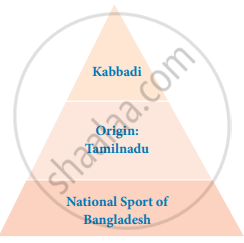
Kabbadi (கபடி - in Tamil) is a contact team sport that originated in Tamil Nadu, India. It is the national sport of Bangladesh. It is also popular in South Asia and is the state game of the Indian states of Tamil Nadu, Kerala, Andhra Pradesh, Bihar, Haryana, Karnataka, Maharashtra, Punjab, and Telangana.

Kabbadi is played between two teams of seven players: the objective of the game is for a single player on offence referred to as a 'raider', to run in to the opposing teams half of a court, tag out as many of their defenders as possible, and return to their own half of the court–all without being tackled by the defenders. Points are scored for each player tagged by the raider, while the opposing team earns a point for stopping the raider. Players are taken out of the game if they are tagged or tackled, but can be 'revived' for each point scored by their team from a tag or tackle. The raider should hold his breath and utter the words like 'kabbadi kabbadi, hututu hututu, chadu kudu' etc. while the opponents try to catch him. If he stops uttering these words, he is considered out.
The game is known by its regional names in different parts of the subcontinent, such as Kabbadi or Chedugudu in Andhra Pradesh, Kabbadi in Kerala and Telangana, Hadudu in Bangladesh, Bhavatik in Maldives, Kauddi or Kabbadi in the Punjab Region, Hu-Tu-Tu in Western India and Hu-Do-Do in Eastern India and Chadakudu in South India. The highest governing body of Kabbadi is the International Kabbadi Federation.
Given below is the visual presentation of the first paragraph.
i) Represent the other paragraphs in a visual form of your choice(flow chart, mind-map, pie-chart, etc.).
ii) Choose the correct option.
1. A contact sport usually involves a ______contact between players.
- violent
- gentle
- physical
2. Kabbadi is a game played between ______.
- seven teams of two players
- two teams of seven players
- four teams of seven players
3. A single ______.
- player on offence is referred to as a raider
- offence is referred to as a raider
- raider is an offence by the player
iii) Answer the following.
- How does a raider score points for his team?
- When does a raider concede a point to the opponent team?
- Can a player be revived when he/she is out of the game? Explain your answer.
- Kabbadi is called by different names in different parts of India. Do you know how Pallankuzhi is called in Karnataka, Andhra Pradesh and Kerala?
Read the passage given below:
| 1. | Very often, we do not take the first step towards a good cause because we say to ourselves, "The task is so big. What can I do alone?" So nothing gets done. There is much talk about environmental protection, air pollution and saving our forests. Do we really care? If we do, here are a few things we can do to make our surroundings more pleasant. |
| 2. | It is good to adopt a two-uses-attitude! By putting an article to a second use, we are giving it a longer lease of life and using up less raw material from nature. One of the worst things we do is abuse of paper. The clean sides of envelopes can be used to write small notes, lists and reminders around the house. The more paper we use, the more trees will have to be cut down. For the same reason, we should avoid the use of paper napkins or paper plates. Cloth napkins are just as good, for they can be washed and used over and over again. |
| 3. | Another area which needs the most urgent attention is effective garbage disposal. People who are conscious about it follow rules and laws strictly. As a result, their neighbourhoods are clean and beautiful Similarly, each one of us can contribute to a cleaner environment. All kitchen waste should be collected separately. Those of you who have green fingers can turn this into valuable manure. Dig a pit and put the kitchen waste into it. When the pit is a little over half full, cover it up with mud. Let nature do the rest. Within three or six months, we will have a good garden manure. It can also be done as a community project by digging a large pit in the colony. Do take help of all the members, for nothing succeeds like co-operation |
| 4. | A lot of people don't care about the environment because they don't understand the adverse effect that society has on it. It is important to convince people to care about the environment. The first step would be to convince people to change by providing simple alternative solutions and ways of doing things. Theintemet is a powerful tool and a group on social media of like-minded people can be formed. People can share environmental stories and issues, as well as pool in solutions and alternatives to educate one another. With the current state that our planet is in, it is imperative that people actively care about the environment and most importantly to act now. |
Based on your understanding of the passage, answer any Eight questions from the nine given below:
- Why don't we take the first step towards a good cause?
- What is a two-uses-attitude?
- What can we do to avoid the abuse of paper? (any two points)
- What is the result of an effective way of a garbage disposal?
- What procedure can one adopt for kitchen waste?
- How can making of garden manure be done as community project?
- How long does it take to make good garden manure?
- Select a suitable word from the passage which means - being concerned or interested. (Paragraph 3)
- Pick out the word from the passage which means - completely necessary? (Paragraph 4)
