Advertisements
Advertisements
प्रश्न
What do you think is the message that the author seems to convey through the story?
Advertisements
उत्तर
The author has tried to make a point that how people living by age-old impractical values weave their own fall and create unnecessary disturbance in society. One should evolve as time advances and society grows. Sticking to false pride is not what will bring prosperity to one. One must be cautious and keep a wide eye to see if one is taking advantage of their virtues.
APPEARS IN
संबंधित प्रश्न
He asked. Boy, did he ask! First he asked me for a chance, then he asked nearly all the people he came across if they wanted to buy a telephone system from him. And his asking paid off. As he likes to put it, “Even a blind hog finds an acorn every once in a while.” That simply means that if you ask enough, eventually someone will say ‘yes’.
He cared. He cared about me and his customers. He discovered that when he cared more about taking care of his customers than he cared about taking care of himself, it wasn’t long before he didn’t have to worry about taking care of himself.
Most of all, Cowboy started every day as a winner! He hit the front door expecting something good to happen. He believed that things were going to go his way regardless of what happened. He had no expectation of failure, only an expectation of success. And I’ve found that when you expect success and take action on that expectation, you almost always get success.
Cowboy has made millions of dollars. He has also lost it all, only to get it all back again. In his life as in mine, it has been that once you know and practice the principles of success, they will work for you again and again.
He can also be an inspiration to you. He is proof that it’s not environment or education or technical skills and ability that make you success. He proves that it takes more: it takes the principles we so often overlook or take for granted. These are the principles of that Ya Gotta’s for success.
Question:
(1) What was the cowboy’s motto?
(2) What did the cowboy learn after he lost millions of dollars?
(3) Why did the cowboy firmly believe that asking would pay off?
(4) When you expect success and take action on that expectation you almost always succeed. [Name the part of speech of the underlined words]
(5)
(a) He cared about me and his customers. [Rewrite using ‘not only ……………….but also’’]
(b) Cowboy has made millions of dollars [Add a question tag]
(6) In what way is the cowboy a source of inspiration for you?
The black kite may start a fire because
Write a summary of the above passage in about 100 words.
In which language do you think Gangadharpant and Khan Sahib talked to each other? Which language did Gangadharpant use to talk to the English receptionist?
How does the connection drawn between the tail and the eyes add to the descriptive detail of the poem?
What causes the element of surprise when the child comes on the scene of 'adult reconciling'?
How did Kumudini react to her mother's death?
Read the extract 'Being Neighborly' and complete the following statement:
To Jo, the fine house seemed like ______.
Fill in the blank.
“Hybrids need more _____________”, said Devu Handa.
Think and answer in your own words.
Does the poet really wish to become a hawker/gardener/watchman? Justify your response.
Go through the text again and find the reasons that forced Peter to shoot down a person.
- The keepers spotted him.
- _________________________
- _________________________
Now write what you observe in the following two pictures.
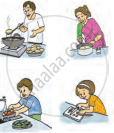

Using a dictionary/internet note down the main difference between a remote-sensing satellite and a natural satellite.
The special thread for kite - flying is sharpened by adding sugar and glass pieces.
A bridge connects people on either side of a river or valleys in cities or villages. Discuss with your partner the importance of a bridge to both the cities and the villages and complete the table.
| Cities | Villages |
Read the description of the Kabaddi match and do the following:
Write, in your own words, what happened in the second half.
The description of the character is given below. Identify the character from the play. Find some sentences which support your choice.
He is a brave but irresponsible person.
‘Smart Answers’: Form a large group. Each person asks the next one a question to get him to say ‘yes’ or ‘no’. He/She can use appropriate statements, requests, or even other questions as a response. But if he/she says ‘yes’ or ‘no’, he/she is out. Otherwise, he/she continues the game. Questions cannot be repeated.
Find two examples of the word made by using the following suffix.
-ness
Discuss what makes the following sentences funny.
- Your wasted time will be refunded.
- There was no highway attached to the booth.
Talk about your favourite season. (A one-minute activity.)
Sayali made a hasty purchase.
Answer in your own words.
How is the boy from the 1500s dressed?
Find the names of the exotic musical instruments and animals mentioned in the poem.
Find from the Internet and write down.
From which play is this song extracted?
Who said the following, to whom, and when?
“Mighty thy Teacher must be and divine.”
Read the word. Write the words that combine to make it.
gentle-hearted
Write other meaningful words that begin/end with stepmother.
Enact the play.
Discuss the following in group.
Do’s and Don’ts for young children.
Write some more expressions like ‘hundreds of’. Expand each expression.
Example, ‘Hundreds of children in the school.’
Guess the meaning of weary.
What is a password?
Guess the meaning of on the wing.
Rearrange the following sentences in a coherent order.
- He ordered Ariel to torment the inmates of the ship.
- Miranda was attracted by Ferdinand and had more concern towards him.
- Prospero and Miranda came to an island and lived in a cave.
- Prospero forgave them and restored his dukedom, Milan.
- He raised a violent storm in the sea to wreck the ship of his enemies.
- Prospero wanted to test Ferdinand and gave a severe task to perform.
- Using his powers, Prospero released the good spirits from large bodies of trees.
- The King of Naples, and Antonio the false brother, repented the injustice they had done to Prospero.
- Ariel was instructed to bring Ferdinand, the prince of Naples to his cave.
- Ferdinand was the second human whom Miranda had seen after her father
Answer the following question in about 100-150 word.
Narrate the extensive search operation made by the policemen in the house.
What did the bird suggest Chulong, in exchange for its freedom?
From the poem ‘The Grumble Family’ what kind of behavior does the poet want the readers to possess?
In New York, Mr. Scotti left the plane because he thought he.
Why was it a struggle for the children to dry their clothes?
What did Usha buy in the market? List them.
Identify the character/speaker.
One side makes you big, the other side makes you small.
Did he hire Kiouni? Why?
Read the line and answer the question.
And all I ask is a windy day with the white clouds flying
Why does the poet ask for a windy day?
Read the following lines and answer the questions.
It isn’t an instantaneous thing
Born of despair with a sudden spring
- What does ‘it’ refer to?
- What does ‘born of despair mean’?
Work in pairs and answer the following.
Write the rhyme scheme of the poem.
Read the story and fill in the grid by ticking each character’s qualities.
Discuss in pairs to rate the characteristic and give marks from 1 to 10 depending on the grade of each quality.
Justify your views in one or two sentences.
| Characteristics | Jane Eyre | Mrs. Reed | Bessie | Helen Burns | Miss. Temple |
| arrogant | |||||
| bitter | |||||
| caring | |||||
| courageous | |||||
| cruel | |||||
| emotional | |||||
| friendly | |||||
| kind | |||||
| sensitive | |||||
| rich | |||||
| poor | |||||
| patient | |||||
| self-disciplined | |||||
| unjust |
How does the coconut tree grow?
The wild boar got up from its daybed because it was disturbed by another boar.
Work in groups. Discuss and have a debate on life in bustling cities and life in calm towns.
Where were the boys taken to?
Why do we discover a mystery?
______hem the border.
Answer the following yes or no question.
Did Appu share guava?
Robinson named the boy______.
The villagers took oath not to harm the _______.
The brush ______ to her will.
Finally, ______, he got permission to study Science.
Match with the opposite gender.
| 1. | prince | bridegroom |
| 2. | hero | princess |
| 3. | bride | heroine |
