Advertisements
Advertisements
प्रश्न
Briefly comment on:
The purpose of the author’s journey to Mount Kailash.
Advertisements
उत्तर
Nick Middleton is a physical geographer and has travelled to over 50 countries. A passionate explorer, he likes to take on the challenges in the extreme conditions and survives them. His experiences in hostile conditions are endured by a television series Going to Extremes. He travels to Mount Kailash for the same reasons, surviving one of the most challenging and hostile geographical territories. The author was fascinated to explore the ancient Silk Road. He details his experience of the region and his mental as well as the physical striving. However, had there been a bit of emotional and sentimental element dropped in, the write up would have been more interesting to read.
APPEARS IN
संबंधित प्रश्न
Maggu’s achievements are particularly noteworthy because – as is well known – academic institutions in India are less than sold on the idea of inclusive education. In fact, when Maggu lost her sight in class IV, her school (which she declines to name) expelled her while suggesting she attend a “blind school”. Though shocked, Maggu rejected the advice. “Attending a special school would have tarred me with a handicap forever, which was not how I saw my future. Therefore I did the rounds of other public schools with my father, a small – time merchant, explaining that my case was different Since I had vision till the age of ten,” she recalls.
Impressed by her persistence and ambition, Delhi’s Bluebells School not only admitted her but pulled out all the stops to support her in academics sporting events and also notched up a respectable 73 percent average in the class XII exam with the help of Braille, interactive textbooks and extra coaching.
The respectable average in her CBSE exam paved the way for admission into LSR where again she proved her mettle by winning medals in a slew of inter – collage events (100 200 and 400 metre sprints) high jump, long jump, javelin and discuss throw: resulting in her being declared ‘Athlete of the year’ 2003’ at a sports meet for 100 physically challenged athletes. And the cherry on the cake was the selection to the IBSA Games last year. “It was a tough regimen,” recalls Maggu. “I had to attend sports camps manage my studies and officiates as sports president. But I managed.”
Questions:
(1) What qualities of Maggu are highlighted in this passage?
(2) Why did Maggu refuse to attend a ‘blind school’?
(3) Quote the lines that show that Jyoti Maggu was good in academics as well as in sports.
(4) Use any two phrases in sentences of your own :
(a) To win laurels
(b) To pave the way
(c) To prove one’s mettle
(d) A tough regimen
(5)
(a) I did the rounds of other public schools with my father [Change the voice]
(b) though shocked Maggu rejected the advice [Rewrite as a simple sentence]
(6) Should the physically challenged be sent to special schools? Express your views.
Answer any four of the following questions in 30 - 40 words each:
(a) What does the poet's smile in the poem, 'My Mother at Sixty-six' show?
(b) Listening to them, I see two distinct worlds ... ." In the context of Mukesh, the bangle maker's son, which two worlds is Anees Jung referring to ?
(c) Though the sharecroppers of Champaran received only one-fourth of the compensation, how can the Champaran struggle still be termed a huge success and victory?
(d) Which article in McLeery's suitcase played perhaps the most significant role in Evans' escape and how?
(e) Why does Derry’s mother not want him to go back to visit Mr. Lamb?
(f) What considerations influenced the Tiger King to get married?
Divide the article into four sections based on the shifts in the sub-topics and give a suitable sub-heading for each section. One has been done for you in the article as an example.
Why do you think Paul's mother was not satisfied with the yearly birthday gift of 1,000 pounds for five years.
Explain the undertones in the statement:
'Wife and husband in unusual rapport
State one unspoken thought':
How does the poet tossed back from ecstasy into despair?
What facet of political life does the behaviour of Ajamil illustrate?
Make sentence of your own using the following expression.
bargain:
What message does this story bring out for youngsters?
Add the appropriate Prefix to make the following word opposite in meaning.
continue
Using a good dictionary, find the shade of difference in the following:
‘Profession’ refers to ____________
Everyone admired the statue of the Happy Prince.
We all know that blogs can be written on many topics. Your teacher will divide the class into groups and assign a task to every group to make a list of various topics on which blogs are normally written. One is given to you.
- Social Awareness
- _________________
- _________________
- ________________
'It all builds on the charm of the 1967 film, which by itself is a must-watch for any child.'
Explain this sentence in the context of the movie, focusing on the two given phrases- 'Charm of the 1967 film' and 'must-watch'.
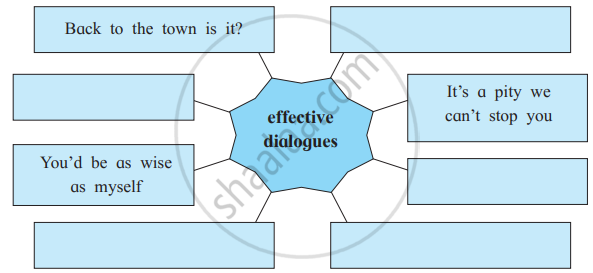
There are some dialogues that are short, but quite effective. They give us enjoyment and add beauty to the main story. Find some more from the text.
State whether the following statement is True or False:
Lysander and Demetrius fall in love with Helena as a result of the love potion.
Read the story and write about the following in short.
Yonamine Chiru of Okinawa
Read the story and write about the following in short.
Bushi Kiyo
Write a short note on the following:
Prince Siddharth’s protected life.
Read the passage and name the following.
She was the wife of King Menelaus.
List the lines that begin with 'Here' or 'And here'.
Also, list the sentences or phrases that begin with ‘And there’.
These phrases and sentences tell us about things that appear one after the other as the carriage moves. Can we tell which ones are closer to the train and which ones are at a distance? How?
Mention the various places that the brook flows past.
Find from the Internet and write down.
Which character from the play sings this song?
Rohan desperately wished for ______.
Read: ‘The Psalm of Life’- a poem by H. W. Longfellow.
Rearrange the following in their proper order as in the poem. Write the serial number against each line:-
(a) The Ostad sang the Malkous Raga enchantingly.
(b) Akbar followed Tansen, dressed miserably.
(c) I request you to sing such a song that will I experience unmatched joy.
(d) Ostad was nowhere to be seen.
(e) O Divine Teacher, please gift us the joy of your song.
(f) One day, the singer sang Deepak Raga in the court.
(g) Akbar expressed his wish to meet the Teacher.
(h) He experienced heavenly delight.
(i) Tansen sings to please the earthly king but Ostad devotes his songs to God.
(j) She sang Raga Malhar, which had a cooling effect.
Find the meaning of the following word.
abused
Guess the meaning of the following word.
barefoot
What was the businessman looking for? Why?
Write other meaningful words that begin/end with gentle-hearted.
Tell any one of the stories orally imagining you are Gulliver.
Enact the play.
Read the following lines from the poem and answer the question given below.
There's a family nobody likes to meet;
They live, it is said, on Complaining Street
- Where does the family live?
- Why do you think the street is named as ‘Complaining Street’?
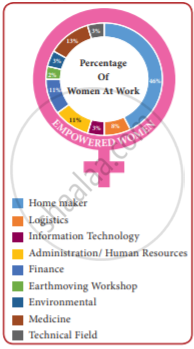
Read the data below and answer the following question.
Choose the correct answer.
In which field of work is women’s involvement the second highest?
Why did the governments of India, America and Pakistan – honour Neerja?
A turtle’s flippers help it to ______.
Fill in the blanks to complete the summary.
Ever since their introduction, ______, and their unique rhythms have ______ poets. In this poem the poet shares his experience ______ with us. He presents natural scenes seen from ______ a railway carriage. The ______ is regular and steady but ______ from the window of the train is constantly changing. The poem’s rhythm and phrases bring ______ of a railway journey. The poet looks out of the window at the ______ images outside. Every line we see here is a quick account of something seen for ______. The line that best sums up is the final one: "Each a glimpse and gone forever!"
The wild boar got up from its daybed because it was disturbed by another boar.
Read the lines and answer the questions given below.
Summer comes
in a blaze of heat with
sunny smiles
and dusty feet
- Does the poet welcome the summer? How do you know?
- Which line tells you that there is no rain in summer?
Fruits, vegetables, and water in the Mars are not ______.
Name the vegetables harvested in the vegetation hab.
How did Santhosh record his diary?
What did the first daughter do?
Who is the wisest of all? Why?
________ was a young talented doctor.
Vicky's father bought a______ robot
The robot did not obey his master.
What is your hobby?
The brown sparrow laid ________eggs.
Muthu collected ______ from every house.
Where were they going?
Kamali gave her savings to______.
Write the rhyming word.
countries- ______.
How long did the competition take to reach the final?
Secondly the greedy merchant is ready to offer______.
Nithin's mom said that Bala's father is a ______ magician.
We ______ yarn to make sarees.
Replace the bold word/words with a word from the quiver and re-write the sentence –
In no time she hit the object she aimed at.
Where did the naughty boy go?
What did he make out of it?
