Advertisements
Advertisements
प्रश्न
Why does Russell call the three passions 'simple'?
Advertisements
उत्तर
The essay actually is the preface to Bertrand Russell's autobiography. Every human is driven by a force, a passion all her/his life. It keeps her/him going. Some desire money, other, fame. There are some who desire simple satisfaction. Bertie's desires that he chased through his life were simple as well. He was driven by passions that any ordinary man or woman might feel for. For one, he wished love and got it too; he believed that it brought ecstasy. He got married four times to tell. Second, he hungered for knowledge and of course we all seek for it. He was a mathematician, a logician, political activist and wrote vastly on philosophy and contributed to literature, for which he received Nobel Prize as well. Third, he shared “an unbearable pity for the suffering of mankind”. He took a stand against World War 1 and Vietnam war. Any human will pity a suffering man or a woman for they have a heart and feel, and so did Russell. Russell was a man who did not lust after materialistic gains; he was born in a prominent aristocratic family of Britain and gave away much of what he inherited. He rose his voice in favour of suffragists and world government. He believed in free thought in religion and morals.
APPEARS IN
संबंधित प्रश्न
Read the extract given below and answer the questions that follow:
Wear skins peeped through by bones and spectacles of steel
With mended glass, life bottle bits on stones.
(b) Explain: 'slag heap'.
(c) What future awaits these children?
(d) Name the figure of speech used in the third line.
Read the passage given below and answer the questions that follow:
The term dietary fibres refers collectively to indigestible carbohydrates present in plant foods. The importance of these dietary fibres came into the picture when it was observed that the people having diet rich in these fibres, had low incidence of coronary heart disease, irritable bowel syndrome, dental caries and gall stones.
The foodstuffs rich in these dietary fibres are cereals and grains, legumes, fruits with seeds, citrus fruits, carrots, cabbage, green leafy vegetables, apples, melons, peaches, pears etc.
These dietary fibres are not digested by the enzymes of the stomach and the small intestine whereas most of other carbohydrates like starch and sugar are digested and absorbed. The dietary fibres have the property of holding water and because of it, these get swollen and behave like a sponge as these pass through the gastrointestinal tract. The fibres add bulk to the diet and increase transit time in the gut. Some of these fibres may undergo fermentation in the colon.
In recent years, it has been considered essential to have some amount of fibres in the diet. Their beneficial effects lie in preventing coronary heart disease, and decreasing cholesterol level. The fibres like gums and pectin are reported to decrease postprandial (after meals) glucose level in blood. These types of dietary fibres are recommended for the management of certain types of diabetes. Recent studies have shown that the fenugreek (Methi) seeds, which contain 40 per cent gum, are effective in decreasing blood glucose and cholesterol levels as compared to other gum containing vegetables.
Some dietary fibres increase transit time and decrease the time of release of ingested food in colon. The diet having less fibres is associated with colon cancer and the dietary fibres may play a role in decreasing the risk of it.
The dietary fibres hold water so that stools are soft, bulky and readily eliminated. Therefore high fibre intake prevents or relieves constipation.
The fibres increase motility of the small intestine and the colon and by decreasing the transit time there is less time for exposure of the mucosa to harmful toxic substances. Therefore, there is a less desire to eat and the energy intake can be maintained within the range of requirement. This phenomenon helps in keeping a check on obesity. Another reason in helping to decrease obesity is that the high-fibre diets have somewhat lower coefficients of digestibility.
The dietary fibres may have some adverse effects on nutrition by binding some trace metals like calcium, magnesium, phosphorus, zinc and others and therefore preventing their proper absorption. This may pose a possibility of nutritional deficiency especially when diets contain marginal levels of mineral elements. This may become important constraints on increasing dietary fibres. It is suggested that an intake of 40 grams dietary fibres per day is desirable.
(Extracted from ‘The Tribune’)
(a) On the basis of your reading of the above passage make notes on it in points only, using recognizable abbreviations wherever necessary. Also suggest a suitable title.
(b) Write a summary of the above in about 80 words.
What inference can you draw from the action of the female gorilla described in para 2 ?
There is mention of three communities in the story: the Marathas, the Mughals, the Anglo-Indians. Which language do you think they used within their communities and while speaking to the other groups?
What, according to Russell, is the importance of love in life?
Certain words in the poem are in capital letters — why?
The poem has a literal level and a figurative level. Why has the poet chosen 'tigers' and 'sheep' to convey his message?
Arrange the following set of words in the alphabetical order in your notebook.
ship, small, successful, scoldings, stone, saving, someone, stood, streets, still, screamed, sat, seemed, saint, share.
Read the poem and write 3 qualities of the following.
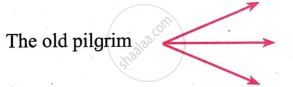
The best punishment is ‘forgiveness’. Discuss the sentence in light of the text you have read. You can make use of the following points.
(a) Forgiveness provides an opportunity to change the behaviour.
(b) Forgiveness leads to repentance.
(c) A person may commit a mistake/crime impulsively or under the force of strong emotions.
(d) ________________________
(e) ________________________
Find evidence from the lesson and write in your own words.
India has many amazing success stories.
Answer the given question in your own words.
What was the first task given to the Swallow?
Find one more example which shows that a beautiful appearance is not enough.
Go through the following web that highlights the essential qualities of a compere. Discuss with your partner the essential qualities and also the precautions that a compere should take while compering a program.

Precautions to be taken :
- __________________________
- __________________________
- __________________________
- __________________________
Shakespeare is acknowledged as the greatest writer because he understood human nature better than anyone else. Explain the statement in the context of the play.
Shakespeare’s poetry has come to be valued for its own sake on the stage. Comment with reference to the play ‘A Midsummer Night’s Dream.’
Expand the following ideas in a paragraph or two:- Courage and resourcefulness are the keys to overcome problems.
What is your favourite time of the day? Describe it in detail.
Read the following sentence aloud. Write who said it and to whom.
“I would rather not go to the party.”
Explain the idea of ‘Conservation of Nature through Livelihood’ briefly, using the example given here.
Talk about the good qualities of any one person you do not like. (You need not name the person.)
Read the poem aloud with the proper rhythm. What does the rhythm remind you of?
Guess the meaning of the following word:
exorbitantly
Write the smaller and related words that you see within this word.
Using your imagination, write about a beautiful region - its landforms, water bodies, flora and fauna, night sky, people, etc.
Write the symbol that is used in the poem to represent the following idea.
Equally good options.
Form groups of 6-8. One person (leader) chooses one item - a picture, a paragraph, or a lesson from any one of the 9th standard textbooks and writes the reference on a slip of paper, and folds it. Others ask him/her questions and try to guess what it is, from his/her answers. Follow the rules given below.
- The maximum number of questions the rest of the group can ask is 20.
- You cannot ask a direct question like ‘What do you have in mind?’
- You can ask ‘Wh-’ questions or ‘Yes/no’ questions.
- The leader has to give truthful answers.
‘Unke, Munke, Timpetoo,
I wish, my wish is coming true.’
Try to compose two other funny magical chants that have rhyming lines.
Put the following expressions in a table of Do’s and Don'ts as expressed by the poet.
- Please listen
- give me advice
- tell me why
- solve my problem
- just hear me
- accept as a simple fact
- contribute to my fear
- wait a minute
| Do’s | Don'ts | |
| 1. | ||
| 2. | ||
| 3. |
What is a website?
Helen Keller’s life is the story of ______.
____________ had provided Prospero formerly with books and provisions.
What do you understand by the mother’s act of throwing the shoe?
Identify the speaker/character.
‘Come in, Zigzag, come in dear!’
What happened when Somu left Zigzag with the Krishnans?
How did Zigzag communicate with the Krishnans?
Rearrange the jumbled sentences and write them in the correct order.
- But Hamid bought a pair of tongs.
- Granny Ameena felt proud of her grandson.
- Hamid’s friends bought different toys of their choice.
- Hamid proudly compared his tongs with a brave tiger.
- Hamid had less money than his friends.
- Granny Ameena was worried as he had to go to the Eidgah alone.
Find a sentence/word from the text which express the following.
The parent’s earlier view of the child
Discuss with your partner and complete the table.
| S.No. | Question | Who asked this? | Who answered? | What was the answer? |
|
1. |
Shall we run back together? | |||
| 2. | Can you see something behind the wall? | |||
| 3. | Who said good bye? | |||
| 4 | Was it just the wind? |
Teach it in accents______ and______.
- soft
- vain
- fear
- joy
- love
- heard
- toiled
- mild
- good
- sand
- life
- harsh
Learning About Nature
Learn about caterpillars and butterflies. Read a book about a caterpillar turning into a butterfly. You can get one from the library or go online and find information with pictures.
Neerja had a sour marriage due to______.
Who is Raj?
Why do the soldiers (people) die? When will it stop?
Jaswant Singh Rawat was awarded ______.
Whose hospitality is described in the poem?
Match the rhyming words.
| 1. | flow | know |
| 2. | grow | week |
| 3. | seek | blow |
______always stays to the last in our needs.
The goose is swimming with its ______.
Divya and Rani decided to draw a ________.
What did Ani's parents teach her?
Name the things that good merchant offered for the plate
Why did Bala go to Chennai with his father?
Mugund loved wild animals.
How did Mugund’s mother die?
What is the main idea of the story?
Recite the poem The Painter with correct intonation.
Who agreed to help Helen?
What secrets did he learn about beasts?
Say Aloud
| dash | bash | splash | cash | trash |
| steer | tear | clear | deer | dear |
| shower | power | tower | flower | mower |
| poked | croaked | soaked | stroked | joked |
| wept | kept | crept | leapt | slept |
Activity: Live English: Packs, packets, pouches, wrappers

Given above is the picture of an imaginary food item’s packet. Let us see how to ‘read’ the matter on the packet as a vigilant consumer.
- Look at the wrapper and complete the sentences.
- The name of the food item is ______.
- It is made by ______.
- It is a ______ food item. (Veg/Non-veg)
- The ______ sign indicates whether it is a Veg or Non-veg food item.
- The ingredients are ______, ______, ______, ______.
- The date of packing is ______ and the expiry date is ______.
- It should be consumed before ______ from the date of manufacturing.
- Try and obtain more information about the various symbols printed on the packet.
- Discuss the following -
- Why the ‘recipe’ is given on the packet.
- Why the packet tells us to visit the website of the company.
- What ideas are used to make the packet attractive?
- How you will verify whether something is good for you to eat.
