Advertisements
Advertisements
प्रश्न
Interpret these phrases in the context of the essay
- Mist of protection
- At a crossroads
- It came with strings attached
Advertisements
उत्तर
Mist of protection: The phrase has been used by the author to signify that her childhood was very protective. Her parents always cared for her and kept watch over her. They tried to influence her in all her activities. She found this protection as something like a mist which covers our vision.
At a crossroads: At a cross roads refers to a situation when some one is not able to decide as to which path to chose. In the text the phrase is used by the author to describe her situation after completing the agriculture course when she was left with few job prospects.
It came with strings attached :
APPEARS IN
संबंधित प्रश्न
Describe the progress made by Helen Keller during the two years she spent at Wright-Humason School for the Deaf in New York City.
Answer any four of the following question in 30 – 40 words each:
(a) ''What a thunderclap these words were to me!'' (Franz). What were those words and what was their effect of Franz?
(b) Why did Douglas fail to come to the surface of the pool as he hoped to?
(c) What was Kamala Das's childhood fear?
(d) How is the Earth a source of life when all seems dead on it? Keeping Quiet)
(e) How does Mr. Lamb react when Derry enters his garden?
(f) Which problem did the Maharaja face when he had killed seventy tigers? How did he solve it?
Read the following extract and answer the questions given below:
If you do not get lowered in your own eyes
While you raise yourself in those of others,
If you do not give in to gossips and lies
Rather heed them not, saying, 'who bothers?'
You may be the person I am looking for.
If you crave not for praise when you win
And look not for sympathy while you lose,
If cheers let not your head toss or spin
And after a set-back, you offer no excuse,
You may be the person I and looking for.
(1) What should be your reaction towards gossips and lies?
(2) Who are your role models? Why?
(3) Give the rhyming pairs of words from the first stanza.
(4) Which line is repeated in this extract and what is its effect?
In ‘The Diary of a Young Girl’ how did the Franks and others celebrate two festivals, Hanukkah and St. Nicholas Day in the Annexe ?
Talk to your partner about the following.
Have you known someone like the author’s grandmother? Do you feel the same sense of loss with regard to someone whom you have loved and lost?
The narrative has many phrases to describe the scenic beauty of the mountainside like:
A flawless half-moon flated in a perfect blue sky.
Scan the text to locate other such picturesque phrases.
What impressions of Shahid do you gather from the piece?
Identify the common characteristics shared by tribal communities all over the world.
What, according to Ruskin, are the limitations of the good book of the hour?
Why does Ruskin feel that reading the work of a good author is a painstaking task?
What do you understand of the three voices in response to the question 'What does a novel do' ?
What do the references to the birds and animals made in the poem suggest?
Fill in the blank.
Baban’s father and some elders mentioned the name of __________.
Arrange the following set of words in the alphabetical order in your notebook.
ship, small, successful, scoldings, stone, saving, someone, stood, streets, still, screamed, sat, seemed, saint, share.
Pick out words from the poem to fill in the web diagram. They should be related to the theme in the web.
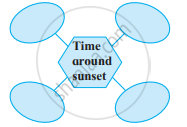
Answer in your own words.
Read and write down 5 points which prove that Tomba, (Lanthoi’s father) firmly believes in gender equality.
Find from the library or internet other poems composed on tiny living creatures. Try to understand the message in each of them.
State whether the following statement is True or False. Correct the false statement by finding evidence from the poem to support your remark.
The poet was exalted at the sight of the cherry tree.
Discuss in groups, reasons/ consequences/ effects:
The cherry blossomed.
A small thought, put in action, led to a great achievement. Pick out the lines from the beginning and end of the poem and explain their significance.
‘The city now, doth, like garment wear’. The poet imagines that the city is wearing a beautiful garment. Hence, the figure of speech is personification. Find out more examples of personification from the poem.
Say where . . . . . . .
______ do stars shine in the daytime?
Say where the image from nature given in the poem exists.
AIR / LAND / WATER
beneath the boughs
How do we help animals and birds?
Match the columns :
| A | B |
| (1) Theseus | (1) Robin Goodfellow |
| (2) Titania | (2) Queen of the Amazons |
| (3) Puck | (3) Duke of Athens |
| (4) Hippolyta | (4) Faeries |
| (5) Cobweb, Moth | (5) Queen of the Faeries |
What question did Shalihotra ask Sushruta?
Expand the following ideas in a paragraph or two:-
Where there is a will, there is a way.
Guess the meaning of the following from the context.
Dawn wakes the starling.
Explain the idea of ‘Conservation of Nature through Livelihood’ briefly, using the example given here.
Read: ‘Just So Stories’ and ‘The Jungle Book’ by Rudyard Kipling.
Rohan desperately wished for ______.
Read the word. Write the words that combine to make it.
springtime
Write slogans for the cleanliness drive in your area.
What does the poet want to know from the lark?
What is the ‘Internet’?
What was Ariel ordered to do with the people on the ship?
How did the Bodwells react, when a shoe was thrown into their house?
Read the story again and write how these character reacted in these situation:
It’s Somu’s thoughtless ways that reduce me to tears. Mrs. Krishnan …………………....…..
Dr. Krishnan ……………..…......…….
Why did Shepherd-Barron reduce the PIN number from six digits to four?
With their treasure, the boys would buy ______ in Eidgah.
What were the children doing beside the stone wall?
“Was it just the wind?”– What do you think Usha thought it was? Why?
Underline the words or phrases that tell you what the wind does to the village.
Read the poem aloud in pairs
The boy was so inspired by Mithali that he was happy for his sister to play cricket.
The poor farmer’s crop was______.
Name some of the activities that the village children were doing on their vacation.
What were Anandhan and Yazhini watching in the television?
Anitha's friends wanted a______ robot in their houses.
The pigeon started to worry for her friend.
Why did everyone ridicule the boy?
Match the following.
| pale |  |
| tremble |  |
| fainted |  |
Circle and write the adverbs.
I'm waiting here. ______
Read the advertisement and answer the question given below.

When does the offer end?
Who were the guest to Kani’s home?
Keep moving though your progress is ______.
What did the library door say?
Read the passage and write a summary of it. Suggest a suitable title for the summary.
|
A sparrow is a small bird which is found throughout the world. There are many different species of sparrows. Sparrows are only about four to six inches in length. Many people appreciate their beautiful songs. Sparrows prefer to build their nests in low places-usually on the ground clumps of grass low trees and low bushes. In cities, they build their nests in building nooks or holes. They rarely build their nests in high places. They build their nests out of twigs grasses and plant fibers. Their nests are usually small and well-built structures. Female sparrows lay four to six eggs at a time. The eggs are white with reddish-brown spots. They hatch within eleven to fourteen days. Both the male and female parents care for the young. Insects are fed to the young after hatching. The large feet of the sparrows are used for scratching seeds. Adult sparrows mainly eat seeds. Sparrows can be found almost everywhere where there are humans. Many people throughout the world enjoy these delightful birds. The sparrows are some of the few birds that engage in dust bathing. Sparrows will first scratch a hole in the ground with their feet then lie in it and fling dirt or sand over their bodies with flicks of their wings. They will also bathe in water or in dry or melting snow. Water bathing is similar to dust bathing with the sparrow standing in shallow water and flicking water over its back with its wings also ducking its head under the water. Both activities are social with up to a hundred birds participating at once and are followed by preening and sometimes group singing. |
