Advertisements
Advertisements
प्रश्न
Write a short note on the following:
Care of animals in the regime of Emperor Ashoka
Advertisements
उत्तर
The great Emperor Ashoka erected the first known veterinary hospitals. He arranged for the cultivation of herbal medicines for men and animals in his empire and the adjoining kingdoms. Animals were given tomes and stimulants, and their physical and mental health was looked after. Prevention of diseases, cleanliness of animals, and their stalls and stables was given importance. The quality of food and the disadvantages of overfeeding were also looked into.
संबंधित प्रश्न
Write 3 to 4 lines about the following in your own words.
The Robotic Surgery
Add ten more words to the list on your own. Each of the component words must be meaningful.
Write the rhyme scheme of the poem (Autumn).
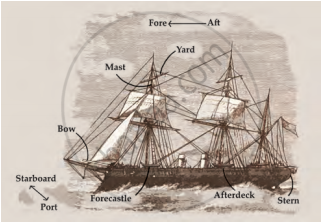
Observe the picture and the labels carefully. Then match the words and the meanings given in the following table.
| Words | Meaning |
| 1. yard | (a) a floor, flat area built on a ship |
| 2. mast | (b) the forward part of the main body of a ship |
| 3. bow | (c) the forward part of a deck |
| 4. deck | (d) tall, upright pole on a ship |
| 5. forecastle | (e) a pole slung across a ship’s mast. A sail hangs from a yard. |
| 6. starboard | (f) the rearmost (back) part of a ship |
| 7. stern | (g) the part which is always at the front while the ship is sailing. |
| 8. afterdeck | (h) the right-hand side of a ship as one faces forward |
| 9. fore | (i) an open deck near the back |
Find the words that mean the following from the first stanza.
- Gold hammered into a flat, thin shape: ______
- show off proudly: ______
- tilt, move at an angle: ______
- across, especially in a slanting direction: ______
Choose the appropriate phrase to insert in the gap, to make the sentence meaningful. Use the appropriate form of the verb.
Before we ______ let us stand in attention for the National Anthem.
Identify the character or speaker.
I will tie you neck and feet together.
Read the incident again and answer the following question.
When did the writer remember the fact that he had to buy something for Mr. Gilson?
Why does the poet fly out of the universe?
Complete the following sentence using the prepositions from the option.
The summer vacation ends _____ Monday.
