Advertisements
Advertisements
प्रश्न
Look up the following entries in the Language Study pages given at the end.
- stress
- intonation
- sound
- consonant
- vowel
Advertisements
उत्तर
- Stress: Extra force applied when pronouncing or speaking a word or phrase. For example, in the word 'English', the syllable 'Eng' is stressed. The word English is stressed in the line 'Say it in English'.
- Intonation: The rise and fall of the voice adds meaning to the statement. For example, the voice rises or goes up at the end of 'You need coffee?' to indicate that it is a query.
- Sound: A sound is something that you hear.
- Consonant: Speech sounds like 'ब्', 'श्', 'ट्', etc., which are not vowels. A consonant letter represents a consonant sound. For example, the letter 'c' (सी) represents the sound 'स्' in 'city' and 'क्' in 'coming'.
- Vowel: A speaking sound produced without closing any part of the mouth or throat. For instance, 'ॲ' and 'आ'. A vowel letter is a letter of the alphabet that represents the vowel sound. The vowel letters are a, e, i, o, and u. The letter 'y', too, can stand for a vowel.
APPEARS IN
संबंधित प्रश्न
Write a summary of the above passage in about 100 words.
Comment on the use of the phrase ‘fresh-peeled voice’.
'Whose roots lay deeper than our lives' – what aspect of human behaviour does this line reflect?
Write words from the poem that describe the following.
- sky ____________
- heart ____________
- hand ____________
- beginning ____________
- surprises ____________
Think and write down how the following creature can be useful:
Dragon fly:
State whether the following statement is True or False. Correct the false statement by finding evidence from the poem to support your remark.
Birds and insects were benefitted from the tree.
Find proof from the poem for the following.
The struggle of the cherry tree for survival.
Discuss in your class.
How can we take help of robots in our daily life?
Use the following word/phrase to make a sentence of your own.
enthusiasm
Find sentences from the play related to the given points.
The tension between different loyalties
- It’s little we get but abuse from the people, and no choice but to obey our orders.
- ________________________________
- ________________________________
- ________________________________
Answer the following question in one sentence.
What examples of man’s progress have been given in the poem?
Does the traveller really have a magic stone?
Find pairs of rhyming words from the poem.
Answer in your own words.
What excuses did Neel give to avoid cleaning his room?
Fill in the blank choosing the appropriate word/idiom from the lesson.
The sight of a snake ______.
Name the following.
Hosts of the 1936 Olympic Games.
Write other meaningful words that begin/end with gentle-hearted.
Make a list of the rhyming words in the poem.
Add one more rhyming word of your own to each pair.
Write down the word that alliterate in the poetic line below
Festival of Flowers.
Do you think this was a good idea?
Answer using Yes or No and pick sentence from the story to support your answer.
Was Robinson alone in the island?
Write the rhyming word.
goat
Like whom did they want to do?
Write a paragraph on the topic ‘Park’.
Jana saw a _______ behind her.
Read the passage three times and colour a dustbin each time.
|
I am Mani. I had to take a bus to nearby city. I crossed the road to reach the bus stand. I got the bus, sat down, and read a book. Before I started to read, I just looked at the people around me. The two men sitting next to me were talking loudly. Some were listening to music on their phone. I was unable to focus on reading. The men were talking about cleaning the city. As they were talking, they opened a pack of biscuits to eat. After some time I dozed off. When I opened my eyes, the bus had reached the city. The two men were not there but pieces of the biscuits and wrappers were there. I cleaned the wrappers and put them in the dustbin.
|
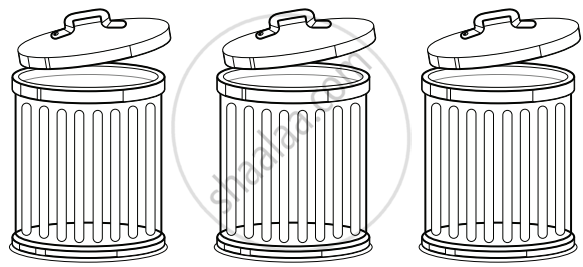
- What did Mani take out?
- What did Mani find on the seat when he woke up?
- If you were Mani, what would you do?
______ had made Math easy for Bala.
Write the word with same meaning.

chips- ______
Why is the play called ‘The Giving Tree’?
Read the passage below:
| 1. | Our history makes it evident that the Indian Plastics Industry made a vigorous beginning in 1957 but it took more than 30 years for it to pervade Indian lifestyles. In 1979, "the market for plastics' was just being seeded by the state-owned Indian Petro-Chemicals and it was only in 1994 that plastic soft drink bottles became a visible source of annoyance. |
| 2. | In the same year, people in other cities were concerned about the state of public sanitation and also urged regulatory bodies to ban the production, distribution and use of plastic bags. However, the challenge was greater than it appeared at first. |
| 3. |
The massive generation of plastic waste in India is due to rapid urbanisation, spread of retail chains, plastic packaging from grocery to food and vegetable products, to consumer items and cosmetics. The projected high growth rates of GDP and continuing rapid urbanisation suggest that India's trajectory of plastic consumption and plastic waste is likely to increase.
|
| 4. | According to the United Nations Environment Programme (UNEP) report of 2018, India stands among few other countries like France, Mongolia and several African countries that have initiated total or partial nationallevel bans on plastics in their jurisdictions. On World Environment Day in 2018, India vowed to phase out single-use plastics by 2022, which gave a much needed impetus to bring this change |
| 5. | In this context, thereafter ten states (Andhra Pradesh, Chhattisgarh, Gujarat, Himachal Pradesh, Karnataka, Madhya Pradesh, Meghalaya, Odisha, Rajasthan and Tamil Nadu) are currently sending their collected waste to cement plants for co-processing, twelve other states/UTs are using plastic waste for polymer bitumen road construction and still four other states are using the plastic waste for waste-to-energy plants and oil production. A world of greater possibilities has now opened up to initiate appropriate and concrete actions to build up the necessary institutions and systems before oceans turn, irreversibly into a thin soup of plastic. |
| 6. | However there is no one single masterstroke to counter the challenges witnessed by the staggering plastic waste management in the country. The time is now to formulate robust and inclusive National Action Plans and while doing so, the country will establish greater transparency to combat the plastic jeopardy in a more sustainable and holistic way. |

Based on your understanding of the passage answer any six out of the seven questions given below:
- What does the writer mean by 'visible source of annoyance'?
- Why did people demand a ban on plastics?
- What created a demand for plastics in India?
- With reference to the graph write one conclusion that can be drawn about the production of plastics in 2019 (approximately).
- What does the upward trend of the graph indicate?
- What does the line, oceans turning 'irreversibly into a thin soup of plastic', suggest?
- What step must be taken to combat the challenges of plastic waste management? What will be its impact?
