Advertisements
Advertisements
प्रश्न
What does the word ‘cardboard’ denote in the poem? Why has this word been used?
Advertisements
उत्तर
In the poem, the word ‘cardboard’ stands for the frame that supports and borders the photograph. The photograph shows the poet’s mother as a twelve-year-old girl with two of her cousins, Betty and Dolly. The word ‘cardboard’ has been used to depict that the photograph is many years old. The use of cardboard as a photo frame was common in old times.
APPEARS IN
संबंधित प्रश्न
Does the poem talk of an exclusively personal experience or is it fairly universal?
Notice these expression in the text. Infer their meaning from the context.
careered down
What do the following utterance indicate?
(i)“I told her, through Daniel ...”
(ii)“It’s a cold,” he said finally through Tsetan.
Briefly comment on:
The purpose of the author’s journey to Mount Kailash.
Identify instances in the story that show the business acumen of Ramanand.
The ending of the story is an instance of irony. Suppose Paul had not died at the end, how would you have reacted to the story?
'It is not an accident that the most discrimination literary criticism of Shelley's thought and work is by a distinguished scientist, Desmond King-Hele.' How does this statement bring out the meeting point of poetry and science?
Why does Ruskin feel that reading the work of a good author is a painstaking task?
State the central issue in the poem.
Why do you think that the poet has chosen the title ‘Telephone Conversation’? If you were to suggest another title for the poem, what would it be?
Guess the types of hardships they must have faced in their childhood and youth.
State the facts about the story.
- Main characters:
- Problem:
- Attempts made to solve it:
- Climax/Turning point:
- Problem solved:
- End:
Correct the following statement.
Sue and Johnsy were good neighbours.
Correct the following statement.
The last leaf was a real leaf that survived.
Prepare an Acrostic from the word ‘Leisure’. The words should be related to what one likes to do in free time.
L______
E______
I______
S______
U______
Reading stories
E______
Go through the text again to understand the important features of blogs. Discuss various blogs and their features with your friends.
A blog helps us to express our - ___________.
- Feelings
- _________
- _________
- _________
Answer the following question in short.
Why was Tenali Raman taken to the court in a palanquin?
Fill in the gap, choosing a word from the bracket to make an appropriate comparison.
(tall / quiet / humble / merry / busy / slippery / fast / sly / slow / big)
as ______ as a fox
What would happen if children didn’t go to school? Discuss the question in groups of 5-8 and prepare a short composition on it.
Wash your handkerchief clean. Hang it with a peg to dry in the wind. Watch how it flutters.
State whether the following statement is True or False:
Oberon transforms Bottom's head into that of an ass.
Find 2/4 expressions of humour from the extract.
Are there any stories/legends about the moon or special names for the moon in your language? Talk to your friends and family members and collect this information.
Collect as many pictures as you can, or draw diagrams of all the sources you have listed above. Make a scrapbook using them.
Form pairs. Complete the following table through discussions.
| Occupation | Necessary Qualities | Reasons |
| Student | ||
| Teacher | ||
| Housewife | ||
| Sportsman | ||
| Artist | ||
| Singer | ||
| Author | ||
| Umpire | ||
| Actor | ||
| Scientist |
Shylock was not at all generous.
Put the following events in chronological order.
- The sword in the stone appeared in the churchyard.
- Lord Uther died.
- Lord Uther drove the barbarians away.
- The Lords and knights began to fight for the kingdom.
- Sir Kay left his sword behind at home.
- Merlin announced that Arthur was the son of Lord Uther.
- Arthur brought the sword from the churchyard.
- Ancient Britain was invaded by wild barbarians.
- Many knights tried to pull the sword out of the stone.
- Arthur grew up in Sir Ector’s house.
- Merlin entrusted a baby to Sir Ector.
Read the poem: ‘Home they brought her warrior dead’ by Alfred Lord Tennyson.
Read the passage and name the following.
He persuaded Helen to elope with him.
Explain the use of the following property in the development of the play.
An envelope containing the letter
Find one example of the following given below from the poem: Metaphor
List the adverbs/adverbial phrases used in the passage.
Form groups of 4-5. Read the following sentences aloud. Using your imagination and with the help of group discussion, write other situations in which the sentences can be used.
- The outcome: disappointment and anger.
- The hour of battle had sounded
- What a chase!
- This was our chance, .........
Which other things in nature can say –
'For men may come and men may go,
But I go on for ever.'
Find from the Internet and write down.
Which character from the play sings this song?
Read aloud a couple of stanzas of the poem ‘Invictus’ and ‘Please Listen’. In what ways do they differ? Think and fill up the table with ‘Yes’ or ‘No’.
| Invictus | Please Listen | |
| Rhyming lines | ______ | ______ |
| Steady rhythm | ______ | ______ |
| Uniformity in the length of lines | ______ | ______ |
| Uniformity of the number of lines in each stanza. | ______ | ______ |
| Figurative language | ______ | ______ |
Rearrange the following in their proper order as in the poem. Write the serial number against each line:-
(a) The Ostad sang the Malkous Raga enchantingly.
(b) Akbar followed Tansen, dressed miserably.
(c) I request you to sing such a song that will I experience unmatched joy.
(d) Ostad was nowhere to be seen.
(e) O Divine Teacher, please gift us the joy of your song.
(f) One day, the singer sang Deepak Raga in the court.
(g) Akbar expressed his wish to meet the Teacher.
(h) He experienced heavenly delight.
(i) Tansen sings to please the earthly king but Ostad devotes his songs to God.
(j) She sang Raga Malhar, which had a cooling effect.
Make a collection of Rangoli motifs and patterns.
Write about each motif or pattern in your own words -
it could just be a label or a description or some information or comment.
The taxi driver took away the narrator’s suitcase.
Hamid’s granny scolded him for buying iron tongs. Then she understood that Hamid had bought it ______.
Tom lay thinking. Presently it occurred to him that he wished he was sick; then he could stay home from school. He examined himself. He found no symptoms or sickness, and he investigated again. This time he felt he had a stomach ache, but it soon grew feeble, and presently died wholly away. He reflected further.
What was the result of Tom’s self-examination?
Two scary events from this section are listed here. Write the events that take place in between in the correct order.
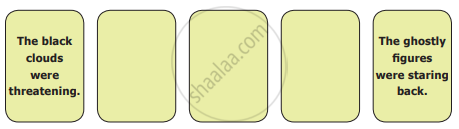
Read the comic strip and answer the following question.
Which website do you often access? Why?
Role play
Put students in pairs to role-play a conversation between:
- Alice and her sister.
- Alice and White Rabbit.
Read these lines and answer the questions given below.
And welcomes little fishes in
With gently smiling jaws!
- Who welcomes the fish? Why?
- Which line tells you that the crocodile is hungry?
Mother called ______.
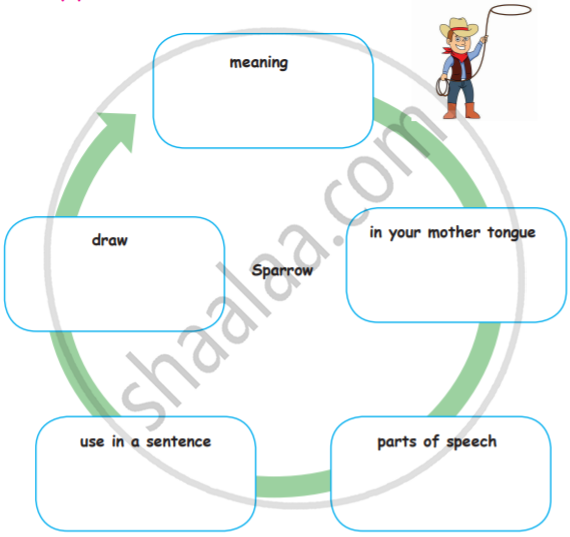
Complete the mind map given below

Geetha madam couldn’t stop the children running out of the train because they ______.
Some words sound the same but their spelling and meaning are different. Such words are called homophones. There are many homophones.
Why do we ask questions?
Try your own.
______are the real wealth.
Leafcutter ants grow fungus.
Match the following and write the new word.
| 1. | pre | continue |
| 2. | dis | familiar |
| 3. | un | open |
| 4. | re | view |
Who is responsible for the society?
Write the word with same meaning.

purse- ______
How does she move the brush?
Write the word with same meaning.

Torch
William Shakespeare was one of the greatest playwrights of all time. He lived in the 16th century. Many Shakespearean plays have been written in the short-story form. Find out the names of at least 5 of Shakespearean plays.
Example: Romeo and Juliet
