Advertisements
Advertisements
प्रश्न
What has the camera captured?
Advertisements
उत्तर
The camera has captured a happy moment from the childhood days of the poet’s mother. The photograph was taken when the poet’s mother (at the age of twelve or so) went to a beach holiday with two of her cousins, Betty and Dolly. The captured picture serves as a preserved memory both for the mother as well as the poet.
APPEARS IN
संबंधित प्रश्न
Read the passage carefully.
1. I remember my childhood as being generally happy and can recall experiencing some of the most carefree times of my life. But I can also remember, even more vividly, moments of being deeply frightened. As a child, I was truly terrified of the dark and getting lost. These fears were very real and caused me some extremely uncomfortable moments.
2. Maybe it was the strange way things looked and sounded in my familiar room at night that scared me so much. There was never total darkness, but a street light or passing car lights made clothes hung over a chair take on the shape of an unknown beast. Out of the corner of my eye, I saw curtains move when there was no breeze. A tiny creak in the floor would sound a hundred times louder than in the daylight and my imagination would take over, creating burglars and monsters. Darkness always made me feel helpless. My heart would pound and I would lie very still so that 'the enemy' wouldn't discover me.
3. Another childhood fear of mine was that I would get lost, especially on the way home from school. Every morning, I got on the school bus right near my home ‒ that was no problem. After school, though, when all the buses were lined up along the curve, I was terrified that I would get on the wrong one and be taken to some unfamiliar neighbourhood. I would scan the bus for the faces of my friends, make sure that the bus driver was the same one that had been there in the morning, and even then ask the others over and over again to be sure I was in the right bus. On school or family trips to an amusement park or a museum, I wouldn't let the leaders out of my sight. And of course, I was never very adventurous when it came to taking walks or hikes because I would go only where I was sure I would never get lost.
4. Perhaps, one of the worst fears I had as a child was that of not being liked or accepted by others. First of all, I was quite shy. Secondly, I worried constantly about my looks, thinking people wouldn't like me because I was too fat or wore braces. I tried to wear 'the right clothes' and had intense arguments with my mother over the importance of wearing flats instead of saddled shoes to school. Being popular was very important to me then and the fear of not being liked was a powerful one.
5. One of the processes of evolving from a child to an adult is being able to recognise and overcome our fears. I have learnt that darkness does not have to take on a life of its own, that others can help me when I am lost and that friendliness and sincerity will encourage people to like me. Understanding the things that scared us as children helps to cope with our lives as adults.
(a) On the basis of your reading of the above passage, make notes using headings and subheadings. Use recognizable abbreviations wherever necessary.
(b) Make a summary of the passage in not more than 80 words using the notes made and also suggest a suitable title.
Talk to your partner about the following.
The author’s grandmother was a religious person. What are the different ways in which we come to know this?
Talk to your partner about the following.
Would you agree that the author’s grandmother was a person strong in character? If yes, give instances that show this.
Notice the italicized sentence placed at the top of the article which tells us at a glance what the article is about.
'The Address' is a story of human predicament that follows war. Comment
Considering that this is an excerpt from a lecture, how does the commentary provided by the speaker string the arguments together?
How do the words in bold, in the lines below, illustrate the poet’s ability to convey criticism cryptically?
Our meddling intellect
Misshapes the beauteous forms of things:
We murder to dissect.
'New Literature' is a misnomer for the wealth of the Indian Literary tradition. How does G. N. Devy explain this?
'Constancy' is the theme of the poem. Indicate the words, phrases, and images that suggest the theme.
Why is the speaker’s childhood described as ‘a forgotten boredom’?
Explain the undertones in the statement:
'Wife and husband in unusual rapport
State one unspoken thought':
Name the world-famous personality who reached great heights despite of humble circumstances.
Say why the speaker of the poem wishes to be a -
watchman
complete the following sentence.
Ajoy reported about ________________.
The two best things the servants brought to God were gold and jewel stones.
The special thread for kite - flying is sharpened by adding sugar and glass pieces.
You might have visited a bridge. Complete the web describing the sights you could see from the bridge.

Discuss with your partner the different ideas connoted by the word 'season'.
- _______________________
- _______________________
- _______________________
Expand the idea inherent in the following proverb :
One should eat to live, not live to eat - Franklin.
Read the following phrase and use it in a sentence of your own in proper form.
To voice something
Find at least two things from the poem that show the following:
It is the early morning.
Make a list of functions/events/programs/activities organized in your junior college. Choose three events and plan a program schedule of your own. Prepare a script as well to show the associating role of the compere for a particular event. Make your own sequence and design a template for the same.
Visit a library:
Read the biographies of other Indian Saints. Share at least one story from their life with your friends. What message does it contain?
The characters are a part of the stage setting. How does this reflect when the characters of the play range from the Duke and the Indian boy to the faeries?
Sayali’s mother did not want her to go on the trip.
Find from the Internet and write down.
Which character from the play sings this song?
Pick out three examples of interrogation (rhetorical questions) from the poem.
Explain in your own words the point that each one makes.
| Interrogation | Explanation |
| (1) | |
| (2) | |
| (3) |
Find out how the following game is played.
Lawn Tennis
Discuss how you will measure the worth of a book.
Form groups of 5-8 and list the following.
Bad habits
Write some more expressions like ‘hundreds of’. Expand each expression.
Example, ‘Hundreds of children in the school.’
Where was the well situated?
Make a collection of Rangoli motifs and patterns.
Write about each motif or pattern in your own words -
it could just be a label or a description or some information or comment.
How did the parents support and encourage the young seagull’s brothers and sister?
How did the Bodwells react, when a shoe was thrown into their house?
Read the incident again and answer the following question.
What is the humour element in the above incident?
Identify the speaker/character.
‘ Remember the tiny penknife he gave me last year’.
Read the comic strip and answer the following question.
Which website do you often access? Why?
The______ of ______ are nearly run.
- soft
- vain
- fear
- joy
- love
- heard
- toiled
- mild
- good
- sand
- life
- harsh
Pick out the words which rhyme with the given words and write similar rhyming words on your own.
| 1. | far | ||
| 2. | fear | ||
| 3. | low | ||
| 4. | kind | ||
| 5. | remain | ||
| 6. | they |
Look at the number pattern. Fill the blank in the middle of the series or end of the series.
FAG, GAF, HAI, IAH, ______
ashen – pale
His face was ashen.
Read the line and answer the question.
And the wheel’s kick and the winds song and the white sail’s shaking
What according to the poet are the pleasures of sailing?
One of the Lilliputians gave a ten minutes talk in Gulliver’s language.
Find example of alliteration and write them in the blank.
to muddy roads
monsoons and mangoes
Choose the odd one out.
Pick out the rhyming words from the poem and write.
| Mars | |
| time | |
| be |
Recite the poem 'Treasure Trove' with the correct intonation.
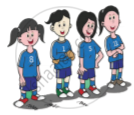
Write the events won by these players.
 |
______ |
 |
______ |
 |
______ |
What does the man have?
Where is Keeraikuppam located?
What will help you say the truth?
What does she paint?
What was different about the rabbit that Alice saw?
What did the boy make with the branches of the tree?
What did the library door say?
What are the details not to be revealed in public domain?
Match the following items from column-A with those column-B:
| Column 'A' | Column 'Non-Textual' |
| (a) Geoffrey Chaucer | (i) Trinidad |
| (b) Daniel Defoe | (ii) Wuthering Heights |
| (c) V.S. Naipaul | (iii) Robinson Crusoe |
| (d) Emile Bronte | (iv) The Canterbury Tales |
Enact any one anecdote in the classroom.
